Liu Zhi 劉智 · c. 1670–after 1724
Nature and Principle in Islam
天方性理
卷五・圖說Book 5: the three Ones and the return to the Real
Book 5 · 1 · Volume Five: overview
概言 補之者美之,掃之者補之
The fifth volume takes up, as a supplement, the meanings concerning the great and small worlds that were not yet fully set out. Its meaning is twice as fine and deep, yet it does not go beyond the one Real. Within the supplement there lies an intent of sweeping away. To supplement is to beautify; to sweep away is to supplement. The finer the supplement, the more complete the sweeping; the swifter the sweeping, the more spirit-like the supplement. The principle lies in a realm between being and non-being; the writing lies between the intelligible and the unintelligible. Let the reader measure his strength and exhaust his heart. If he understands the intelligible by understanding, and understands the unintelligible by not understanding, he is one who understands this book well. If he understands the intelligible by what is not to be understood, and the unintelligible by claiming to understand everything, then not only will the book be unintelligible, the reader too will be unintelligible.
第五卷總大小兩世界未盡詳之義而補說之,義倍精奥,不越一真。補說之中,寓掃抹之意。補之者,美之也;掃之者,補之也。補之愈精,掃之愈盡;掃之愈疾,補之愈神。理在若有若無之境,文在可解不可解之間。閱者量其力,盡其心。可解者以解解之,不可解者以不解解之,則善解是書者也;可解者以非所解解之,不可解者以無所不解解之,則不惟書不可解,閱書者亦不可解矣。
AIScan vol. 5, p. 76–77Transcribed from the scan by AI (Claude), checked as described on the About page.
Book 5 · 2 · The three grades of the Real One
真一三品圖說 真一三品
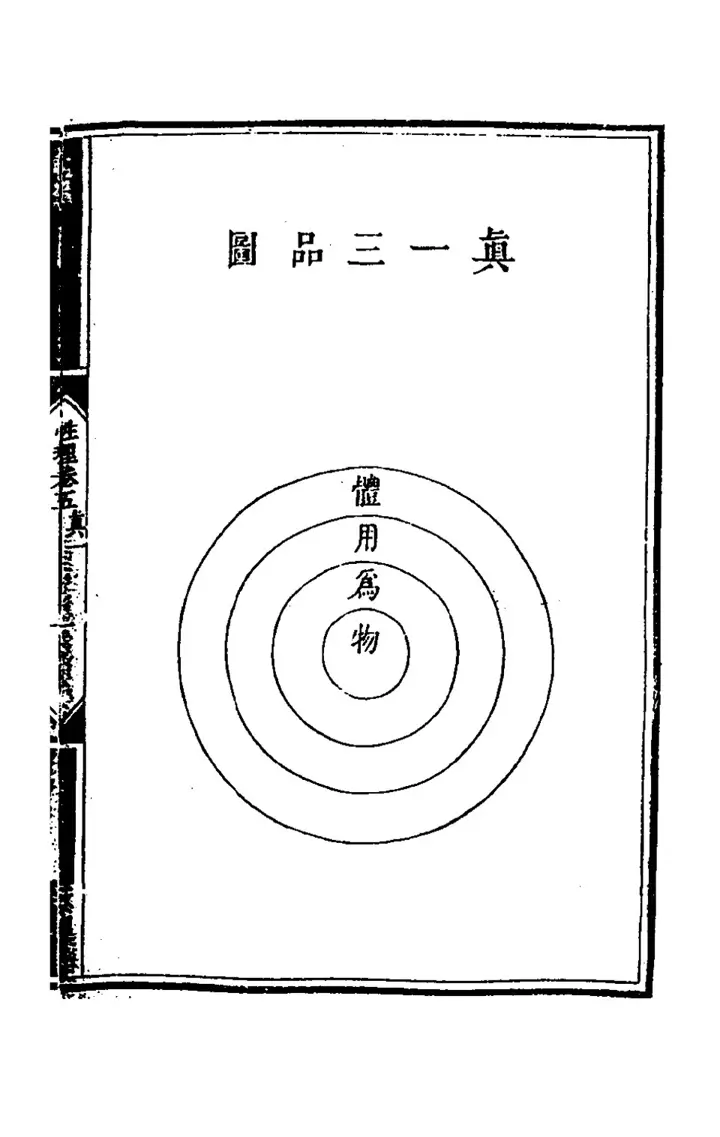
Within the dark and dim, which cannot be seen, there is the Real One, the Lord and Ruler of all that exists. That in it which is still and attached to nothing is called substance; that in it which illumines and misses nothing is called function; that in it whose apportionments never err is called act. Hence one speaks of three grades. Function arises from substance and act arises from function: this is the order running from the inner to the outer. Act is not apart from function and function is not apart from substance: this is the refinement of different names for one and the same reality. All the countless unequal things that come after are the manifestation of this which has different names but one reality. Yet how could there ever be three grades? 'Real' means free of falsity; 'One' is the name for what is not two. If the Real had substance, had function, had act, all would be false, and where then would the Real be? If the One had substance, had function, had act, it would not merely be two but three, and where then would the One be? Therefore within the Real One there is no going and coming, no delusion and awakening, no motion and rest, no arising and ceasing; how then could it have substance, function or act? And yet, without substance, whence would function arise? Without function, whence would act be born? Without act, whence would the countless unequal things appear? From this we know that the Real One must have substance, function and act. And yet we know too that it is not so: there is nowhere that is not substance, yet the Real One never has substance; nowhere that is not function, yet the Real One never has function; nowhere that is not act, yet the Real One never has act. This is the Real One's own realm. Never having substance, yet everywhere is the Real One's substance; never having function, yet everywhere is the Real One's function; never having act, yet everywhere is the Real One's act. This is the Real One's manifestation. The realm of manifestation, too, is not something the own realm really possesses. If even the manifestation of the three grades is not really possessed by the Real One's own realm, how much less the myriad things manifested out of the three grades? How could they be what the own realm really possesses? Nevertheless, although the countless unequal things are not really possessed by the Real One's own realm, the myriad things it manifests are, everywhere, the manifestation of the Real One's root-suchness. The Sage said: 'Hidden, it is called the Real; manifest, it is called things.' That is, there is no thing that is not the Real. Manifested as formless things, the formless things are the Real; manifested as things with form, the things with form are the Real; manifested as flowing time, time is the Real; manifested as fixed place, place is the Real. There is nothing that is not manifestation, and so nothing that is not the Real: this is why the Real One is the Real One. Note (Hei of Qingyuan): 'Real' means truly existent yet without name; 'One' means without counterpart and self-standing. As for its three grades, they are simply its true existence; because there is something that can be named, there arise correlatives. Consider: when the whole book speaks of the Real and speaks of things, are they one or two? The Sage broke it open in a single word: for all ages there has never been a second. Two is not admissible; how much less three?
冥冥不可得而見之中,有真一焉,萬有之主宰也。其寂然無着者,謂之曰體;其覺照無遺者,謂之曰用;其分數不爽者,謂之曰為:故稱三品焉。用起於體,為起於用,是為由內而達外之敘;為不離用,用不離體,是為異名而同實之精。後此萬有不齊之物,皆此異名而同實者之所顯著也。雖然,三品亦何嘗之有?蓋真者,無妄之謂也;一者,不二之稱也。真而有體,真而有用,真而有為,則皆妄矣,妄則何真之有?一而有體,一而有用,一而有為,則不特二,而且三之矣,三則何一之有?是故真一之中,無去來也,無迷悟也,無動靜也,無起滅也,而又安得有體,而又安得有用,而又安得有為?雖然,無體則用於何起?無用則為於何生?無為則萬有不齊之物於何而顯?以是知真一之必有體也,必有用也,必有為也。而抑知其不然也:無往非體,而真一未嘗有體;無往非用,而真一未嘗有用;無往非為,而真一未嘗有為,是則真一之本境也。未嘗有體而無往非真一之體,未嘗有用而無往非真一之用,未嘗有為而無往非真一之為,是則真一之顯著也。顯著之境,亦非本境之所實有者也。三品之顯著,尚非真一本境之所實有,又何況自三品顯著之萬物乎?而又豈得為本境之所實有者乎?雖然,萬有不齊之物,雖非真一本境之所實有,而其所顯著之萬物,則又無往非真一本然之顯著者也。聖人曰:「隱而名真,顯而名物。」蓋謂無物之非真也。顯之而為無形之物,則無形之物即真也;顯之而為有形之物,則有形之物即真也;顯之而為流行之光陰,則光陰即真也;顯之而為一定之處所,則處所即真也。無所非顯,即無所非真,此真一所以為真一也。
Note by a later commentator: 清源黑氏 (Hei of Qingyuan)
清源黑氏曰:「真,實有而無稱;一,無對而自立也。其三品,則實有而已,因有可稱,斯有對待。詳惟通部言真言物,是一是二?聖人一言道破,千古並無二也。二不可,況三?」
AIScan vol. 6, p. 4–8Transcribed from the scan by AI (Claude), checked as described on the About page.
2 uncertain readings in this passage
- 着其寂然無着者or 著· variant · printed 着 here; 著 elsewhere (顯著); kept as printed (p. 5)
- 覺其覺照無遺者or 党· witness-differs · C and 1923 覺; Wikisource 党 (OCR) (p. 5)
AIBook 5 · 3 · The three grades of the Numerical One
數一三品圖說 數一三品
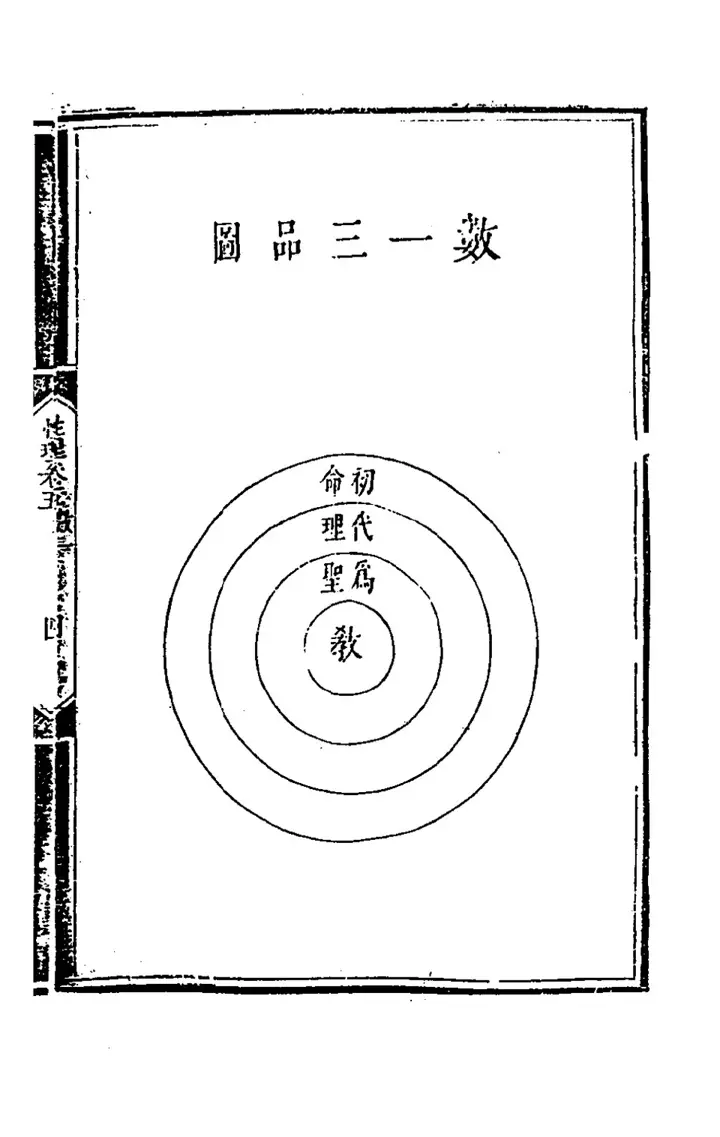
The 'one' of the Real One is the sense of 'alone': it is alone and without peer. Its honour is alone and without peer, its greatness is alone and without peer, its reality is alone and without peer. The 'one' of the Numerical One is where number begins: the numbers of the myriad principles arise from this one, and the numbers of the myriad things are extended from this one. Its existence arose from a single stirring of intention in the Real One and so became manifest. Set against the Real, the Real One is real and the Numerical One illusory; set against honour, the Real One is lord and the Numerical One servant; set against greatness, the Real One is the sea and the Numerical One a bubble. Both are called 'one', yet this is how unlike they are. Compared side by side, the Numerical One certainly dare not presume to rank with the Real One. But speaking of the Numerical One's own capacity: the world of principle and the world of images both branch out from this Numerical One; even the Real One, in passing from the world of principle into the world of images, must go out through this one, and only so can it manifest freely. Such too is the Numerical One's own capacity. Tracing it from beginning to end, root to branch, it too has three grades: the First Mandate, the Vicegerent, and the Prophet (literally 'the one who acts as sage'). The First Mandate is the Real One's first manifestation, the very earliest of mandates. The Vicegerent: once there is this First Mandate, all the Real One's work of transforming and nurturing is carried out by it on the Real One's behalf. 'Acting as sage' is also the sense of vicegerency: dwelling in the world in a bodily form, governing human beings by a human being, and on the Real One's behalf spreading its utmost Way far and wide. These are called the three grades. Now these three grades do not exist because the Numerical One governs them by itself. From the Real One's single stirring of intention this Numerical One was made manifest, and the Numerical One then moves by that same stirring: it moves because it cannot but move; it moves as the Real One wishes to move, and does not even know why it moves. Therefore the movement from the First Mandate to the Vicegerent is a vicegerency it cannot but exercise, not something the Numerical One can decide for itself; and the movement from the Vicegerent to the Prophet is likewise a sagehood it cannot but assume, not something the Numerical One can decide for itself. Even though the movements that follow go on without end, if one asks this Numerical One why there is this movement and why it cannot pause for a single moment, the Numerical One does not know. That which the Numerical One cannot know is, once again, the Real One manifesting itself. The Real One manifests itself and yet must entrust this to the Numerical One: that is how the Real One is not stained by illusion and not mixed with number. Not stained by illusion is the height of reality; not mixed with number is the perfection of oneness. Utterly real and utterly one, with illusion and number having no part in it: this is the Real One's own realm. The Real One, without illusion and without number, yet freely moving between hiddenness and manifestation: this is how the Real One is wondrous in its real oneness. The Numerical One is precisely that wherein the Real One is wondrous. Note (Hei of Qingyuan): The three grades of the Numerical One are the manifestation of the three grades of the Real One: the First Mandate is substance, the Vicegerent is function, the Prophet is act. It is manifest and does not itself know that it is manifest, because there are not two knowings; two knowings would require two substances. Hence it is said: the Numerical One is that wherein the Real One is wondrous.
真一之一,獨之義也,謂其獨一無偶也:其尊獨一無偶,其大獨一無偶,其真獨一無偶。數一之一,數之所自始也:萬理之數自此一起,萬物之數自此一推。其有也,起於真一一念之動而顯焉者也。其與真對,則真一為真,數一為幻;其與尊對,則真一為主,數一為僕;其與大對,則真一為海,數一為漚。同以一稱,而其不同蓋若此。夫比而較之,數一固不敢妄擬於真一;而若自數一之本量言之,理世、象世皆自此數一而分派以出,即真一之從理世而之於象世,亦須從此出,而乃得任意以為顯著也。數一之本量又如此。原其始終本末,亦三品焉:曰初命,曰代理,曰為聖。初命者,真一之首顯而為命之最初者也。代理者,自有此初命,而真一化育之事,皆其所代為發揮者也。為聖,亦代理之意也,色身住世,以人治人,而代真一以廣宣其至道也。是之謂三品。夫此三品,非數一之自為主持而有是三品也。自真一一念之動,顯有此數一,而數一遂因此一念之動而動之,動乎其不得不動也,動乎真一之所欲動,而並不自知其所以動也。是故自初命而有是代理之動也,代乎其不得不代也,非數一之所得而自主者也;自代理而有是為聖之動也,亦聖乎其不得不聖也,非數一之所得而自主者也。雖後此之動正自無已,而至問此數一者,何以有是動,而不能有一刻之停止如此?數一不知也。數一不得而知者,仍復真一之自為顯著也。真一自為顯著,而必託之於數一者,真一之所以不染於幻、不雜於數也。不染於幻者,真之極也;不雜於數者,一之至也。至真至一,而幻與數無所與於其中者,真一之本境也。真一無幻無數,而復任意於隱顯之間者,真一之所以妙乎其真一也。數一,即真一之所妙也。
Note by a later commentator: 清源黑氏 (Hei of Qingyuan)
清源黑氏曰:「數一三品,即真一三品之顯也:初命為體,代理為用,為聖為為。顯焉而不自知其顯者,無二知也,二知必二體。故曰:數一,即真一之所妙。」
AIScan vol. 6, p. 9–14Transcribed from the scan by AI (Claude), checked as described on the About page.
1 uncertain reading in this passage
- 住色身住世,以人治人or 往· witness-differs · C and 1923 both clearly 住; Wikisource text layer has 往 (OCR/edit) (p. 11)
AIBook 5 · 4 · The three grades of the Embodied One
體一三品圖說 體一三品
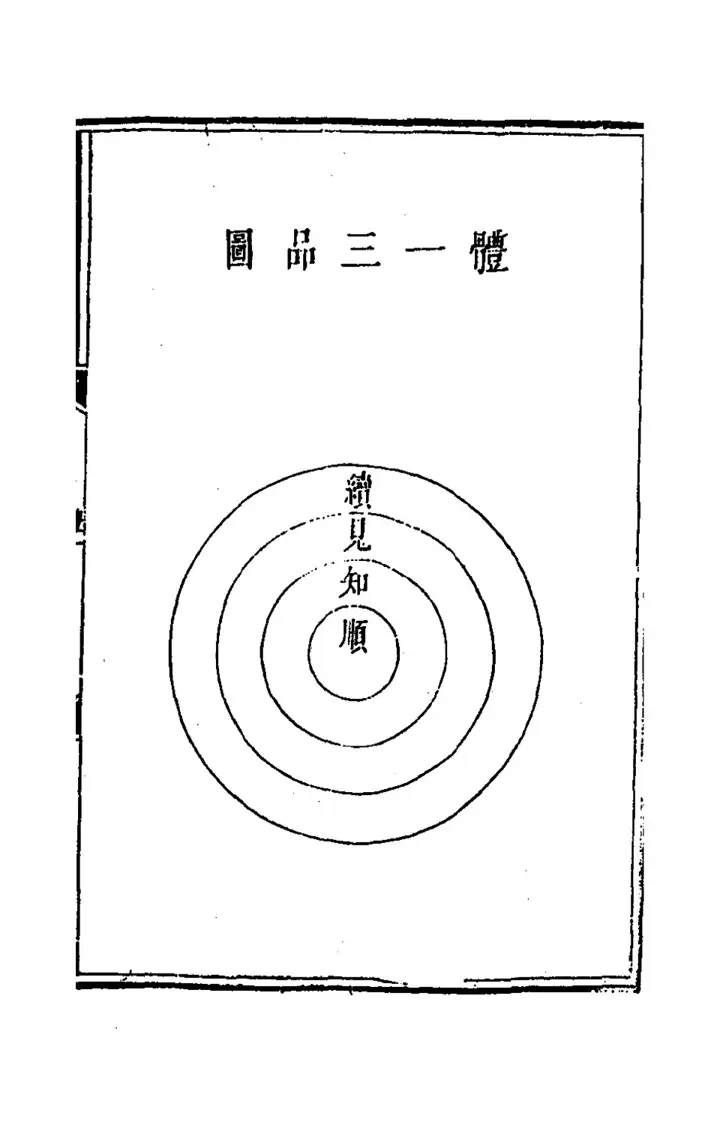
When a human being is born, his substance is threefold: bodily substance, heart substance and nature substance. Embodying the Real One with this substance is likewise threefold: he embodies it with these three substances. One who embodies the Real One with the bodily substance works through compliance. Compliance knows what ought to be so but cannot know why it is so; this grade knows the name but not yet the reality. One who embodies the Real One with the heart substance works through understanding and awakening. Understanding sees why it is so but cannot attain why it is so; this grade sees the parts but not yet their union. One who embodies the Real One with the nature substance works through the absence of any gap. Being without gap means taking one's root in why it is so and being wholly merged with why it is so: this is the utmost. These three grades are the whole meaning of cultivating the Real, past and present. One person's effort may pass through the sequence of these three grades, or these three stages may be divided among three persons. Among the three grades, embodying through knowledge is shallow, embodying through seeing is deep, and embodying through the nature is so deep as to be almost unfathomable. Even so, one who embodies the One with the nature is still embodying it as one who has a self. Embodying it with a self, the self still goes and comes; where there is going and coming, traces remain. When the One embodies the self, there is no more going and coming. But if, when the One embodies the self, the self knows that it is the One embodying it, the traces are not yet transformed; if it does not know, the traces vanish. Yet if I do not know that the One embodies me, I cannot be sure that the One does not itself know; and if the One knows, that is still like having knowledge: not yet transformed. When I do not know that the One embodies me, and the One does not know that there is a self of mine to be embodied: that is transformation. Note (Hei of Qingyuan): The Real One and the Numerical One cannot be seen, but they are seen in the Embodied One. Seeing one's body is seeing its act; seeing one's heart is seeing its function; seeing one's nature is seeing its substance. The body is easy to see, the heart and nature hard; therefore people know only that it is so, and not why it is so. If one can embody it with one's own three, then those three of the Other are all seen without being outside oneself. If one can forget one's own three and forget those three of the Other as well, then one is transformed in the substance and transformed in the One too. The Embodied One returns to the Numerical One, the Numerical One returns to the Real One, and the Real One too has nothing by which to be named the Real One. Hence it says: that is transformation.
人之生也,其體有三:身體、心體、性體是也。以體而體夫真一也,亦有三,即以此三體而體之也。以身體而體夫真一者,其功在於遵循。遵循者,知其所當然,而不能知其所以然,此一品者,知其名矣,未知其實。以心體而體夫真一者,其功在於解悟。解悟者,見其所以然,而不能得其所以然,此一品者,見其分矣,未見其合。以性體而體夫真一者,其功在於無間。無間者,本其所以然,而渾乎其所以然,至矣。此三品者,古今修真者之總義也。或一人之功而有此三品之次第,或於此次第之三者而分為三人。三品之中,體之於知者淺,體之於見者深,體之於性者,其深更幾於不可測也。雖然,以性體一者,仍是以有我者體之也。以有我體之,則我猶有往來;有往來,則其迹尚存。一體乎我,則無往來矣;然一體乎我,而我知其為一之體乎我也,則其跡未化也;不知,則其跡泯矣。然我不知其一之體我,而不能必其一之不自知也,一知則猶之乎其有知也,未化也。我不知其有一之體我,而一亦不知其有我之可體也,化矣。
Note by a later commentator: 清源黑氏 (Hei of Qingyuan)
清源黑氏曰:「真一、數一不可得而見也,而於體一見之:見其身,即見其為;見其心,即見其用;見其性,即見其體。身易見而心性難見,故但知其然,而不知其所以然也。能以我之三者而體之,則彼之三者不外我而俱見之;能忘乎我之三者,而並忘乎彼之三者,則化乎其體,并化乎其一。體一歸數一,數一歸真一,真一亦無自而名真一矣,故曰化矣。」
AIScan vol. 6, p. 15–19Transcribed from the scan by AI (Claude), checked as described on the About page.
3 uncertain readings in this passage
- 迹則其迹尚存or 跡· variant · C prints 迹 here but 跡 twice in the next lines; kept as printed (p. 17)
- 泯則其跡泯矣or 混· witness-differs · C and 1923 泯; Wikisource 混 (p. 17)
- 并則化乎其體,并化乎其一or 弁/幷· variant · C cuts the graph like 弁 (a 并 variant); 1923 幷 (p. 18)
AIBook 5 · 5 · The common meaning of the three Ones
三一通義圖說 三一通義
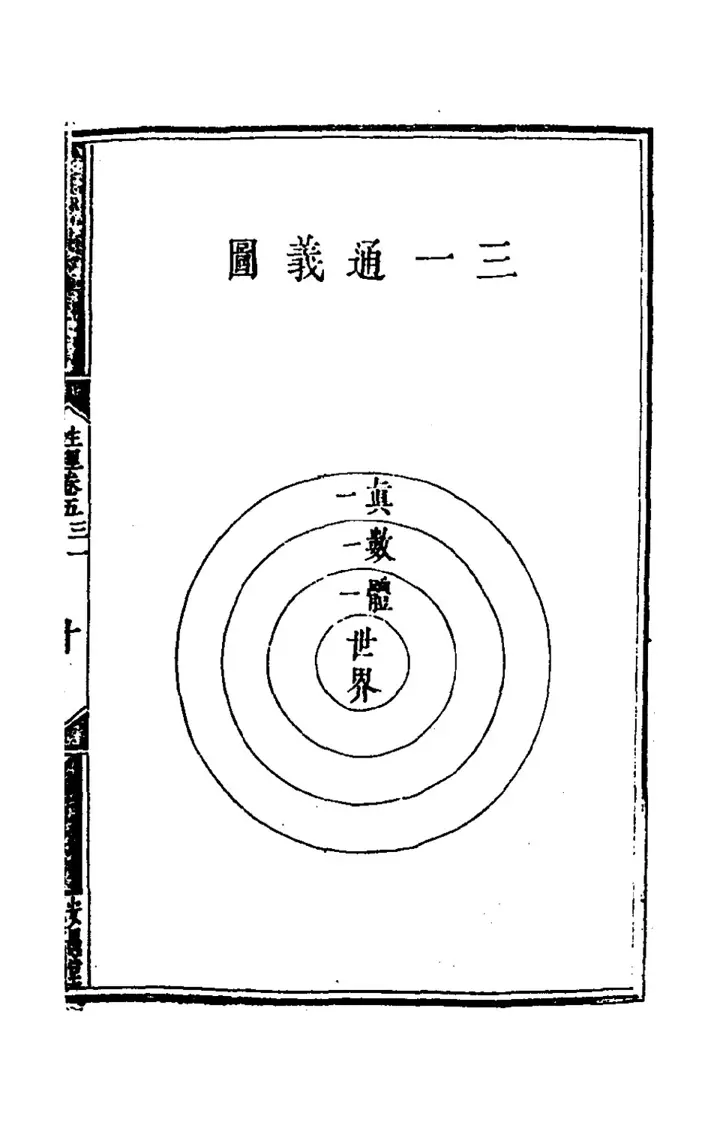
'Communicating' means being three and yet one. When this communicates with that, it is called communicating, but there must be a 'that' before 'this' can communicate with it; when that communicates with this, it is called communicating, but there must be a 'this' before 'that' can communicate with it. If there were only one, it would simply be one and nothing more; by what then would anything communicate? Only because it is one and yet three is there something that can communicate. The Real One is real and real; the Numerical One is real and illusory; the Embodied One is illusory and real. Real and illusory: then the real communicates with the illusory. Illusory and real: then the illusory communicates with the real. The illusory is the manifestation of the real; when the real that exists illusorily communicates with the real that exists originally, the real communicates with the real. Time has daylight, and it is because it has dark night that we recognise daylight as daylight. If it were pure day with no night, how could one recognise it as daylight? If it were purely real with nothing illusory, how could one distinguish it as the Real One? Moreover, the Real One as a thing is still and without place; if it were real without illusion, it would be simply one stillness, and where would communication take place? From this we know that it is one and yet three, three because it cannot but be three. Being three because it cannot but be three is the Real One hiding and manifesting itself. The world is where the three Ones are all lodged and where their communication can be manifested. Outside the world there is a world: the world of true principle. Within the world there is a world: the world of the human ultimate. Without the world of heaven and earth, the world of the human ultimate has nothing to draw on; without the world of the human ultimate, the world of true principle has no seat; without the world of true principle, the world of the human ultimate and the world of heaven and earth would have no way to manifest themselves. So the existence of the world is an existence that cannot but be; and existing because it cannot but exist is again the Real One hiding and manifesting itself. The Real One manifests as the Numerical One: the Numerical One is the Real One's communication, not a Numerical One apart from the Real One. The Numerical One manifests as the Embodied One: the Embodied One is the Numerical One's communication, not an Embodied One apart from the Numerical One. The three Ones are manifested in the world: the world is where the three Ones communicate. Through the communication of the three there is the world, and through the world the communication of the three can be manifested; all of it is the Real One hiding and manifesting itself. The Real One's hiding and manifesting itself arises from the Real One's single stirring of intention. I do not know whether, apart from this single stirring, there would still be three Ones to communicate. Note (Hei of Qingyuan): Communicating is 'one thread running through'. Grasp that the three Ones communicate, and you will not be obstructed by the three Ones; grasp that the world is where the three Ones communicate, and you will not be bewildered by the world. If the three Ones cannot obstruct one's principle and the world cannot cloud one's nature, would one who discusses principle still have principles unclear to him? Would one who speaks of nature still have a nature not fully realised? In contemplating images and handling things, would anything still be left over and not encompassed? Ah! Communicate with this, and the great world and the small world, the Former Heaven and the Latter Heaven, all that exists, great and small, fine and coarse, outer and inner, hidden and manifest, are seen as if in the palm of one's hand.
通者,三而一之之謂也。此通於彼曰通,然必有彼,而後此乃可以通之也;彼通於此曰通,然必有此,而後彼乃可以通之也。若使但有一也,不過一焉而已矣,則將以何者通之?惟一而三也,乃有可得而通之也。真一者,真而真也;數一者,真而幻也;體一者,幻而真也。真而幻,則真通於幻;幻而真,則幻通於真。幻者,真之顯也,以幻有之真而通於本有之真,則真通於真矣。光陰而有白晝也,因其有黑夜,而乃以識其為白晝也。若使純然晝也,無有夜也,則安從而識其為白晝也?若使純然真也,無有幻也,則亦安從而別其為真一也?且真一之為物也,寂然無方所者也,真而無幻,則一寂然而已矣,將於何而通之耶?以是知一而三也,三乎其不得不三也。三乎其不得不三者,真一之自為隱顯也。世界者,三一之所總寓,而得以顯其通焉者也。世界之外有世界焉,真理之世界也;世界之內有世界焉,人極之世界也。無天地之世界,則人極之世界無資;無人極之世界,則真理之世界無位;無真理之世界,則人極之世界與天地之世界,又無從得而自顯。則世界之有也,亦有乎其不得不有也。有乎其不得不有者,亦真一之自為隱顯也。真一顯而為數一,數一即真一之通也,非真一之外另有數一也;數一顯而為體一,體一即數一之通也,非數一之外另有體一也。三一顯於世界,世界即三一之所通也。因三者之通而有世界,因世界而乃得以顯三者之通,總真一之自為隱顯也。真一之自為隱顯者,真一起於一念之動也。吾不知去此一念之動,仍復有三一之可通焉否也。
Note by a later commentator: 清源黑氏 (Hei of Qingyuan)
清源黑氏曰:「通,即一貫也。識得三一通,則毋為三一礙;識得世界為三一之所通,則毋為世界迷。三一不能礙其理,世界不能蔽其性,談理者復有不明之理乎?言性者復有不盡之性乎?觀象玩物,復有所遺剩而未週徧者乎?嘻!通乎此,而大世小世、先天後天,一切所有之巨細精麤、表裏隱顯,其視諸掌矣。」
AIScan vol. 6, p. 20–25Transcribed from the scan by AI (Claude), checked as described on the About page.
3 uncertain readings in this passage
- 礙則毋為三一礙· variant · printed with 石+疑 form; normalised to 礙 (p. 24)
- 週徧復有所遺剩而未週徧者乎or 周遍· variant · kept as printed (p. 24)
- 麤一切所有之巨細精麤or 粗· variant · C prints 麤 (triple 鹿); 萬物全美 uses 粗 (p. 25)
AIBook 5 · 6 · Spontaneous generation and transformation
自然生化圖說 自然生化
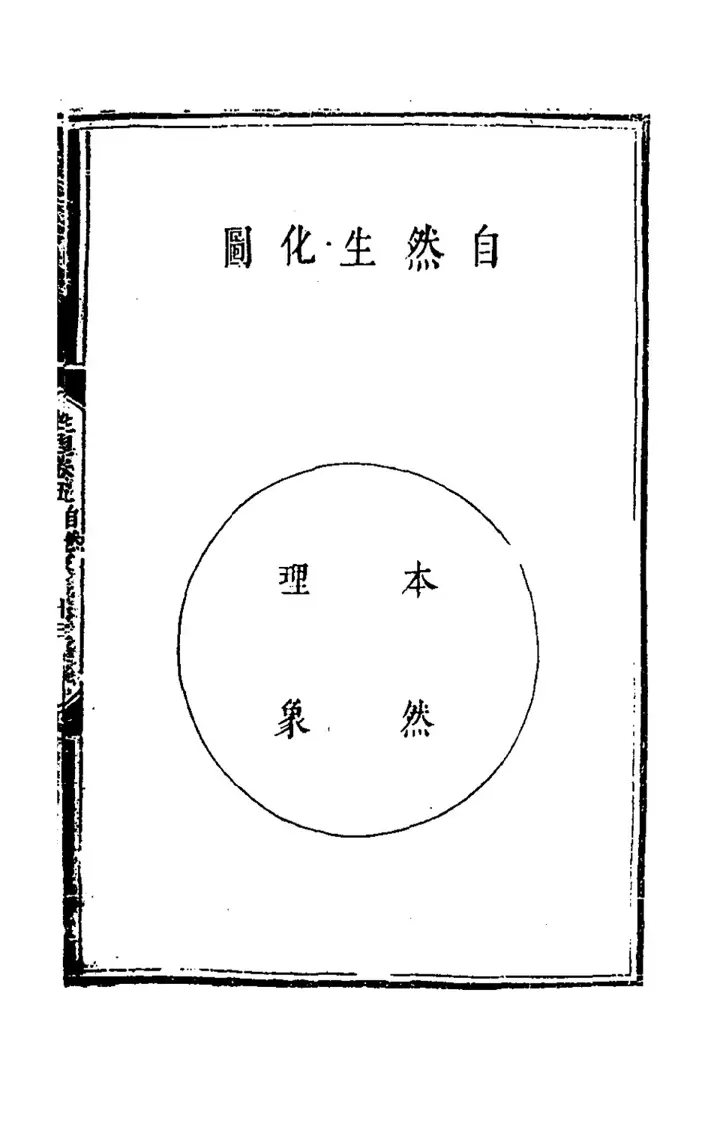
The generation and transformation of the Creator does not go beyond two poles: what cannot be seen is principle; what can be seen is image. These two are born without anything giving birth to them and transformed without anything transforming them; both are rooted in what is spontaneously so. Only because they are spontaneously so, within spontaneity there is this principle, within spontaneity there is this image, and within spontaneity principle and image enter into one another. Principle does not seek to be matched with image, yet of itself there is a mechanism of matching; image does not seek to accord with principle, yet of itself there is a wonder of according. Were there within it the slightest arranging and disposing, the Creator would be applying a contriving mind in its midst. If it applied a contriving mind, then where arranging reached there would also be what arranging did not reach; where disposing was divine there would also be what disposing did not make fully divine. However skilful the Creator, it could not then avoid the error of excess and deficiency. What then is being spontaneously so? It is this: the principles of the world of principle and the images of the world of images exist as if born, yet in truth nothing gives them birth; they exist as if transformed, yet in truth nothing transforms them. They are what the root-suchness possesses of itself: hidden then, manifest now. Before manifestation, neither increased nor diminished; after manifestation, neither empty nor solid. The countless diverse principles of the world of principle and the countless diverse images of the world of images were originally thus and will be thus forever. Being originally thus, they are born without being given birth and transformed without being transformed; being forever thus, they are born yet nothing is born, transformed yet nothing is transformed. What the world of principle possesses does not exist before the world of images; what the world of images possesses does not exist after the world of principle. Principle and image possess it in the original possession and are not divided into before and after. Were there before and after, there would still be traces of generation and transformation, and it could not be called spontaneous; only their manifestation has a before and after. Hidden spontaneously, their hiddenness is not far from manifestation; manifest spontaneously, their manifestation does not depart from hiddenness. Hidden and then manifest, manifest and then hidden: all is the root-suchness making itself real and illusory, not generation and transformation. The root-suchness does not belong to generation and transformation; to say that principle and image both exist through generation and transformation would be to take principle and image and the root-suchness as two. That would be most unspontaneous indeed. Note (Hei of Qingyuan): When people make things they must make things out of things; precisely because this is not spontaneous, there is no generation or transformation in it. People speak of spontaneity without investigating the principle of spontaneity or its source: such talk has no master. Know that spontaneity is the root-suchness: because the root-suchness is thus, spontaneity is thus. Rooted in the principles and images it originally possesses, principle and image are spontaneous; rooted in the hiding and manifesting it is able to do, hiding and manifesting are spontaneous; rooted in its wondrous function of ceaseless generating and transforming, generation and transformation are spontaneous. That spontaneity is thus is entirely because the root-suchness is thus. How could an empty void with no master be spontaneous?
造物之生化,不越兩端:不可得而見者,理也;可得而見者,象也。此二者,無所生而生,無所化而化,皆本於自然而然者也。惟其自然而然,夫是以於自然之中而有是理也,於自然之中而有是象也,於自然之中而理與象相入也。理不期與象配,而自有相配之機;象不期與理合,而自有相合之妙。假使於其中有一毫之安排布置,是造物庸心於其間也。庸心於其間,則有安排之所及者,即有安排之所不及者;有布置之所神者,即有布置之所不盡神者。造物雖巧,當亦不能無過不及之差矣。然則自然而然者奈何?曰:理世之理,象世之象,生焉而有者也,而實非有所生也;化焉而有者也,而實非有所化也。本然所自有,當日隱,今日顯矣。未顯之先,不增不減;既顯之後,非虛非實。理世等等不一之理,象世等等不一之象,本如此也,將來永如此也。本如此,是以無所生而生,無所化而化;永如此,所以生焉而無所生,化焉而無所化。理世之所有,非有於象世之先;象世之所有,非有於理世之後。理與象有之於本有也,無分先後者也。有先後,則是猶有生化之跡,不可以為自然也,但其顯有先後耳。自然而隱,則其隱也不遠於顯;自然而顯,則其顯也不離於隱。隱而顯,顯而隱,皆本然之自為真幻也,非生化也。本然不屬於生化,而謂理與象皆因生化而有也,將謂理象與本然為二焉者乎?斯亦不自然之甚矣。
Note by a later commentator: 清源黑氏 (Hei of Qingyuan)
清源黑氏曰:「人之製物,必因物製物,惟非自然,故不生化。人言自然,而不究其自然之理、自然之原,俱無主之說也。抑知自然即本然也,本然如是,故自然如是也。本其所原有之理象,而理象自然也;本其所能為之隱著,而隱著自然也;本其所妙用生生化化而不息,而生化自然也。自然如是,皆本然如是也,豈空空無主而能自然哉?」
AIScan vol. 6, p. 26–30Transcribed from the scan by AI (Claude), checked as described on the About page.
Book 5 · 7 · Name and form depend on each other (1)
名相相依圖說 名相相依(一)
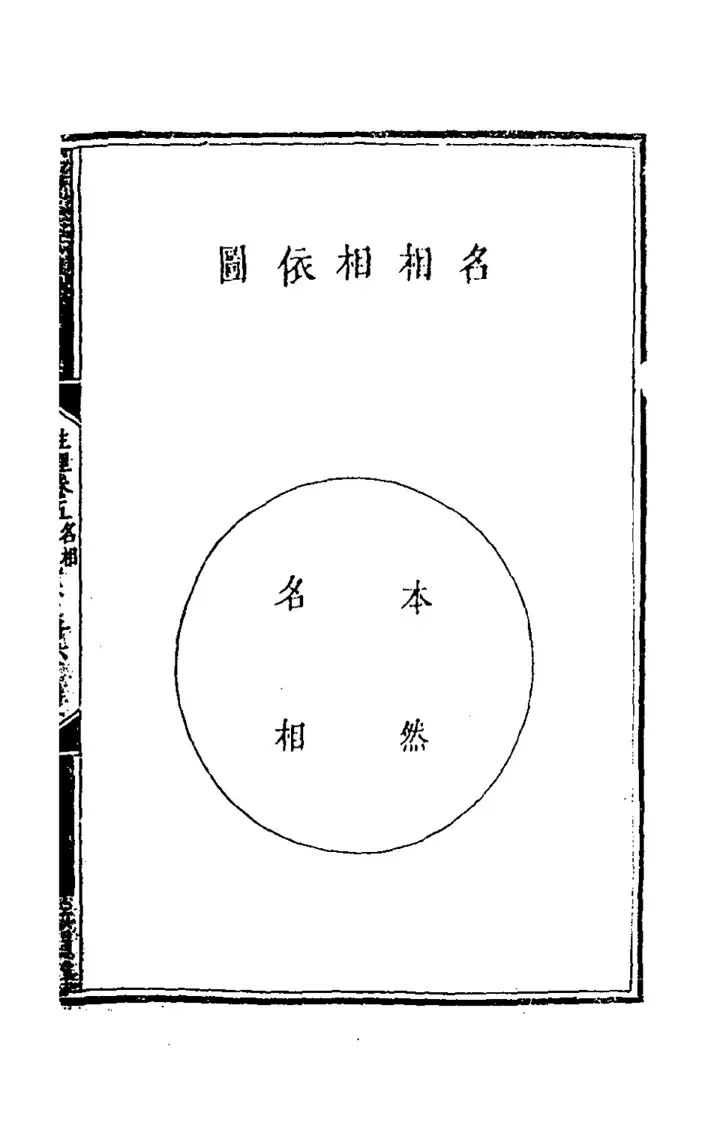
Two things attached to each other are said to depend. One has never seen a single thing depend on itself; a single thing can only be called self-standing, not mutually dependent. But the dependence meant here is not one thing depending on another thing. A thing's own name depends on its own form; its own form depends on its own substance; its own substance depends on its own name and form. Form is the manifestation of substance: according to what kind of substance it is, its form is of such a kind; form depends on substance, yet form and substance are not two things. Name is what form is called: according to what kind of form it is, its name is of such a kind; name depends on form, yet name and form are not two things. Name is not other than form, and form is not other than substance: they are simply one. But name as a thing is empty and form as a thing is illusory, and the empty and the illusory seem not to be close to the Real. Yet without name, form has no designation; without form, the Real is not manifested. The empty and the illusory are in fact how the Real One transforms itself and names itself. What is remarkable is that the substance is one while its forms differ; that they differ is not remarkable in itself, but each differing form is the whole substance of the Real One, one and the same. The forms of the Real One are measureless and numberless; then is the one and same whole substance of the Real One also measureless and numberless? Can the whole substance really be so many? When one form arises, the one and same whole substance of the Real One appears; when one form ceases, does the one and same whole substance of the Real One cease too? It has never been many and never ceased; there is only this one whole substance. Appearing here, this is the one and same whole substance of the Real One; appearing there, that is the one and same whole substance of the Real One. Whether it appears once or twice, or does not appear at all, the one and same whole substance of the Real One is not lessened; whether it appears a hundred times, a thousand times, or measurelessly, it is not increased.
兩物相附曰依。未見一物焉而自相為依者,若一物,則只可謂之獨立,不可謂之相依。此之所謂依者,非一物與一物相依之謂也,自之名與自之相相依,自之相與自之體相依,自之體與自之名相相依。相者,體之顯也,因其體為何如之體,而其相斯為何如之相,相與體依,而相與體非二物也。名者,相之稱也,因其相為何如之相,而其名斯為何如之名,名與相依,而名與相非二物也。名不二於相,相不二於體,一焉而已矣。但名之為物也虛,相之為物也幻,虛與幻,似乎不近於真也。然非名則相無稱,非相則真不顯,虛與幻,實真一之所以自為變化而自為稱名也。所可異者,體一也,而其相不同;不同亦無足異也,而每一不同之相,皆真一一同之全體。真一之相無量無數,則真一一同之全體亦無量無數矣,全體顧若是多乎哉?一相起則真一一同之全體現,一相滅,豈真一一同之全體亦滅乎哉?未嘗多也,亦未嘗滅也,秖此一全體耳。現之於此,則此即真一一同之全體;現之於彼,則彼即真一一同之全體。現一現二,或一無所現,真一一同之全體不加少;現百現千現無量,真一一同之全體不加多。
AIScan vol. 6, p. 31–34Transcribed from the scan by AI (Claude), checked as described on the About page.
3 uncertain readings in this passage
- 每而每一不同之相or 毎· variant · C prints the 毎 form here and at 蓋每一相 (p34); normalised to 每 as 1923 (p. 33)
- 秖秖此一全體耳or 祇/只· witness-differs · C 秖 (禾+氐); 1923 祇; Wikisource 只 (p. 33)
- 起一相起則真一一同· variant · printed with a variant 起 form (走 + 巳 cut loosely) (p. 33)
AIBook 5 · 8 · Name and form depend on each other (2)
名相相依圖說 名相相依(二)
Form is appearing; appearing is the hidden becoming manifest. Form is the Real. To say that form depends on substance is, where there is nothing to depend on, forcibly to name it 'depending'. Name is what states the reality of the form. For every form has the meaning proper to that form and the use suited to that form. When the form is manifest, the whole substance appears, but the form cannot itself state in detail the meaning proper to it and the use suited to it; when the name arises, that proper meaning and suited use are fully contained in the name. One who does not know the meaning and use of a form can, by examining its name, grasp its meaning and know its use. Therefore the name of this form is this form's register, and the name of that form is that form's register; a register is what states the reality of its own form. Thus a name is the form of a form. When the name is established the form is displayed, and when the form is displayed the whole substance of the Real One becomes ever more manifest. A name without form: what name would it name? A form without name: what form would it be? Name and form are two and yet one; this is not dependence. To say that name depends on form is also, where there is nothing to depend on, forcibly to name it 'depending'. In form one sees the whole substance of the Real; in name one sees the apportionments of form. The whole substance and the apportionments are not two: outside the Real One there is not a single thing. Note (Hei of Qingyuan): At the very beginning there was no designation; how could there be names? At the very beginning there was no shape; how could there be forms? From the single stirring of intention there was One that could be named; forms of principle and forms of image, and names began to multiply. Examined to the end, there is no form without a name, no name without a form, and no name and form without substance. Hence it says: measureless names and forms are the Real Ruler's measureless wondrous function. Not understanding this, some say that since there are names and forms these cannot be the substance, and so they split names and forms from substance as two. That is a mistake.
相者,現也;現者,隱而顯也,相即真也。相依於體者,於無所依之中而強名之曰依也。名者,所以道其相之實也。蓋每一相,必有一相之義,必有一相相宜之用。相顯則全體現,而此一相所當然之義,與其所相宜之用,相固未能自道其詳也;名起,則其所當然之義,與其所相宜之用,俱於其名焉盡之。不知其相之義與其用者,詳其名,可以得其義、知其用矣。是故此一相之名,即此一相之譜也;彼一相之名,即彼一相之譜也。譜者,所以道其本相之實也。是故名也者,相之相也。名立而相彰,相彰則真一之全體顯而愈顯矣。名無相,則名為何名?相無名,則相為何相?名與相,二而一者也,非依也。名依於相者,亦於無所依之中而強名之曰依也。於相見真之全體,於名見相之分數,全體與分數非二也,真一之外無一物也。
Note by a later commentator: 清源黑氏 (Hei of Qingyuan)
清源黑氏曰:「最初無稱,何有於名?最初無形,何有於相?自一念動,有一可名,理相、象相,名始紛著。究而言之,必無無名之相,必無無相之名,必無無體之名相。故曰:無量之名相,即真宰無量之妙用。不明乎此,而謂既有名相,不應是體,遂判名相與體為二,則失之矣。」
AIScan vol. 6, p. 34–36Transcribed from the scan by AI (Claude), checked as described on the About page.
Book 5 · 9 · All things are wholly beautiful (beginning)
萬物全美圖說 萬物全美
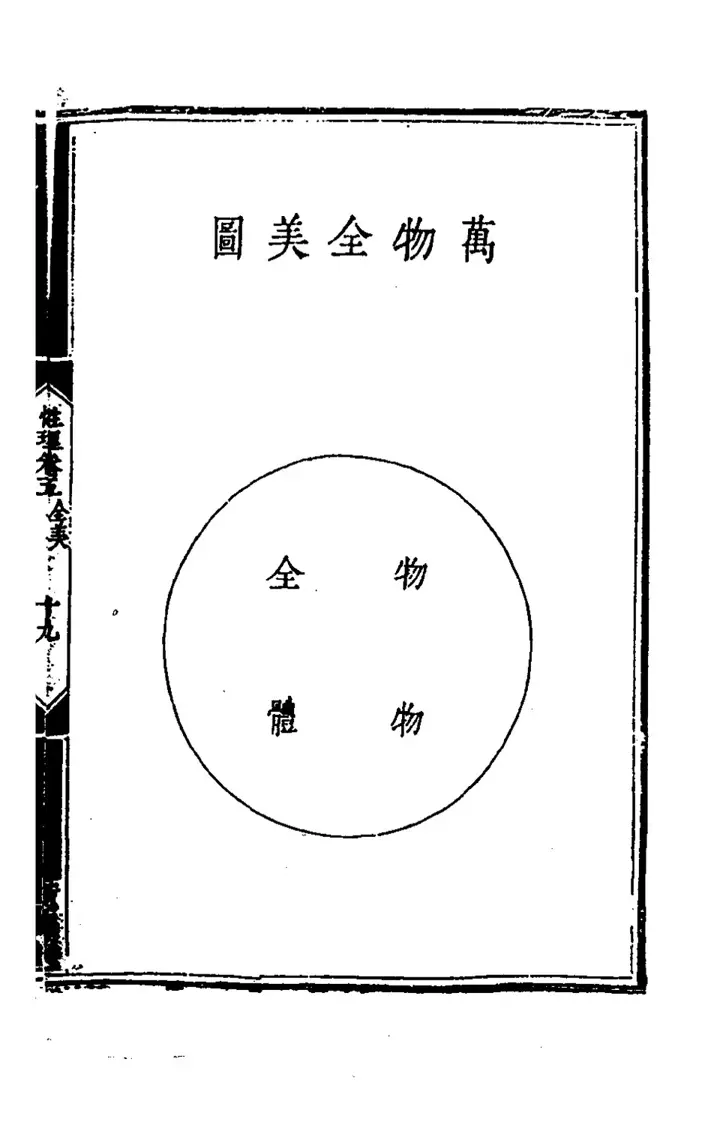
All that fills heaven and earth is things; even heaven and earth are things. All things are what the Real One has transformed into being, so there is certainly not one thing that is not wholly beautiful (complete and perfect). Viewed from its inner substance, every thing has the principle of the Former Heaven; viewed from its outer substance, every thing has the vital energy (qi) of the Latter Heaven; viewed from the substance where inner and outer join, every thing has the function proper to it. Its principle is a principle lacking nothing, its qi is a qi lacking nothing, so its function is naturally a function lacking nothing. Things are large and small, but where they are wholly beautiful there is no large or small; things are fine and coarse, but where they are wholly beautiful there is no fine or coarse. Heaven and earth are the largest and finest of things; take from among them the smallest and coarsest thing and compare it with heaven and earth for complete beauty, and in their complete beauty there is no distinction of this and that. For heaven and earth have this principle and a mote of dust also has this principle; heaven and earth have this qi and a mote of dust also has this qi; heaven and earth have the function proper to heaven and earth, and a mote of dust also has the function proper to a mote of dust. It is only that the function proper to heaven and earth is applied to heaven and earth, and so its working is universal, while the function proper to a mote of dust is applied to the mote, and so its working is minute. If one took this mote of dust, carried its function to the full measure and extended it, its function might well bear comparison with heaven and earth. But since there is already one heaven and earth, there is no need for another; since there is already the function proper to one heaven and earth, there is no need for another such function. That is why the mote of dust rests content in its lot and simply fulfils its function as a mote of dust. As for complete beauty, the complete beauty of heaven and earth is also that of the myriad [things ...] [continuing:] ...things too have this same complete beauty. An objector says: "Among the things between heaven and earth there is not one that is completely beautiful. Heaven is deficient in the north-west and earth is deficient in the south-east; if even heaven and earth cannot be completely beautiful, how much less everything else?" I reply: "Incompleteness is precisely what brings about completeness. When a thing exceeds complete beauty it is no longer completely beautiful. Within pure yang one yin lies hidden; this means the measure of pure yang is not complete. Yet if this one hidden yin were not there, then on the day yang is exhausted, how would yin be born? So the incompleteness of yang is precisely what brings about its completeness. Within pure yin one yang lies hidden; this means the measure of pure yin is not complete. Yet if this one hidden yang were not there, then on the day yin is exhausted, how would yang return? So the incompleteness of yin is precisely what brings about its completeness. The complete substance of the Sage is without limit, the utmost of purity; yet within that purity there must be one grain of dust, which means the measure of his pure clarity is not complete. Yet if this hidden grain of dust were not there, where would the spring of unceasing life in the human way find its lodging? So the incompleteness of purity is precisely what brings about its completeness. Such is the principle of yin and yang, such is the principle of the Sage; why then doubt it of heaven, earth and the myriad things?" The objector says: "Granted that no thing is incomplete in its substance, it may still be incomplete in its function. Where the function is complete, benefit appears in its use; where the function is incomplete, harm appears in its use instead." I reply: "The myriad things are what the root-suchness manifests. Since there is no incomplete root-suchness, how could there be an incomplete function answering to it? It is only that within creation there is the subtlety of right time and right boundary. When a thing is in its proper time and within its proper boundary, what incompleteness could there be? When it is out of its proper time, or displaced from its proper boundary, then a complete thing is being used in a place where it is not complete. This is the fault of whoever uses the things, not a fault in the things' function. Looking at it more broadly: the world is a completely beautiful world and time is a completely beautiful time. But when what suits the south is set to live in the north, or what suits the north is set to live in the south, the world then seems incomplete; when in summer one wears winter furs and in winter summer linen, time then seems incomplete. Incomplete, unbeautiful use comes only from the user's failing to use things fittingly. What blame attaches to time or to the world?" Note (Hei of Qingyuan): To speak of completeness is already to posit incompleteness; to speak of beauty is already to posit what is not beautiful. Only through what is not completely beautiful is complete beauty shown the more, and brought the more to completion. Consider: the growing of a single grain of millet takes the power of all the nine heavens. How could anything still fail to be completely beautiful?
盈天地間皆物也,即天地亦物也。物皆真一之所化,固無一物之不全美也。自其內體觀之,莫不有先天之理;自其外體觀之,莫不有後天之氣;自其內外相合之體觀之,莫不有當然之用。理無不全之理,氣無不全之氣,則其用自無不全之用。物有大小,而其全美處無大小;物有精粗,而其全美處無精粗。天地,物之至大而至精者也,任取其中一至小至粗之物,與天地較全美,其全美無彼此之分。蓋天地此理,微塵之物亦此理;天地此氣,微塵之物亦此氣;天地有天地當然之用,微塵之物亦有微塵當然之用。但天地當然之用,用之於天地,則其為用也普;微塵當然之用,用之於微塵,則其為用也細。若即此微塵之物,極乎其用之分量而推廣之,則其用未始不可與天地比。但既有一天地,不須更有一天地;既有一天地當然之用,不須更有一天地當然之用。微塵之物,是以各安其分,而但盡乎其微塵之用耳。論全美,則天地此全美,萬物亦此全美也。說者曰:「天地間之物,無有一全美者。天不滿於西北,地不滿於東南,天地亦不能全美,而況其餘?」曰:「不全,正所以成其全也。凡物過於全美,便非全美。純陽之中伏一陰,是其純陽之量未全也;然若無此一陰之伏,則陽盡之日,陰何以生?是陽之不全,正所以成其全也。純陰之內伏一陽,是其純陰之量未全也;然若無此一陽之伏,則陰盡之日,陽何以復?是陰之不全,正所以成其全也。聖人全體無極,清之至也,其清中必有一塵,是其純清之量未全也;然若無此一塵之伏,則人道生生不息之機何以寓焉?是清之不全,正所以成其全也。陰陽之理如此,聖人之理如此,而又何疑於天地萬物乎?」
說者曰:「萬物無不全之體,庸有不全之用。用之全者,則於用處見益;用之不全者,反於用處見損。」曰:「萬物即本然之所發現,無不全之本然,安有不全之應用?但在造化中有時與際之妙耳。當其時宜,在其分際,則何不全之有?非其時宜,易其分際,則以全者用於不全之地矣。此用萬物者之過也,非萬物之用之過也。擴而觀之,世界一全美之世界也,光陰一全美之光陰也。但宜於南者而北居之,宜於北者而南居之,便覺世界有不全也;夏也而服冬之裘,冬也而服夏之葛,便覺光陰有不全也。不全不美之用,用之者之不得其當耳,於光陰、世界乎何尤?」
Note by a later commentator: 清源黑氏 (Hei of Qingyuan)
清源黑氏曰:「言全,即有不全;言美,即有不美。惟不全美,始益顯其全美,益成其全美矣。顧其一粟之生,九天之力,豈尚有不全美者乎?」
AIScan vol. 6, p. 37–43Transcribed from the scan by AI (Claude), checked as described on the About page.
1 uncertain reading in this passage
- 陽是其純陽之量未全也· variant · 陰 is cut throughout this range as 隂 (阝+侌 form); normalised silently to 陰 in all passages, matching earlier volumes (p. 40)
AIBook 5 · 10 · Seeing the great within the small
小中見大圖說 微塵一念,全體所藏
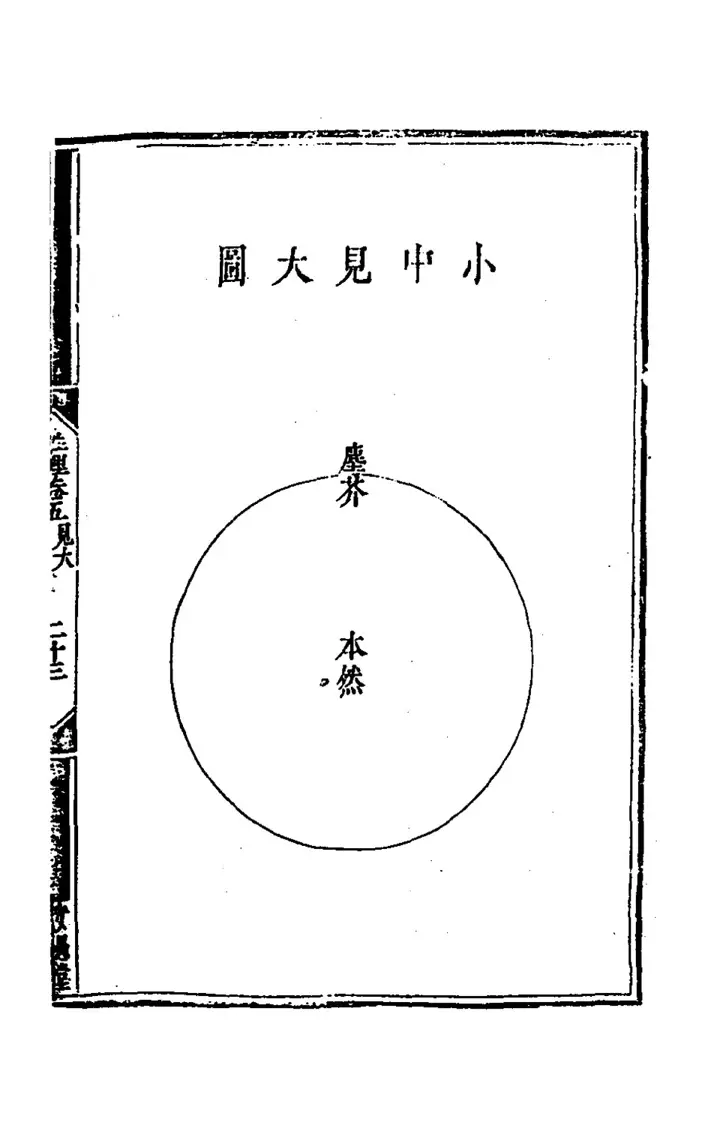
The things under heaven go down in smallness to mustard seeds and motes of dust; this is the very extreme of smallness. Even so, they may not be regarded as small. Consider the Real One: within its silent, traceless stillness there chanced a single motion of intent no bigger than a mote of dust. That one intent was only one intent; nothing is smaller than it. Yet from it came the Great Mandate, first manifested; from the Great Mandate came the ordered ranks of the endless natures and principles; from what the natures and principles left over came the primal qi; from the unfolding of the primal qi came the two modes and the four images; from the four images dividing into clear and turbid came heaven, earth and the myriad things; and once more, within heaven, earth and the myriad things, the Real One manifested its own complete substance. So vast is all this, and all of it came from a single motion of intent the size of a mote of dust. Thus the small is not small: within the small is something supremely great to which nothing can be added. Ouzai'er says: "The Real One is a hidden treasure." All that it manifests is its treasure-store. Heaven and earth are a treasure-store; each thing is a treasure-store; one mote, one drop, one awn, one grain is a treasure-store. This too is the meaning of seeing the great within the small. But this has not yet been carried to its full extent; carried to its full extent, its greatness is beyond anything thought can reach. The treasure-store is where the hidden treasure of the Real One is stored. Being stored, it is merely stored, merely held within a substance that is silent and has no place. This is great indeed, but its greatness has not yet been seen at its utmost. Why? Because we have spoken of the storing and not yet of the issuing forth. When it issues forth, the complete substance of the Real One stored in a tiny mustard seed again unfolds the great function of that complete substance, just as it unfolded before and so produced the heaven and earth of today, which have no end in time; heaven and earth producing so many unceasingly living things; and the myriad things each embracing a boundless, limitless Real One. One thing, one Real; ten thousand things, ten thousand Reals; countless, numberless things are countless, numberless Reals, and all of them come out of this tiny mustard seed. Is the mustard seed then a small thing? And can its greatness still be grasped by thought? Alas, there is no place that is not small and no place without the greatness within the small, yet very few people see this. Oumo'er (ʿUmar) says: "I have never looked at a single thing without seeing the complete substance of the Real One in it." He, perhaps, is one who is able to see. Note (Hei of Qingyuan): Dust and mustard seed may not be regarded as small; may man be regarded as small? If dust and mustard seed can unfold the complete substance and great function, is man to be worse than dust and mustard seed and unable to unfold them? When a man says "I am foolish", he is throwing himself away. When a man says "I know", then examine the complete substance and great function: how much of it does he know? Let him lay his hand on his heart and ask himself: can he be without shame?
天下之物,小至於芥子焉、微塵焉,亦極乎其小之至矣。雖然,不可作小觀也。試觀真一於寂然無朕之中,偶有微塵一念之動,此一念也,不過一念焉耳,小亦無有小於此者,乃因是而有首顯之大命焉,因大命而有無窮性理之次第焉,因性理之所餘而有元氣焉,元氣之所發揮而有兩儀四象焉,因四象之分清分濁而有天地萬物焉,復於天地萬物中而自顯其真一之全體焉。夫如此其廣大也,皆自微塵一念之動而有。然則小非小也,小之中有至大而無以復加者在也。偶栽爾曰:「真一為隱藏之寶。」其所顯者,無非其寶藏也。天地一寶藏也,一物一寶藏也,一塵一滴、一芒一粟,一寶藏也,此亦小中見大之義也。然猶未推廣言之也,推廣之,則其大有非思議可及者矣。
寶藏也者,真一隱藏之寶之所藏也。藏則不過藏焉已耳,不過寂然無有方所之體之所藏焉已耳,大矣,而猶未見其為大之至也。何也?論及於藏,而未論及於發也。發則微芥中所藏真一之全體,復為發揮其全體之大用,則亦猶夫前此之發揮,而有今日無窮期之天地也,天地而有如許生生不息之萬物也,萬物而各抱一無邊無際之真一也。一物一真,萬物萬真,無算無數之物,即無算無數之真,皆從此微芥中出。微芥其小焉者乎?而其為大也,尚可得而思議乎?惜乎無處非小,無處不有小中之大,見及此者,亦甚鮮其人也。歐默爾曰:「吾未嘗於一物而不見真一之全體。」則庶幾乎能見者矣。
Note by a later commentator: 清源黑氏 (Hei of Qingyuan)
清源黑氏曰:「塵芥不可小觀,人可小觀乎?能於塵芥發揮全體大用,人反不若塵芥而不能發揮全體大用乎?人曰『予愚』,自暴自棄也;人曰『予知』,究之全體大用,其所知有幾?撫衷自問,能無愧乎?」
AIScan vol. 6, p. 44–48Transcribed from the scan by AI (Claude), checked as described on the About page.
2 uncertain readings in this passage
- 芒一塵一滴、一芒一粟· variant · C cuts 芒 with an old form of 亡 (looks like 苡/芢); 1923 and W read 芒 (p. 46)
- 衷撫衷自問,能無愧乎· variant · C 衷 cut cramped (resembles 裵); 1923 衷 (p. 48)
AIBook 5 · 11 · Seeing the small within the great
大中見小圖說 真一至小無內
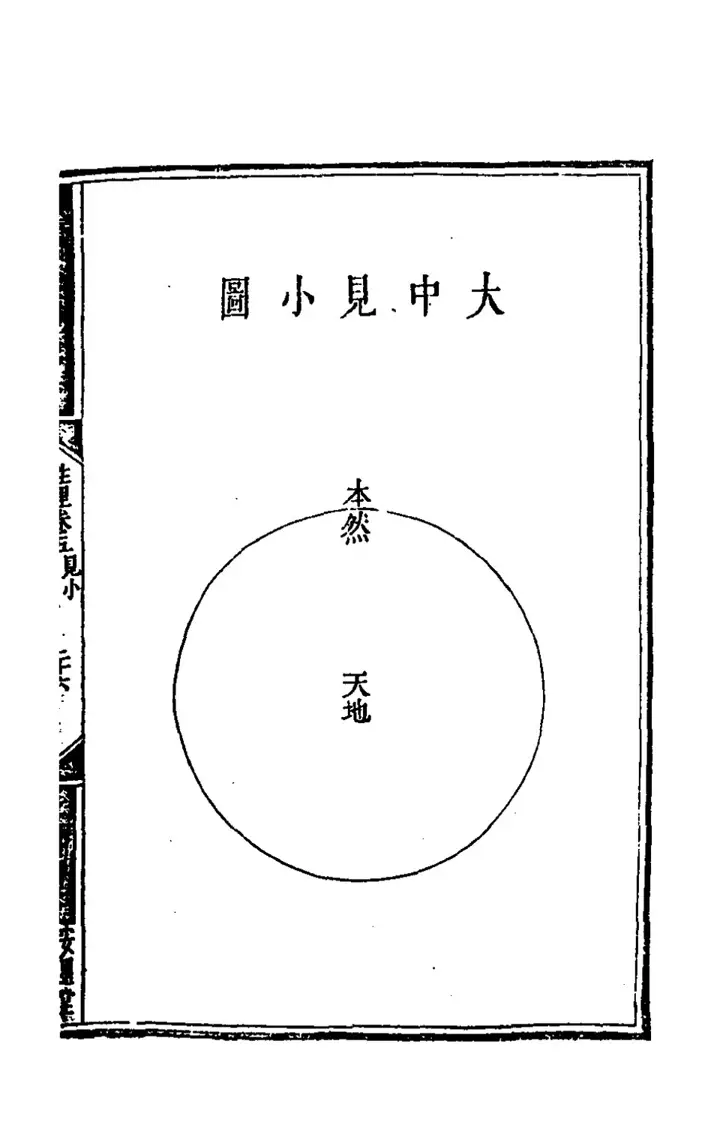
No thing is greater than heaven and earth. Yet looked at as great they are great, and looked at as small they are small; it depends on how the one who sees them sees. If one's seeing has not returned to the seeing of the root-suchness, one's view of heaven and earth is not small; if one's seeing has returned to the seeing of the root-suchness, one's view of heaven and earth is not great. For heaven and earth are form, and the heaven and earth that have form are produced by the heaven and earth that are formless. Standing within the formless heaven and earth and looking at the heaven and earth that have form, they are no more than a single mote of dust within heaven and earth. Even so, one may not simply regard them as small across the board. Not only may heaven and earth not be regarded as small; neither may the myriad things. Why? Because heaven, earth and the myriad things have no fixed size. If that is larger than this, then this is small; if that is smaller than this, then this in turn seems large. Heaven, earth and the myriad things have no fixed size because the Real One has no fixed size. It is not that the Real One has size: speaking of greatness, the Real One is great beyond thought; speaking of smallness, the Real One is small beyond thought. Yezide (Bāyazīd) said: "The Aershi (ʿarsh, the Throne) has come and gone in a corner of my heart many times, and I never noticed it." This is how Yezide saw the small within the great. Of the things under heaven, even the smallest, like a grain of sand or a mustard seed, must have an inside, and whatever has an inside can be entered and broken open. But the smallness of the Real One goes so far that it has no inside; having no inside, how could it be entered and broken open? This is smallness at its extreme. Yet is the Real One really small? To say it cannot be broken means that the substance of the Real One is utterly empty and utterly still, with no boundary by which it could be entered. Those who see it want with all their strength to express its greatness, and when they cannot exhaust its greatness they turn round and exhaust it through smallness. To speak of smallness is exactly the way to speak of greatness. Speaking of greatness, we know that heaven, earth and the myriad things have a source from which they came, and that they all came out of the great. Speaking of smallness, we know that what gives birth to heaven, earth and the myriad things is untainted. How do we see that it is untainted? Having no inside, there is certainly no way for it to be tainted. Note (Hei of Qingyuan): The greatness of heaven and earth was born from a single intent; so heaven and earth too are only dust and mustard seed within one intent. Not only does the Real One regard heaven and earth as dust and mustard seed; even dust and mustard seed regard heaven and earth as dust and mustard seed. Why then are people content to settle for being small?
物無有大於天地者也,然大視之則大,小視之則小,亦顧其見之者何如耳。見未復本然之見,則其視天地也非小;見能復本然之見,則其視天地也非大。葢天地者,形也;有形之天地,無形之天地之所生也。立於無形天地中,觀有形之天地,不啻天地中一塵也。雖然,一槩視之為小,則又不可。不惟天地不得視之為小,即萬物亦不得視之為小。何也?天地萬物無一定之大小也。彼大於此,則此小;彼小於此,則此又覺其大矣。天地萬物無一定之大小,葢因真一無一定之大小也。非真一有大小也,語大則真一為不可思議之大,語小則真一為不可思議之小。葉子德曰:「阿而實來往於吾心之隅也次數多矣,而吾未之覺也。」此葉子德之所以為大中見小也。
天下之物,即至小如塵沙芥子,亦必有內,有內則可以入乎其中而破之;而真一之小,則至於無內,無內則何以入乎其中而破之也?小之至也。雖然,豈真一果小乎哉?無破云者,謂真一之體至虛至寂,無從得其分際而入之也。見之者欲極力表著其大,而不得盡乎其大,則反於小焉盡之。語小,正所以語大也。語大,則知天地萬物有所自來,其來也,皆自大中來也;語小,則知生天地萬物者無染。何以見其無染也?無內,固無從得染也。
Note by a later commentator: 清源黑氏 (Hei of Qingyuan)
清源黑氏曰:「天地之大,生於一念,則天地亦一念中之塵芥耳。不特真一視天地如塵芥,即塵芥視天地亦如塵芥也。奈何人甘自居其小哉?」
AIScan vol. 6, p. 49–53Transcribed from the scan by AI (Claude), checked as described on the About page.
2 uncertain readings in this passage
- 因葢因真一無一定之大小· variant · C prints the variant 囙; normalised to 因 (1923 因) (p. 51)
- 槩雖然,一槩視之為小or 概· variant · C and 1923 print 槩; kept as printed (W 概) (p. 50)
AIBook 5 · 12 · In one breath, the whole of time (1)
一息終古圖說 一息而終古之事業完(一)
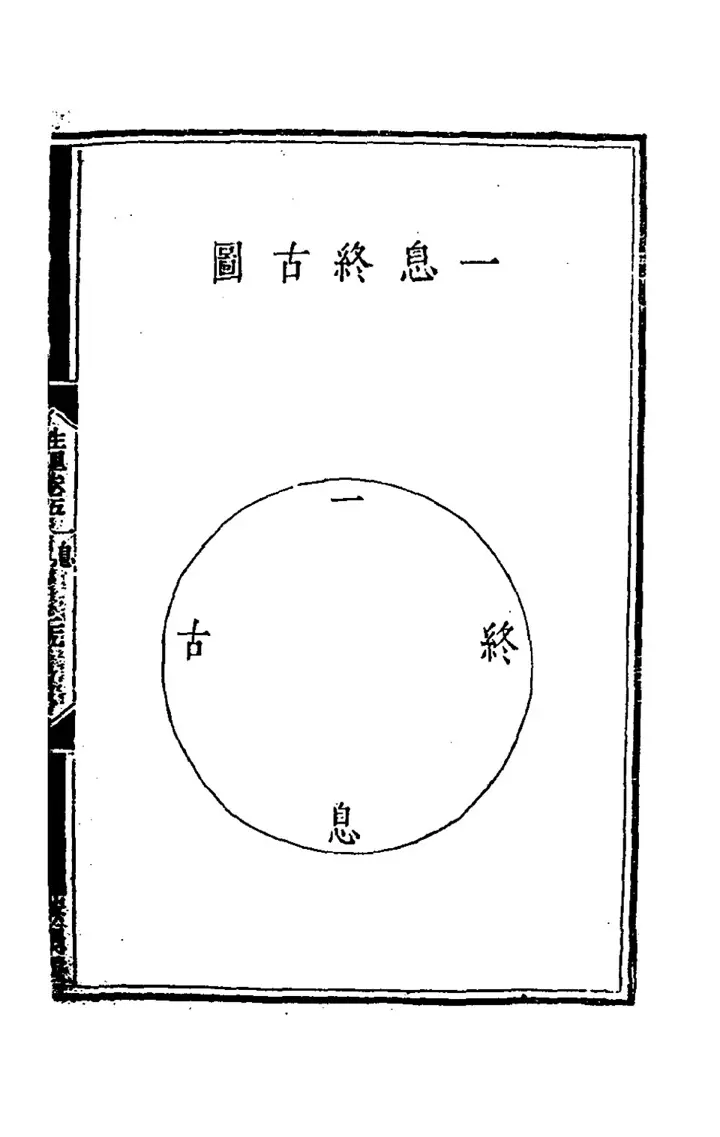
One exhalation and one inhalation are called a breath. A breath is the shortest span of time. In one breath the work of all the ages is completed, yet it is not easy for a human life to reach this one breath. The one who reaches it is the one through whom heaven and earth are rolled up. Within one breath one sees the past, sees the present, sees the future. Within one breath one sees the principles that belonged to the world of principle in the past, the images that belong to the world of images in the present, and the principles and images of both worlds in the future. Within one breath one sees the past yet in truth nothing has gone by; sees the present yet in truth nothing is present; sees the future yet in truth nothing is to come. Within one breath one sees that there is no past, yet in truth there is nothing that has not gone by; sees that there is no present, yet in truth there is nothing that is not present; sees that there is no future, yet in truth there is nothing that is not to come. Within one breath one sees that there is no past and, with that very seeing, is transformed into the no-past; sees that there is no present and, with that very seeing, is transformed into the no-present; sees that there is no future and, with that very seeing, is transformed into the no-future. Within one breath it is so, and within one breath it is also so: it is not that another breath is needed beyond this one; all is exhausted in this single breath. Within one breath there is going out and coming in; within one breath the spirit goes out and the spirit comes in; within one breath there is neither going out nor coming in; within one breath one enters from the Former Heaven and goes out from the Latter Heaven; within one breath one enters from the Latter Heaven and goes out from the Former Heaven; within one breath one enters from the measureless and numberless and goes out from the One; within one breath one enters from the One and goes out from the measureless and numberless; within one breath one enters from what has neither colour nor subtlety and goes out from what has colour and subtlety; within one breath one enters from what has colour and subtlety and goes out from what has neither; within one breath one enters from where there is an entering and goes out from where there is no going out; within one breath one enters from where there is no entering and goes out from where there is a going out; within one breath one enters from the beginningless and endless and goes out from what has beginning and end; within one breath one enters from what has beginning and end and goes out from the beginningless and endless; within one breath one enters from what is neither pure nor foul and goes out from what is pure and foul; within one breath one enters from what is pure and foul and goes out from what is neither; within one breath one enters by a gate and goes out where there is no gate; within one breath one enters where there is no gate and goes out by a gate. It is not that another breath is needed beyond this one; all is exhausted in this single breath.
一呼一吸之謂息。一息,光陰之最短者也。一息而終古之事業完焉,人生亦未易至此一息。至此一息者,天地從此人而捲起者也。一息之中,見已往,見現在,見將來。一息之中,見已往理世所有之理,見現在象世所有之象,見將來兩世所有之理象。一息之中,見已往而實未嘗有所往,見現在而實未嘗有所在,見將來而實未嘗有所來。一息之中,見無已往而實無所不往,見無現在而實無所不在,見無將來而實無所不來。一息之中,見無已往,而並自以其見化入於無已往之中;見無現在,而並自以其見化入於無現在之中;見無將來,而並自以其見化入於無將來之中。一息之中如此,一息之中又如此,非一息之外更須一息也,總此一息焉盡之也。
一息之中,有出有入;一息之中,神出神入;一息之中,無出無入;一息之中,從先天入,從後天出;一息之中,從後天入,從先天出;一息之中,從無量無數而入,從一而出;一息之中,從一而入,從無量無數而出;一息之中,從無色無妙而入,從有色有妙而出;一息之中,從有色有妙而入,從無色無妙而出;一息之中,從有所入而入,從無所出而出;一息之中,從無所入而入,從有所出而出;一息之中,從無始無終而入,從有始有終而出;一息之中,從有始有終而入,從無始無終而出;一息之中,從無淨無穢而入,從有淨有穢而出;一息之中,從有淨有穢而入,從無淨無穢而出;一息之中,從有門而入,從無門而出;一息之中,從無門而入,從有門而出。非一息之外更須一息也,總此一息焉盡之也。
AIScan vol. 6, p. 54–58Transcribed from the scan by AI (Claude), checked as described on the About page.
3 uncertain readings in this passage
- 最一息,光陰之最短者也· variant · C prints 㝡 (冖 top); normalised to 最 (1923 最) (p. 55)
- 捲天地從此人而捲起者也or 卷· variant · C and 1923 捲; W 卷 (p. 55)
- 並而並自以其見化入於無已往or 竝· variant · C cuts 竝 here and elsewhere (pp. 56, 58, 68, 72); written 並 as in earlier volumes (p. 56)
AIBook 5 · 13 · In one breath, the whole of time (2)
一息終古圖說 一息而終古之事業完(二)
In one breath the work of all the ages is completed. This breath is not my breath alone; it is one that I share with the Lord. When I share it with the Lord, there are times when within the breath I see only myself and do not see the Lord; when the Lord shares it with me, there are times when within the breath I see only the Lord and do not see myself; and there are times when within the breath I see neither the Lord nor myself. The wonders of all the ages are wholly gathered into this one breath; this is the utmost wonder of the one breath. Our Sage's ascent to heaven was no more than the affair of one breath: from the beginning of creation to the end of the return, all principles, images and events, he saw every one and knew every one. This is the clear proof that in one breath are all the ages. Erli (ʿAlī), in the moment of swinging into the saddle, recited the whole learning of heaven and earth from beginning to end; this almost approaches the glory of the one breath of the Ascent, and it too is a clear proof that in one breath are all the ages. Note (Hei of Qingyuan): When I had read to this chapter, someone asked me: "How is it that in one breath the work of all the ages is completed?" I said: "Reaching this one breath lies in knowing and doing. To know and not do is empty knowing; to do and not arrive is wasted doing. It rests with those who cultivate the Real to accomplish it." The creative transformation of heaven and earth, the manifest and hidden of principles and images, we can come to know from beginning to end in full detail. But if one does not unite with the true meaning through one's own being, and remains bound and clogged by desire for things and selfish concern, how could one reach this one breath? Therefore: if the original nature is not manifest, it is not easy to know this breath; if the continuing nature is not manifest, it is not easy to see this breath; if the true heart is not opened, it is not easy to pass into this breath; if the ascent and return are not complete, it is not easy to reach this breath. The one who reaches this breath is one whose ability heaven and earth cannot constrain and whose work ghosts and spirits cannot constrain; enclosing and completing, knowing all things thoroughly, the wondrous Way that has no place and no body is wholly exhausted in one breath. This is the sign that the complete substance has returned to the Real.
一息而終古之事業完焉,此一息非我之一息也,我與主共焉者也。我與主共,而有時一息之中,秖見有我,不見有主;主與我共,而有時一息之中,秖見有主,不見有我;又有時而一息之中,並不見主,並不見我。終古之妙,盡收納於一息之中,斯亦極乎其一息之妙矣。吾聖登霄,不過一息事耳,自起化之始,至歸復之盡,凡所有理象與事,無不備見而備識之,此一息而終古之明證也。爾里於跨鞍之頃,將天地自始至終之學備述一通,殆亦幾幾乎登霄一息之盛也,亦一息而終古之明證也。
Note by a later commentator: 清源黑氏 (Hei of Qingyuan)
清源黑氏曰:「予讀至是篇,或有問者曰:『何如斯,則一息而完終古之事業乎?』予曰:『至此一息,在知與行。知而不行,徒知;行而不至,枉行。是在修真者能之耳。』天地之造化,理象之顯微,吾得而知其始終蕃細矣。不有以體合真諦,而乃錮滯於物欲己私,何能便至此一息?是故本性不顯,未易知此一息;繼性不顯,未易見此一息;真心不開,未易通此一息;升復不全,未易至此一息。至此一息者,天地莫能制其能,鬼神莫能制其事,範圍曲成,通知有物,而無方無體之妙道,皆於一息焉盡之,此全體歸真之驗也。」
AIScan vol. 6, p. 58–60Transcribed from the scan by AI (Claude), checked as described on the About page.
2 uncertain readings in this passage
- 秖秖見有我,不見有主or 只· variant · C and 1923 print 秖 (both occurrences); kept as printed; W 只 (p. 58)
- 蕃吾得而知其始終蕃細矣or 善· unclear · C top of character slightly broken; 蕃 confirmed by 1923; W 善 is an error (p. 59)
AIBook 5 · 14 · The whole of time is but one breath (1)
終古一息圖說 終古在主宰本量中不過一息(一)
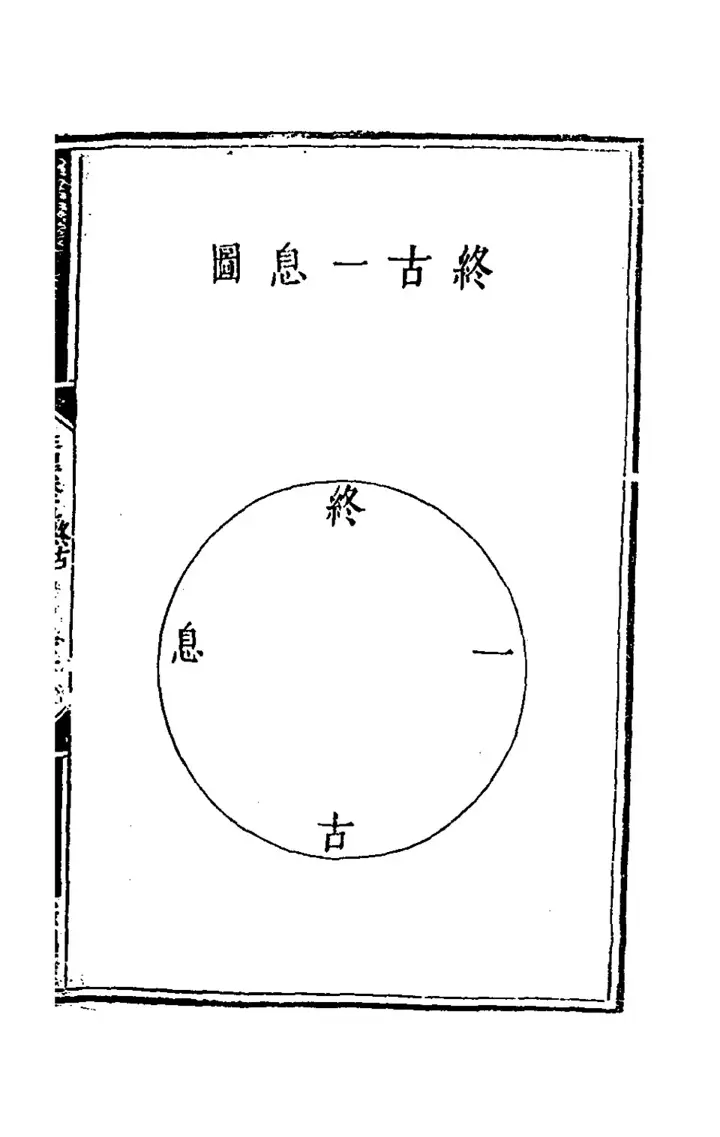
Gu (the ancient) means the beginning. To run through the whole of time from that ancient beginning and complete the work of this one round of creation is called zhonggu, 'all the ages'; its duration cannot be reckoned in years. 'One breath, all the ages' is said solely with regard to the capacity of human virtue; it is something a human being can do. 'All the ages, one breath' is said solely with regard to the original capacity of the Lord; it is not something a human being can do. The original capacity of the Lord has in itself no 'all the ages' and no 'one breath', because within that original capacity there is no morning and evening. We say 'all the ages' and 'one breath' only because there is time. Now the time of all the ages cannot be called anything but long. Being so long, unless there were measureless, numberless principles without end, there would be nothing to answer to the unfolding of all the ages; and so the Lord has in fact manifested measureless, numberless principles without end within his original capacity. Being so long, unless there were measureless, numberless colours (forms) without end, there would be nothing to answer to the depicting of all the ages; and so the Lord has manifested measureless, numberless colours without end within his original capacity. Being so long, unless there were measureless, numberless qi and matter without end, there would be nothing to answer to the succession of all the ages; and so the Lord has manifested measureless, numberless qi and matter without end within his original capacity. Such is it, such is it; can what he has manifested be called anything but many? Yet manyness is enough to show the wealth of all the ages, not enough to show their wonder.
古之為言,初也。終其古初之光陰,而完此造化一局之事,曰終古,其為時不可以歲運計也。一息終古者,專自人之德量而言之也,人之所能為也;終古一息者,專自主宰之本量而言之也,非人之所能為也。主宰之本量,原無終古,原無一息,葢以本量中無晨夕也。曰終古,曰一息者,自其有光陰而言之也。然而終古之光陰,不可謂不長矣。長,則非有無量無數無窮期之理,不足以應終古之發揮也,乃主宰亦既於本量中而顯有無量無數無窮期之理也。如是長,則非有無量無數無窮期之色,不足以應終古之描畫也,乃主宰亦既於本量中而顯有無量無數無窮期之色也。如是長,則非有無量無數無窮期之氣與質,不足以應終古之嗣續也,乃主宰亦既於本量中而顯有無量無數無窮期之氣與質也。如是如是,而其所顯有者,可不謂多焉矣乎!然而多也,足以見終古之富,不足以見終古之奇。
AIScan vol. 6, p. 61–63Transcribed from the scan by AI (Claude), checked as described on the About page.
Book 5 · 15 · The whole of time is but one breath (2)
終古一息圖說 終古在主宰本量中不過一息(二)
Of wonders none is more wonderful than that the wealth of all the ages cannot be measured, and more wonderful still that this wealth cannot be fathomed. To bring one world of mandate into all worlds of mandate, and all worlds of mandate into one world of mandate, without destroying their forms: that is all the ages. To bring one world of qi into all worlds of qi, and all worlds of qi into one world of qi, without destroying their forms: that is all the ages. To bring one treasure-store into all treasure-stores, and all treasure-stores into one treasure-store, without destroying their forms: that is all the ages. To bring one root-suchness into all root-suchnesses, and all root-suchnesses into one root-suchness, without destroying their forms: that is all the ages. To bring one manifestation into all manifestations, and all manifestations into one manifestation, without destroying their forms: that is all the ages. To bring one time into all times, and all times into one time, without destroying their forms: that is all the ages. To bring one heaven and earth into all heavens and earths, and all heavens and earths into one heaven and earth, without destroying their forms: that is all the ages. Can all the ages be called anything but wealthy? Anything but wealthy and wonderful? It exhausts principles that cannot be fathomed and further exhausts numbers that cannot be fathomed; it exhausts forms that cannot be fathomed and further exhausts subtleties that cannot be fathomed. Can the time of all the ages be called anything but wealthy and long? Yet within the original capacity of the Lord it is no more than one breath. A former worthy said: "The duration of heaven and earth is half a day of time", meaning that the world of principle is half a day and the world of images is half a day. Another former worthy said: "The Lord's creation of the two worlds of principle and image is one exhalation and one inhalation." The two worthies who said these things were perhaps absorbed before the throne of the Real One and did not know that there are mornings and evenings. Even so, speaking from the utmost limit of the original capacity of the Real One, even 'one breath' is too much. Within the original capacity of the Real One there is no such thing as all the ages at all; how then could there be one breath? Note (Hei of Qingyuan): 'One breath, all the ages' speaks of the utmost of the sage's and the spirit's transforming work: the affairs of the small world are then finished. 'All the ages, one breath' describes the wonder of the Real Ruler's creation: the affairs of the great world then come to their end.
奇莫奇於終古富有之不可量也,而尤莫奇於富有之不可測。以一命世入一切命世,以一切命世入一命世,而不壞其相者之終古也;以一氣世入一切氣世,以一切氣世入一氣世,而不壞其相者之終古也;以一寶藏入一切寶藏,以一切寶藏入一寶藏,而不壞其相者之終古也;以一本然入一切本然,以一切本然入一本然,而不壞其相者之終古也;以一顯然入一切顯然,以一切顯然入一顯然,而不壞其相者之終古也;以一光陰入一切光陰,以一切光陰入一光陰,而不壞其相者之終古也;以一天地入一切天地,以一切天地入一天地,而不壞其相者之終古也。終古可不謂富焉者乎?可不謂富而奇焉者乎?終其不可測之理也,而復終其不可測之數;終其不可測之形也,而復終其不可測之妙。終古之光陰,可不謂富而長焉者乎?然而在主宰本量之中,不過一息焉耳。先賢云:「天地之久,半日光陰。」葢謂理世為半日,象世為半日也。又一先賢云:「主宰造化理象兩世,一呼一吸。」為此言者之二賢也,或亦渾然於真一之闕下,而不知有晨夕者也。雖然,若自真一本量之極致而言之,一息之說猶多也。真一本量之中,原無所謂終古也,而又何有一息哉?
Note by a later commentator: 清源黑氏 (Hei of Qingyuan)
清源黑氏曰:「一息終古,乃言聖神功化之極,小世界之事畢矣;終古一息,乃述真宰造化之奇,大世界之事終焉。」
AIScan vol. 6, p. 63–66Transcribed from the scan by AI (Claude), checked as described on the About page.
Book 5 · 16 · The Real One returns to the Real
真一還真圖說 以無所還為還
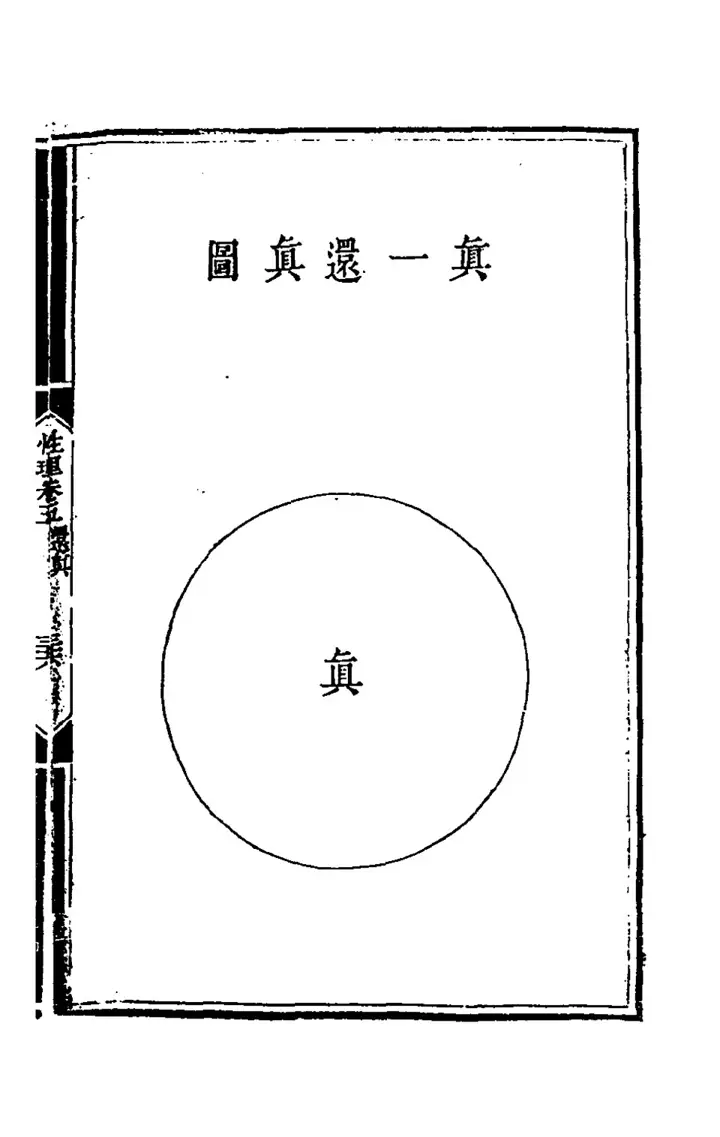
Before the Real One's single intent had moved, it was silent and without name; not even the name 'Real One' had any ground to stand on. How then could there be a Real to return to? To return means to go back to one's beginning. Only when a person has become unlike his beginning does he go back to it. In what respect, then, could the Real One be unlike its beginning? I answer: once the Real One had its single motion of intent, everything that it holds came to be because of that one intent. The one intent is where the Real issues forth and where falsity arises. What is false never lasts long without wearing out, never is borrowed long without being given back. Heaven, earth, humans and things arise from the natural course of number and the necessity of principle; when number is spent and principle reaches its limit, there are no heaven, earth, humans or things that do not cast off form and matter and return to the Real One. Should the Real One alone not weary of feelings and desires and think of returning to the Real? An objector says: "The Real One's motion of intent is only one motion of intent; it seems not to taint the complete substance, so what need is there to return? Moreover, one intent is extremely slight: when it arises it becomes illusion, and when it is transformed it has already become Real. How then could there be a Real to return to?" I answer: "Although one motion of intent is not enough to burden the complete substance, the complete substance never fails to know this motion of intent. When the complete substance knows, the complete substance moves; how then can you say it does not taint the complete substance? Further, the saying 'when it arises it becomes illusion, when it is transformed it has already become Real' may be said of those who cultivate the Real, but not of the original substance of the Real One. For the thinking and doing of those who cultivate is wholly spent when they are transformed into the Real One; even if some impurity remains, they hand it to the Real One and let it take its natural course. Those who cultivate the Real can leave things to the Real One, but to whom could the Real One leave things? When illusion enters the Real, illusion certainly becomes Real; when the Real is mixed with illusion, the Real in turn becomes illusion. The Real One is surely not so rigid and clogged as that." How then is it to return? It is simply to take not-returning as returning. What has moved and appeared as principle, let it be principle, and do not ask whether that principle will again be kept or put forth. What has moved and appeared as qi, let it run its course to exhaustion, and do not ask whether that qi will again contract or expand. What has moved and appeared as image and number, let it vanish, and do not ask whether image and number will again arise or perish. To insist on gathering up all that became principle, qi, image and number and returning it wholly to the Real would be to make the Real One rigid and clogged, which it surely is not. Where the intent has moved, dissolve it right where it moved and leave no trace; where the intent has not moved, settle it right in its not-moving and let nothing issue from its spring. At that moment there is only stillness and no stirring, only silence and no sign. Real and illusory are not divided, substance and function are not distinguished; one cannot find anything to divide and divide it, nor anything to name and name it. It is simply the original, first state once again. What return is there? Note (Hei of Qingyuan): Pure stillness is the root-suchness. A single intent gives rise to measureless affairs, yet a single intent does not last as long as one breath; and within the root-suchness there is not even one breath. One intent arises and at once another dissolves, so within the root-suchness there is not even one intent. This is what is meant by the Real One returning to the Real. 'Real' is said in contrast with the illusory, 'One' in contrast with the myriad: the Real returns to its Real and the One returns to its One, and it is the first state just as before.
真一一念未動之先,寂然無稱,並真一之名亦無自而立,而何有真之可還?還者,返乎其初之謂也。人必有不如其初者,而後乃返之於其初焉。真一則何不如其初之有?曰:真一自有一念之動,而其無所不有者,皆因此一念而有也。一念者,真之所發,妄之所起。妄則未有歷久而不敝、久假而不歸者也。天地人物,起於數之自然,理之不得不然,而迨夫數窮理極之時,天地人物未有不捐棄形質而歸於真一者,豈真一獨不厭離情欲而思還復於真也哉?
說者曰:「真一一念之動,不過一念之動已耳,似乎無染於全體也,而焉用還為?且一念甚微,起則成幻,化已成真,而又安得有真之可還?」曰:「一念之動,雖不足為全體之累,然而全體未有不知此一念之動者。全體知,則全體動矣,而又安得謂其無染於全體也?且夫所謂起則成幻、化已成真者,為修真者言之則可,為真一之本體言之則不可。葢修者之思也、為也,化入於真一焉盡之矣;即有不淨,亦付之真一焉而聽其自然已矣。修真者可聽之於真一,而真一則更將安所聽乎?幻入於真,則幻固成真;真雜於幻,則真又成幻。真一固不若是之凝滯也。」
然則如之何而還之?夫亦曰:以無所還為還而已矣。動焉而現之於理者,聽其理焉而已矣,不必問其理之復有所存發也;動焉而現之於氣者,聽其盡焉而已矣,不必問其氣之復有所翕闢也;動焉而現之於象數者,聽其泯焉而已矣,不必問其象數之復有所起滅也。若必欲收其所為理氣象數者,而盡返之於真也,真一固不若是之凝滯也。念之曾有所動者,即於其動處銷之,而無所存其跡;念之未有所動者,即於其不動安之,而無所發於其機。於斯之際,但有寂而無感也,但有默而無朕也。真幻不分,體用無別,區之無可得而區也,稱之無可得而稱也,仍然一最初之境而已矣,何還焉?
Note by a later commentator: 清源黑氏 (Hei of Qingyuan)
清源黑氏曰:「清淨一本然也,一念而起無量之事。然一念不逮一息,況本然中並無一息乎?一念旋起,一念旋消,則本然中亦並無一念也,此真一還真之謂也。真對幻言,一對萬言,真還其真,一還其一,依然最初之境而已。」
AIScan vol. 6, p. 67–72Transcribed from the scan by AI (Claude), checked as described on the About page.
2 uncertain readings in this passage
- 妄一念者,真之所發,妄之所起· variant · C cuts 妄 in an older form (亡 over 女 with 亾-like top), three occurrences on this page (p. 68)
- 翕復有所翕闢也· variant · C 翕 slightly abbreviated; 1923 翕闢; W 龛辟 is an OCR error (p. 70)
AI
Key terms in this text
Each term's Arabic or Persian counterpart carries its grounding: the text itself, a published scholar, or AI. Tap one to find it in the text.
Connections
真一三品Wang Daiyu's Real One, Numerical One and Embodied Onelineage
Book 5 opens with three diagrams of the three Ones, each in three grades (Book 5 · 2–4): the scheme Wang Daiyu laid out in the Great Learning of the Pure and Real half a century earlier, where each One has three 'witnesses'.
真一Plotinus, On the Good, or the One (Ennead VI.9)resonance, not influence
The Real One that holds 'the one and the numbers' and to which all returns, beside Plotinus's One before all number. A likeness in structure; no line of transmission is claimed here, though Jāmī's school inherited Neoplatonic ideas by other routes (Whinfield's preface to the Lawāʾiḥ argues for Plotinus's influence on Sufism).
AI
Chinese: transcribed by AI (Claude) from the CADAL scans on Wikimedia Commons (public domain), checked against the zh.wikisource text (CC BY-SA); Books 1–5 also collated with the 1923 photoreprint (CADAL, Commons), and the Root Classic with the Chinese printed in Murata, Chittick and Tu (2009); punctuation is editorial. Books 1–5 keep the notes of Hei of Qingyuan (清源黑氏, Hei Mingfeng), a later commentator, apart from Liu Zhi's text. Arabic: Nūr al-Ḥaqq (Ma Lianyuan), al-Laṭāʾif, as printed in Murata, Chittick and Tu, The Sage Learning of Liu Zhi (2009), pp. 103–153 (public domain text; taken from the book's text layer and checked against the page images by AI, page by page; not yet proofread by a person). Characters: Unihan (Unicode licence), cjk-decomp (Apache-2.0), the Kangxi Dictionary (public domain) via Wikisource (CC BY-SA). The English and the term mappings marked AI were written by AI (Claude). Murata's translations are in copyright and are cited, never reproduced. How this text was established.