Liu Zhi 劉智 · c. 1670–after 1724
Nature and Principle in Islam
天方性理
卷四・圖說Book 4: the heart, the Human Ultimate and the way back
Book 4 · 1 · Volume Four: Overview
概言 頓漸天人
The fourth volume sets forth what the third volume left unsaid. The transcendent wonder of the Human Ultimate may be sudden or gradual; the classes of sage and ordinary person may be of Heaven or of human effort. To know the sudden without knowing the gradual is to make the sudden unusable as a method, for sudden transcendence is the road of one or two people, while gradual entry is the road of hundreds and thousands. To rest content with the ordinary and not aspire to sagehood is to abandon oneself, whether in matters of Heaven or of human effort. For whoever knows shame becomes brave, and whoever perseveres can become a sage; without bravery and without perseverance, to wish to transcend the three worlds and enter the unsurpassed is hard indeed. How much worse, when one is not brave and persevering oneself, to go on to speak rashly of others' bravery and perseverance! That is abandoning oneself and abandoning oneself again.
第四卷乃發明第三卷未盡之意,人極之超妙也,有頓有漸;聖凡之分科也,有天有人。知其頓,不知其漸,則其頓不可以為法。蓋頓超者,一二人之路;漸入者,千百人之路也。安於凡,不希於聖,則無論天事人事,皆自棄之矣。蓋知耻則勇,恒可作聖;不勇不恒,欲其超三界而入無上也,難矣。况已不勇恒,而復妄議人之勇且恒者乎?自棄而又自棄者也。
AIScan vol. 4, p. 63Transcribed from the scan by AI (Claude), checked as described on the About page.
2 uncertain readings in this passage
- 耻蓋知耻則勇or 恥· variant · C 耻; 1923 恥 (p. 63)
- 恒恒可作聖or 恆· variant · C 恒; 1923 恆 (p. 63)
AIBook 4 · 2 · The meeting of heart and nature
心性會合圖說 心性互為用
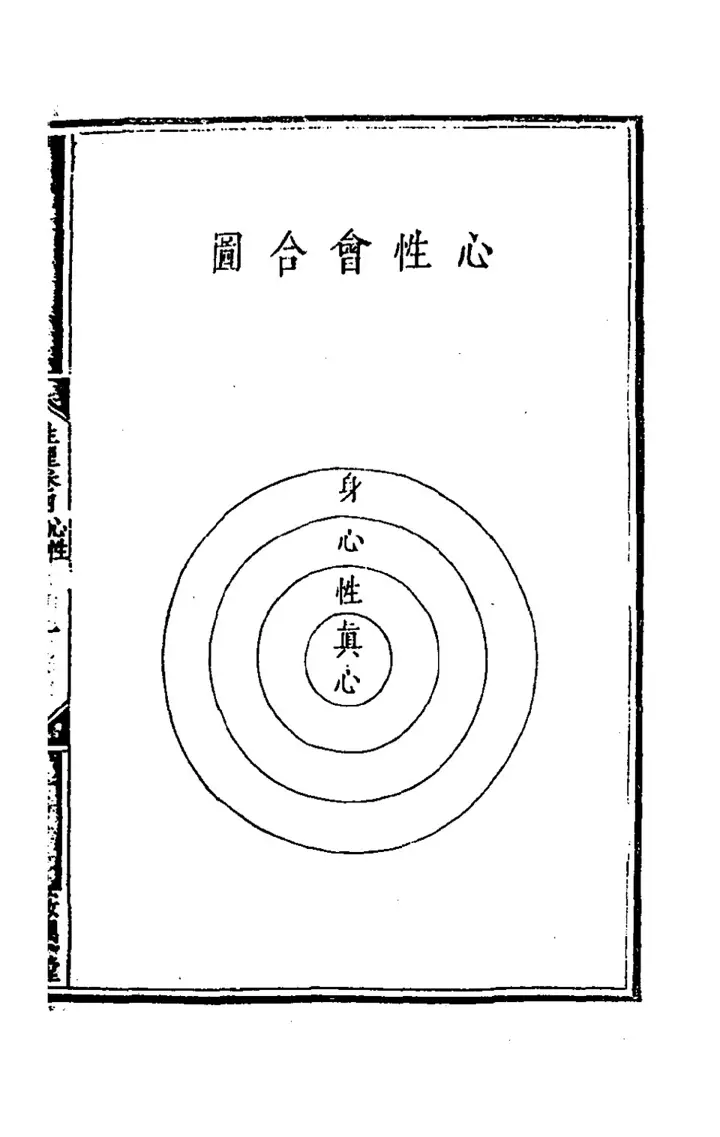
Before nature and principle were divided there was only this one heart. The heart is that which has no place or location. After nature and principle were divided, it was no longer called heart but called nature. When nature passes from the world of principle toward the world of images, it has no form and no body, and lodges in the heart. The wondrous substance of the heart is empty, still and without outside; the heart that is within the body is the heart's location, the place where nature lodges. The wondrous substance of the heart is nature's Former Heaven; the square inch of the heart is where nature is lodged and attached, and the square inch is its Latter Heaven. The heart of the Former Heaven is the source from which nature is divided out; the location of the square inch is the aid by which nature is made manifest. Why? Although the square inch belongs to the Latter Heaven, the talent and intelligence it possesses are truly sufficient to know nature and truly sufficient to see nature. The empty wonder of nature contains everything, yet it is wondrous without being able to manifest itself; it must obtain the heart's talent and intelligence, which are able to bring it forth, and only then does nature have something to borrow and rely on in order to appear. Nature may be likened to fire, the heart to coal: coal without fire does not blaze, and fire without coal, what would it cling to? To put it briefly, the principle of the Former Heaven must rely on the heart of the Latter Heaven, and must also rely on the vital energy of the Latter Heaven. With the heart of the Latter Heaven, principle is illuminated; with the vital energy of the Latter Heaven, principle is carried into action. How does the heart of the Latter Heaven have the power to illuminate principle? When the embryo's bodily apertures first divide, there is already something belonging to fire which issues as the apertures of numinous clarity, standing opposite each other on the left and right of the heart. The apertures of numinous clarity are the root of talent and intelligence, and the power to illuminate principle already lies hidden there from the start. How does the vital energy of the Latter Heaven have the power to fulfil nature? The nature of vital energy is that which obediently receives the function of the original nature and takes it as its own function; it is the horse that the original nature rides. The heart's talent and intelligence suffice to know it, and the native capacity of vital energy suffices to carry it out, so that the ordered pattern of nature from beginning to end may approach the point where everything is gathered together. This is why the Former Heaven must rely on the Latter Heaven. Even so, it is not right to say that the nature of the Former Heaven has no means at all of exerting its own strength. For heart and nature serve as function to one another, and the Former and Latter Heaven each shine their own capacities into the space between. When the talent and intelligence of the square inch meet with the pure and subtle wisdom contained in the original nature, its knowing becomes all the stronger; when the talent and intelligence of the square inch meet with the natural reflected light that appears within the original nature, its discernment of principle becomes all the truer. From this we know that the nature lodged in the square inch is not entirely without means of exerting its own strength. It borrows the location of the square inch as its lodging and uses the brightness of the square inch as its function; and when the heart's talent and strength are exhausted and the six grades of the substance of nature are gathered into one, the location of the square inch has no further use, and it becomes once more the heart of wondrous substance, no longer falling into place and location. Then one may say that the heart is nature, and one may say that nature is the heart. Note (Hei of Qingyuan): "The formless heart is that from which the nature of the Former Heaven comes forth; the heart with form is that into which the nature of the Latter Heaven enters. Heart and nature are names: seed and fruit are one meaning. The heart is the outer wall of nature; if there is no abiding with the heart, everything falls to one side."
性理未分之先,秪此一心。心也者,無方所者也。性理既分之後,不名心而名性。性自理世而趨象世之時,無形無體,而寓於心。心之妙體空寂無外,而身內所有之心,心之位也,性之所寓也。心之妙體為性之先天,心之方寸為性之寄屬,方寸其後天也。先天之心為性所分析之源,方寸之位為性所顯露之助。何也?方寸雖屬後天,而其所具之才智,實足以知性,實足以見性。性之虛妙無所不有,但妙而不能自為顯發也,必得心之才智足以發之,而其性乃有所借資而顯。性譬則火也,心譬則煤也。煤無火則不熾,火無煤又何以着乎?約而言之,先天之理,必有借於後天之心,亦必有借於後天之氣。有後天之心,而其理乃燭;有後天之氣,而其理乃行。後天之心何以有燭理之能?葢胚胎當體竅初分之時,已先有所為屬火者,發為靈明之孔,而對峙於心之左右。靈明之孔,即才智之根,而燭理之能已蚤伏於此矣。後天之氣何以有盡性之能?葢氣性者,順承本性之用而以為用者也,駕本性之馬也。心之才智足以知之,氣之本量足以行之,而性之始終條理,庶乎其有統會之機矣。此先天之所以必有借於後天也。
雖然,謂先天之性全無所以自用其力,則又不可。葢心與性互相為用,而先後天各以其本領照映於其間也。以方寸所有之才智,與本性中所含清妙之智會合,而其為知也益力;以方寸所有之才智,會合本性中所顯天然之返照,而其察理也益真。是知方寸所寓之性,亦非全無以自用其力也。借方寸之位以為寓,因方寸之明以為用,迨至心之才力既盡,而六品性體統會於一,則方寸之位無所用之,而依然成其為妙體之心,而不落於方所也。然後謂心即性也可,謂性即心也可。
Note by a later commentator: 清源黑氏 (Hei of Qingyuan)
清源黑氏曰:「無形之心,為先天性所從出;有形之心,為後天性所從入。心性為名,種果一義耳。心者,性之郛郭;與心無所住,皆落一邊在。」
AIScan vol. 5, p. 4–9Transcribed from the scan by AI (Claude), checked as described on the About page.
5 uncertain readings in this passage
- 秪性理未分之先,秪此一心or 祇 (1923)· variant · C prints 秪 (for 祇/只 'only'); 1923 prints 祇; kept as printed (p. 5)
- 蚤而燭理之能已蚤伏於此矣or 早· variant · 蚤 for 早 as printed (also 1923); Wikisource normalises to 早 (p. 6)
- 胚葢胚胎當體竅初分之時or 肧· variant · printed with 月+丕 form; normalised to 胚 (p. 6)
- 郛心者,性之郛郭;與心無所住· witness-differs · C and 1923 both print 郛郭; Wikisource has 郭 only. Punctuation of this clause uncertain (p. 8)
- 在皆落一邊在。」· unclear · the final 在 stands alone on p9 (verso); confirmed by 1923 p175 (p. 9)
AIBook 4 · 3 · The seven grades of the heart and the virtues they store
心品藏德圖說 心有七品,品各藏德
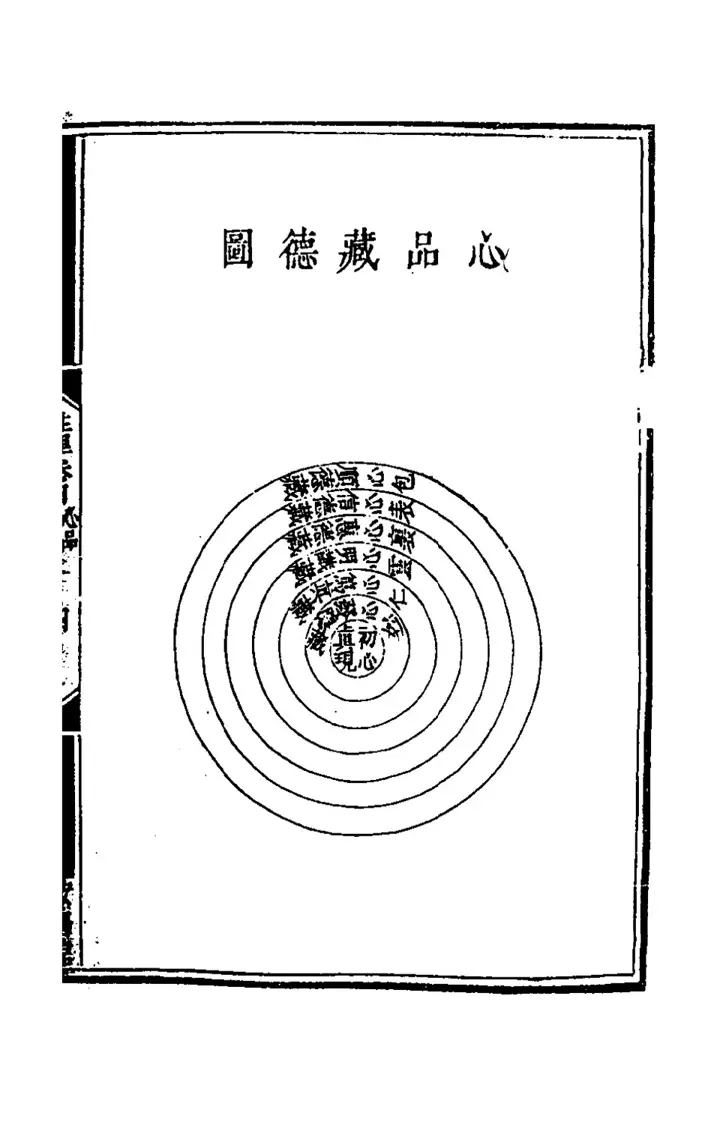
The heart of form and colour is originally a single thing, yet it has seven grades, and each grade has its own virtue. Virtue is what the heart obtains and makes into talent and intelligence. Each virtue has its own operation, just as heaven has the Seven Governors and each governor has its own charge. The outermost grade is the store of the virtue of compliance. Compliance means not resisting; yet at times it turns from compliance to resistance, because the place where it is stored lies furthest out. Being outside, it stands in the thoroughfare along which blood and vital energy flow, and the virtue is easily invaded by them; so what is compliant sometimes becomes resistant. The second grade is the store of the virtue of faith. Faith means not wavering; yet at times it wavers and does not believe, because the virtue of compliance is burdened by the thoroughfare of blood and vital energy, turns from compliance to resistance and sends a shock to its neighbour, so that the virtue of faith is shaken by it. The third grade is the store of the virtue of kindness. Kindness means not being harsh; yet at times it turns from kindness to harshness, again because of the changes in the two virtues of compliance and faith, which cause this virtue to change as well. The places where these three virtues are stored lie either in the heart's envelope, or on the heart's surface, or in the heart's lining; in general they all fall within the bounds of form and colour, so they are easily invaded by blood and vital energy and all come to be subject to change. The places where the following four virtues are stored are neither on its surface nor in its lining; though they do not leave the square inch of form and colour, they do not fall within the bounds of form and colour, and blood and vital energy cannot invade or obscure them; so they do not come to change. When the latter four virtues are brought to light, the former three virtues are also enabled by them to keep to their constancy. The fourth grade is the store of clear discernment. When this virtue appears, principle is illuminated clearly and thoroughly, and no other opinions can dazzle or confuse it. The heart's having this grade is like heaven's having the sun: the sun's light can eclipse all other lights, but no other light can eclipse it. The fifth grade is the store of devotion to the Real. When this virtue appears, one turns toward one's origin with nothing pulling one back and nothing obstructing. This grade of the heart is like fire: fire by nature blazes upward and heads straight inward; heading inward, it keeps itself far from the outside. The sixth grade is the store of the disclosure of the hidden. All principles of the Former and Latter Heaven, the deepest and most hidden that cannot be conceived or discussed, are stored and accumulated in this grade. Principle comes from the boundless and limitless and arrives here; this is called disclosure of the heart. Of itself it can delight and investigate until nothing at all stands between, and this too is called disclosure. Disclosure is the gradual approach to appearing. The seventh grade is the store of the appearing of the Real. The substance and function of the Real are so great that nothing is outside them, and also so small that nothing is inside them. From the moment there is a heart, the Real is stored and lodged within this grade; but while effort has not been applied and talent and intelligence have not been exhausted, what is stored remains stored and there is no way for it to appear. When talent and intelligence are exhausted and effort has reached its full, passing from clear discernment to devotion to the Real and on to the disclosure of the hidden, then the whole substance and great function of the Real Ruler appear here completely. When it appears, the traces of the square inch vanish, and the wonder that has no direction and no place makes no division between this and that. Note (Hei of Qingyuan): "The seven grades match the Seven Governors; the reasoning and numbers are plain. See what stage a person's practice has reached, and you know how many layers of his heart are opened. How can a man hide himself? Clear discernment is the sun, the grade of the wise. The sun is never without light; therefore the wise are not deluded. That it does not change means it knows where to stop."
形色之心,本一物也,而其品有七,每一品有一品之德。德者,心之所得以為才智者也。每一德有一德之作用,亦猶天有七政,而每一政各有專司也。最外一品為順德藏。順則不逆,然亦有時反順而為逆者,則以所藏之位處於最外也。外當氣血流行之衝,而德易受其所侵,故順者亦有時而為逆也。其二品為信德藏。信則不搖,然亦有時搖動而不信者,葢因順德受累於氣血之衝,反順為逆,震動於隣,而信德因之以搖也。其三品為惠德藏。惠則不刻,然亦有時反惠而為刻者,葢亦因順、信二德之變,而此德因之以變也。三德所藏之位,或於心之包,或於心之表,或於心之裏,大約皆落於形色之分際,故易為氣血所侵,而皆至於有變也。後此四德所藏之位,不於其表,不於其裏,雖不離於形色之方寸,而却不落於形色之分際,非氣血之所得而侵蔽也,故不至於有變。後此之四德發明,而前此之三德亦因之以守其常矣。
其四品為明識藏。此一德顯,則燭理明透,而其他知見皆不得而眩惑之。葢心之有此一品,猶天之有日也,日光能掩諸光,而非諸光之所可得而掩者也。其五品為篤真藏。此一德顯,則趨向本來,無所牽亦無所障。葢心之此品猶火也,火性炎上而直趨於內者也。趨於內,則自遠於外矣。其六品為發隱藏。凡先後天一切所有之理,至深至隱而不可以思議者,皆藏積於此一品之中。葢理自無邊無際而來,至於此曰發心,自能悅能研,而至於一無所隔,亦曰發。發者,現之漸也。其七品為真現藏。真之體用,大而無外,亦復小而無內,自有心而真即藏寓於此一品之中。但功力未加,才智未盡,則藏者終藏,而其現無由。迨才智盡矣,功力至矣,由明識而至於篤真,而至於發隱矣,則真宰之全體大用畢現於此矣。現則方寸之跡泯,而無方無所之妙,無分於彼此矣。
Note by a later commentator: 清源黑氏 (Hei of Qingyuan)
清源黑氏曰:「七品合七政,理数昭然。視其人功夫何境,即知其心開幾層。人焉廋哉?明識為日,智者之品也。日無不明,故智者不惑。其能不變者,知止矣。」
AIScan vol. 5, p. 10–15Transcribed from the scan by AI (Claude), checked as described on the About page.
8 uncertain readings in this passage
- 每其品有七,每一品有一品之德or 毎· variant · printed 毎 throughout; normalised to 每 (graphic variant) (p. 11)
- 隣震動於隣,而信德因之以搖or 鄰· variant · 隣 as printed (p. 11)
- 却而却不落於形色之分際or 卻· variant · as printed (p. 12)
- 直火性炎上而直趨於內者也· variant · printed in the 亘-like form of 直; Wikisource 直 (p. 13)
- 研自能悅能研or 硏· variant · printed 硏; normalised (p. 13)
- 数理数昭然or 數 (1923)· variant · C prints the abbreviated form 数; 1923 has 數. Kept as printed (p. 14)
- 開即知其心開幾層or 闢· variant · printed 門+幵 form of 開; 1923 開 (p. 14)
- 廋人焉廋哉or 瘦 (Wikisource)· witness-differs · C and 1923 廋 (Analects 2.10); Wikisource 瘦 is OCR error (p. 14)
AIBook 4 · 4 · Descent and ascent, coming and return
升降來復圖說 大世界降升,小世界來復
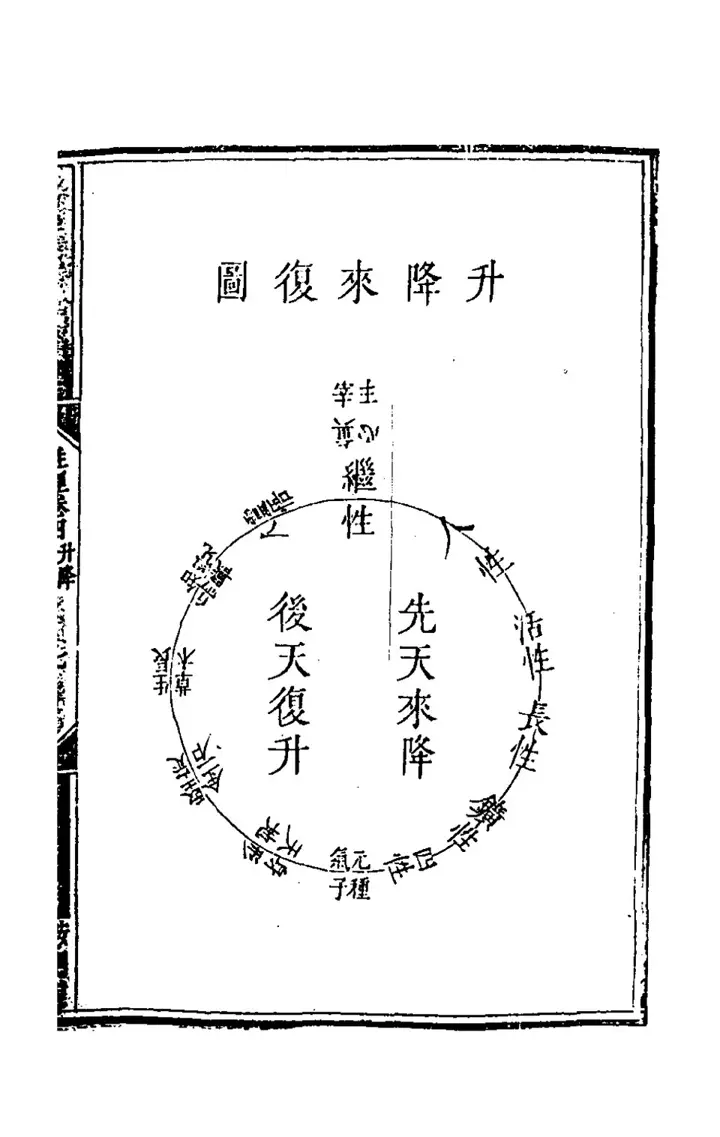
The principles of the universe, with their thousand beginnings and ten thousand threads, are inexhaustible; yet they are nothing more than the one Real Ruler's own descending and ascending, coming and returning. It descends into the seed and ascends into the fruit; it comes to the very lowest and returns to the very highest. The descending and ascending of the great world is the coming and returning of the small world; but the coming and returning of the small world is more wondrous than the descending and ascending of the great world, because when the great world goes from descent to ascent, its ascent ends in what has form, whereas when the small world goes from coming to return, its return ends in the formless, and the formless is finer than what has form. At the beginning of 'profound and unceasing', before descent and before coming, it is named the Ruler; at the end of human affairs, when ascent and return are complete, it is named the heart. The transformation of the Former Heaven: from the single principle flowing forth come the Continuing Nature, the numinous nature, the living nature, the growing nature, the mineral nature and the nature of the four elements, descending step by step until it stops at primal vital energy. This is the Real Ruler, originally on high, descending of its own accord. The descent of the great world is founded on this, and the coming of the small world is founded on this too. The transformation of the Latter Heaven: from primal vital energy dividing and becoming manifest come earth, water, fire and wind, metals and stones, plants and trees, birds and beasts, developing in order until it stops at the human being. This is the great world passing from descent into ascent, and in reality it is the Real Ruler passing from descent to ascent of its own accord; this is what is meant by descending into the seed and ascending into the fruit. The fruit of the Latter Heaven is the seed of the Former Heaven. The small world comes at the same time as the great world descends from above; and it returns after the great world has completed its ascent from below, returning into what is last, returning into what is finest. The coming of the Latter Heaven comes into a single point; from the single point there is the bodily form, from the bodily form there are firmness, growth, perception and numinous awakening, advancing step by step until it stops at the first-manifested Continuing Nature. This is the small world coming and then returning. It returns to the ground of the Real Ruler's root-suchness, and the great world stands within it like one grain of sand in a vast wilderness. It comes to the very lowest and returns to the very highest; this is what is meant by saying that the formless return is finer than the return in form. The sage Jesus said: "Unless a man is born again, he cannot obtain the meaning of heaven and earth." To be born is to ascend; 'again' means twice. Once he follows the ascent of the great world to complete his image; once he follows the ascent of the small world to exhaust his principle. This is called being born again. When both ascents are complete, the whole depth of the great creation is exhausted here. The Scripture says: "The two arcs meet, or nearer still." The two arcs: the coming and descending makes one arc, and the returning and ascending makes another. When descent and ascent are complete, the two arcs meet. 'Or nearer still' means passing beyond the bounds of names and forms and standing in the realm of Nothing-at-all, the whole substance transformed and merged, fitting exactly with the root-suchness. This is the state that only the Utmost Sage treads. Note (Hei of Qingyuan): "The source and course of the great transformation, the beginning and end of the small world, the stages of practice and realization for sages and ordinary people, the subtle point that distinguishes humans from animals, the path from heaven to man and from man back to heaven: all are fully set out in this one diagram of ascent and descent. Let students who wish to know how far their attainment has reached look at the diagram of ascent and descent and not be careless."
宇宙間千頭萬緒之理,至無盡也,然不過一真宰之自為升降來復而已矣。降於種,升於果;來於最下,復於最上。大世界之為降為升,即小世界之為來為復;而小世界之為來為復,妙於大世界之為降為升,則以大世界之由降而升也,其升盡於有形;小世界之自來而復也,其復盡於無形。無形較有形為至精也。於穆之初,未降未來,名曰主宰;人事之盡,既升既復,名之曰心。先天之化,自一理流行,而有繼性、靈性、活性、長性、鑛性、四行之性,遞降而至於元氣止焉,此真宰之本升而自為降也。大世界之降也,基之於此;小世界之來也,亦基之於此。後天之化,自元氣分著,而有土、水、火、風、金石、草木、鳥獸,漸次發明,而至於人止焉,此大世界之由降而為升也,而實真宰之由降而自為升也,所謂降於種而升於果也。後天之果,即先天之種也。小世界之來也,來於大世界自升而降之同時;而其復也,復於大世界由降而升之既畢,復於其最後者,復於其最精也。後天之來,來於一點,由一點而有身形,由身形而有堅定、生長、知覺、靈悟,遞進而至於首顯之繼性止焉,此小世界之自來而為復也。復至於真宰本然之地,而大世界之立於其中也,如大荒中之一沙。來於最下,復於最上,所謂無形之復較有形之復為至精也。爾撒聖人云:「人不再生,不能獲天地之義。」生者,升也;再者,二次之謂也。一次隨大世界之升以成其象,一次從小世界之升以盡其理,是之謂再生也。兩升既全,而大造之底蘊盡於此矣。經云:「兩弧界合,或復至近。」兩弧者,來降為一弧,復升為一弧。升降既全,則兩弧界合矣。或復至近者,超越名相之界,立無何有之鄉,全體渾化,吻合本然,此至聖獨踐之境也。
Note by a later commentator: 清源黑氏 (Hei of Qingyuan)
清源黑氏曰:「大化源流,小世始終,聖凡修證之次第,人禽辨別之幾微,由天之人、自人至天之途逕,升降一圖備盡之矣。學者欲識造詣之所至,觀升降圖,可無謾焉。」
AIScan vol. 5, p. 16–20Transcribed from the scan by AI (Claude), checked as described on the About page.
4 uncertain readings in this passage
- 鑛而有繼性、靈性、活性、長性、鑛性or 礦· variant · as printed (p. 18)
- 逕自人至天之途逕or 徑· variant · as printed (p. 20)
- 謾觀升降圖,可無謾焉· unclear · small-type glyph read as 謾 'careless' in both witnesses; Wikisource agrees (p. 20)
- 吻全體渾化,吻合本然· variant · printed in a variant (勿 with extra stroke) form; also in tf8-8 (p. 20)
AIBook 4 · 5 · The complete perfection of the human ultimate (1)
人極大全圖說 人極大全(一):妙之具與真光
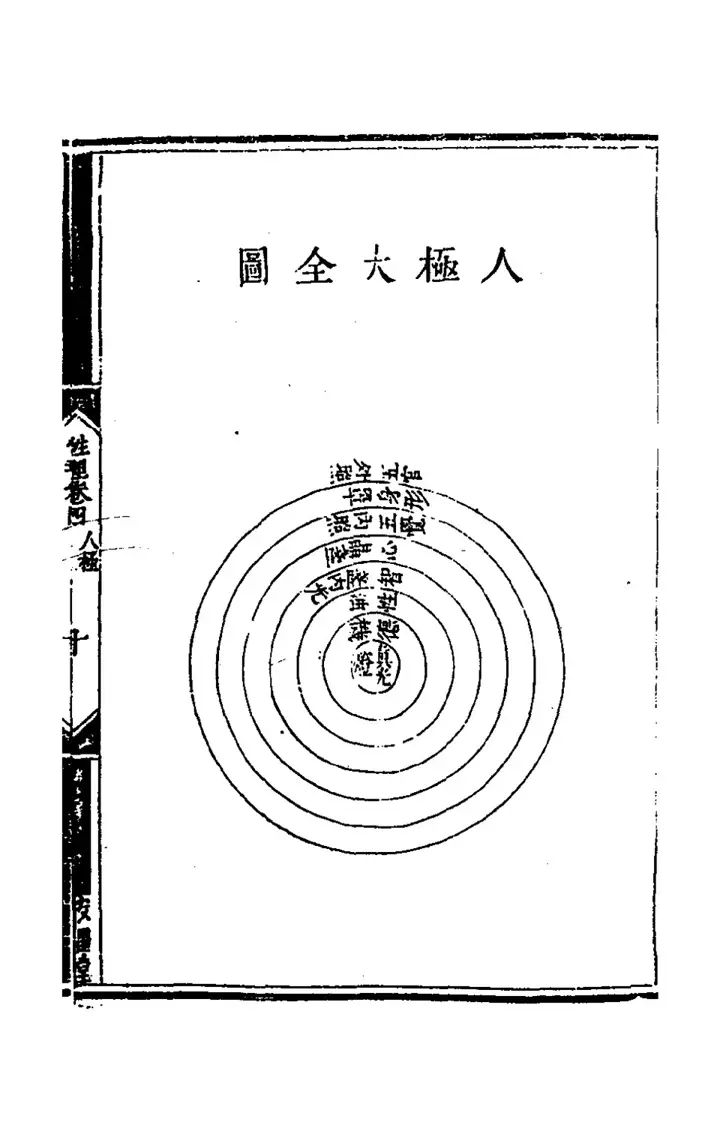
'Ultimate' means utmost: it says that the wonder by which a human being is human is utmost and cannot be added to. If beyond this wonder there were a wonder greater still, then the human could not be called wondrous, and the wonder could not be called ultimate; only because beyond this wonder there is no greater wonder is the human wonder utmost and incapable of addition. The five senses, the body, the five perceptions, the heart, intelligence, nature and virtue are the instruments of wonder. But if the true light has not arrived, one merely has the instruments of wonder and still lacks that which brings the wonder to its ultimate. The true light is what brings the wonder to its ultimate. When that arrives, the wondrous is wondrous, and the instruments of wonder all become wholly wondrous. The true light is like a lamp-flame. Without the wick, the oil, the cup and the shade, the flame has nowhere to attach itself; wick, oil, cup and shade are the instruments the lamp requires. If wick, oil, cup and shade are all present but the flame is not attached, then wick, oil, cup and shade are merely the instruments of a lamp and nothing more; to have the instruments of a lamp without the flame is to have useless utensils. Suppose one has the instruments and the flame is attached to them, and yet the flame does not realise all that makes it a lamp: it is not that the flame is not wondrous, but that the lamp's instruments have not realised all that makes them instruments, and therefore the flame too cannot realise its full wonder. There is a crystal cup, but the crystal cup is not clear and clean; there is oil, but the oil is not clarified; there is a wick, but the wick is not straight; there is a shade, but the shade is not transparent. The lamp's instruments have not realised their wonder, and therefore the flame too does not realise its wonder.
極之為言至也,謂人之所以為人之妙,至極而無以復加也。妙之外更有妙於此者,人亦不可以言妙,妙亦不可以言極也;妙之外更無有妙於此者,人之妙乃為至極而無以復加也。五官也,身體也,五覺也,心也,智也,性也,德也,妙之具也。而若真光未至,則但有其妙之具,而猶非所以極乎其妙也。真光者,極乎其妙者也。極乎其妙者至,則妙者妙,而妙之具總成其為無所不妙而已矣。真光猶燈也。燈非機、油、盞、罩,則燈無附着之地;機、油、盞、罩,燈所須之具也。機、油、盞、罩無所不備,而燈未附着,則機、油、盞、罩不過僅成其為燈之具而已。有燈之具而無燈,則其具猶廢器也。若有其具矣,燈亦附着之矣,而燈不盡乎其所以為燈之妙,非燈之不妙也,燈之具未盡乎其所以為具之妙,而以故燈亦不能盡乎其妙也。有晶盞矣,而晶盞未瑩潔也;有油矣,而油未澄清也;有機矣,而機未端正也;有罩矣,而罩未透亮也。燈之具未盡乎其妙,而以故燈亦不盡乎其妙也。
AIScan vol. 5, p. 21–24Transcribed from the scan by AI (Claude), checked as described on the About page.
Book 4 · 6 · The complete perfection of the human ultimate (2)
人極大全圖說 人極大全(二):燈具喻身心性德
Thus the inner light is not bright and the outer light does not penetrate; the light within the cup does not reach its fullness, so how could one hope that it would illuminate things far away? When wick, oil, cup and shade each realise their wonder and the flame is attached to them, how could the lamp fail to illuminate things far away? The wonder of the crystal cup lies in being clear and clean, the wonder of the oil in being clarified, the wonder of the wick in being straight, the wonder of the shade in being transparent. When none of the lamp's instruments is lacking in wonder, the wonder of its flame is a hundred times greater than before. The human being's five senses, body, five perceptions, heart, intelligence, nature and virtue are all instruments of wonder, like the wick, oil, cup and shade. If a lamp's wick, oil, cup and shade do not realise their wonder, the flame does not realise its wonder; if a person's wick, oil, cup and shade do not realise their wonder, the flame of the true light will not show itself in the instruments of wonder. The heart is like the lamp's crystal cup: its wonder lies in being perfectly clear and clean. The body is like the lamp's shade: its wonder lies in being perfectly unstained. Nature is like the lamp's oil: its wonder lies in being perfectly pure and clarified. Virtue is like the lamp's wick: its wonder lies in fully bringing forth. When body, heart, nature and virtue are wholly wondrous, how could the wonder of the true light fail to be wondrous in them? When the wonder of the true light arrives, shining within and shining without, how could a single thing be left out? When the wonder reaches this point, one may take it as the utmost of wonder, utmost and incapable of addition. This is the complete perfection of the human ultimate. Note (Hei of Qingyuan): "The lamp's light and the lamp's instruments: here lies the great division between the loyal and the treacherous, the upright and the crooked. If people merely adorn the instruments and do not know how to make the light shine brightly, how can they be called ultimate, how can they be called complete? Or if they lose their own light and take the brightness of the instruments for light, how can that be a lamp, how can it give light? Alas, how many lamp-instruments there are in the world!"
夫是以內照不朗,外照不徹,盞內之光亦不盡乎其光之盛也,而又何以望其能照物於遠也?機、油、盞、罩各盡其妙,而又附着以燈,則燈豈有不燭物於遠者乎?晶盞之妙在於瑩潔,油之妙在於澄清,機之妙在於端正,罩之妙在於透亮。燈之具無所不妙,而其燈之妙更妙於前此百倍矣。人之有五官也,身體也,五覺也,心也,智也,性也,德也,皆妙之具也,猶之乎機、油、盞、罩也。燈之機、油、盞、罩不盡其妙,則燈亦不盡乎其妙;人之機、油、盞、罩不盡其妙,則真光之燈亦不顯於其妙之具矣。心猶燈之晶盞也,妙在極其瑩潔;身猶燈之罩也,妙在極其無染;性猶燈之油也,妙在極其清澄;德猶燈之機也,妙在極其發現。身心性德無所不妙,而真光之妙豈有不妙之於此者乎?真光之妙至,而內照外照,夫豈有一物之遺焉者乎?妙至於此,而乃以為極乎其妙之至也,至極而無以復加也,此人極之大全也。
Note by a later commentator: 清源黑氏 (Hei of Qingyuan)
清源黑氏曰:「燈光燈具,乃忠佞正邪之大分也。人徒飾美其具,而不知盛耀其光,何以稱極?何以稱全?抑自失其光,而以具之清亮為光,又何以為燈?何以為照?嗟乎!世間燈具之多也。」
AIScan vol. 5, p. 24–26Transcribed from the scan by AI (Claude), checked as described on the About page.
1 uncertain reading in this passage
- 飾人徒飾美其具· variant · printed 餙 (p. 26)
AIBook 4 · 7 · The flowing-forth of the root-suchness (1)
本然流行圖說 本然流行(一):自外而內、自內而外
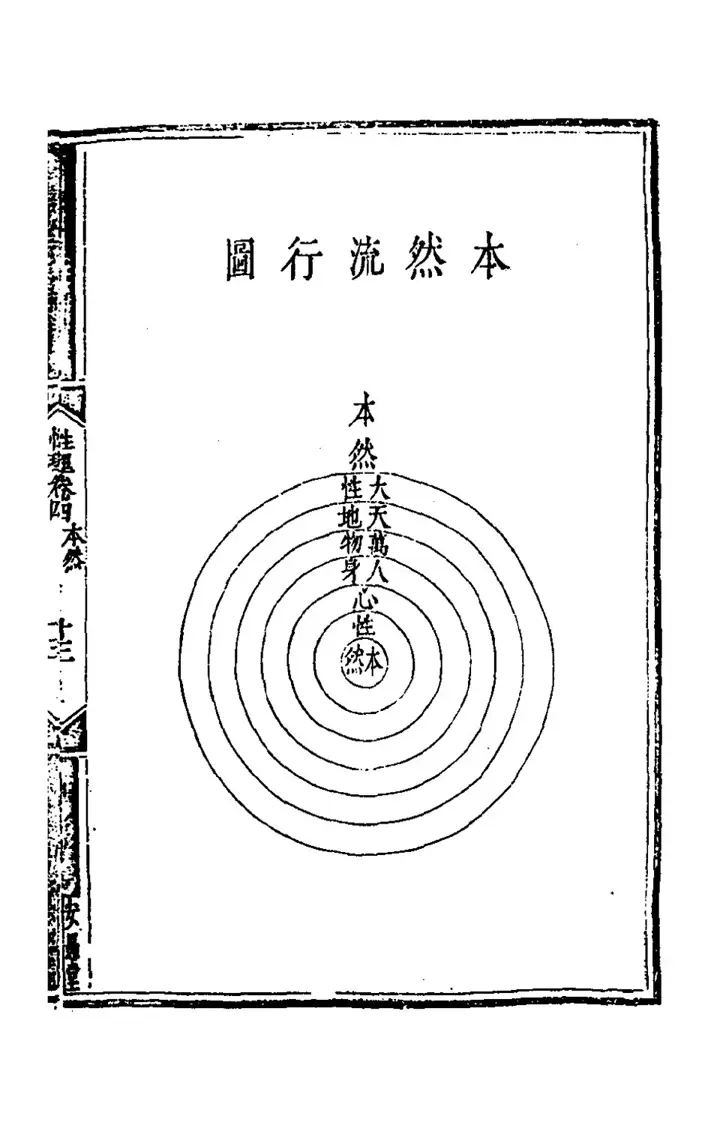
Since heaven and earth, things and the self came to be, illusory realms have been many; yet none of them is anything but the flowing-forth of the root-suchness. Sometimes it flows from the utmost outside to the utmost inside; sometimes from the utmost inside to the utmost outside. Flowing from the utmost outside to the utmost inside belongs wholly to the work of creation and transformation; this is the flowing that is so of itself. Thus from the flowing-forth of the root-suchness that has no outside there arise the great common nature, heaven and earth, the myriad things, and the human body, heart and nature; and each human being in turn possesses a root-suchness of flowing-forth. This is the flowing that is so of itself. Flowing from the utmost inside to the utmost outside also involves human effort; it does not all come from the flowing that is so of itself. From the manifestation of the innermost root-suchness, a person is enabled to fulfil the nature that he individually possesses. When nature is fulfilled, the heart of his root-suchness's flowing is made upright; when the heart is upright, the body of his root-suchness's flowing is made upright; when the body is upright, everything is upright and the myriad things are nurtured; when the myriad things are nurtured, he is able to assist the transforming and nurturing of heaven and earth, and heaven and earth are set in their places. When placing and nurturing leave nothing out, then all of heaven and earth, things and the self are gathered back into the great nature of the root-suchness's flowing; when the great nature is restored, it merges into the root-suchness that has no outside. This is what is called flowing from the utmost inside to the utmost outside, and it also involves human effort. Yet although it is called human effort, in reality it is all the root-suchness flowing of itself.
自有天地物我以來,幻境多矣,然而莫非本然之流行也。或自至外而流行於至內,或自至內而流行於至外。自至外而流行於至內者,專屬造化之事,此自然而然之流行也。夫是以自本然無外之流行,而有公共之大性焉,有天地焉,萬物焉,有人之身焉,心焉,性焉,而人復各具一流行之本然焉,此自然而然之流行也。自至內而流行於至外者,兼屬人為之事也,不皆出於自然而然之流行也。自至內本然之發現,而人因得以盡其各具之性焉。性盡,而其本然流行之心正焉;心正,而其本然流行之身正焉;身正,則一切皆正,而萬物育焉;萬物育,則為有以贊天地之化育,而天地位焉;位育無遺,則胥天地物我而總還於本然流行之大性焉;大性復,而渾入於無外之本然焉。是之謂自至內而流行於至外也,兼屬人為之事也。雖然,名為人為之事,而實皆本然之自為流行也。
AIScan vol. 5, p. 27–29Transcribed from the scan by AI (Claude), checked as described on the About page.
Book 4 · 8 · The flowing-forth of the root-suchness (2)
本然流行圖說 本然流行(二):以本然還本然
For the human being is a person of the root-suchness's flowing-forth; and when such a person in turn possesses a root-suchness of flowing-forth, then inside and outside the body there is nothing that is not root-suchness. To start from the root-suchness one individually possesses and search out the common root-suchness is still to search out root-suchness by means of root-suchness; to merge one's own root-suchness into the common root-suchness is still to merge root-suchness into root-suchness. When root-suchness returns to root-suchness, root-suchness has no division of this and that at all; there is only the addition of this sequence of flowing. In reality this sequence of flowing is not added; it is only that, seen from the human side, one perceives that there is such a sequence. If one discusses root-suchness according to its reality, root-suchness neither goes nor comes, so how could this sequence of flowing be added to it? People think there is nature, but in the root-suchness there is no such nature; people think there are heaven and earth, things and self, body and heart, but in the root-suchness there are in truth no heaven and earth, things and self, and in truth no body and heart. Why? When the one who returns to the Real returns root-suchness to root-suchness, at that moment heaven and earth are rolled up from this point on, and time and place all lose their traces; this very moment is the day of rebirth. Are heaven and earth rolled up just for this one person? It is because in the root-suchness there never were such heaven and earth; it is only seen from the human side that one thinks they exist. Do time and place lose their traces just for this one person? It is because in the root-suchness there never were such time and place; it is only seen from the human side that one thinks they exist. This state is known only to the one who returns to the Real; those who have not reached the return to the Real do not know it. Note (Hei of Qingyuan): "The true heart, the true light and the root-suchness are one thing. Viewed as returning the mandate and answering the summons, it is called the true heart: the completion of the work of practice. Viewed as manifesting in its season, it is called the true light: the completion of cultivation and realization. Viewed as flowing forth, full and abundant, penetrating outside and inside, present everywhere, it is called the root-suchness: practice has entered into complete transformation. Heaven, earth, humans and things are all the flowing-forth of the root-suchness; once the root-suchness is restored, how could there still be heaven, earth, humans and things? To be confined by things is death; to confine things is life. Therefore it is called the day of rebirth. Rebirth is the return to the Real, and the return to the Real is rebirth."
葢人者,本然流行之人也,以本然流行之人而復具一流行之本然,則身之內外無非本然也。本各具之本然而尋究公共之本然,是仍以本然而尋究本然也;以各具之本然而渾入公共之本然,是仍以本然而渾入於本然也。以本然還本然,則本然原無彼此之分,但多此一流行之次第也。實非多此一流行之次第,而自人見之,覺其有此流行之次第也。據本然之實以論本然,則本然無去無來,而何多此流行之次第乎?人見以為有性也,而本然中無有是性;人見以為有天地物我身心也,而本然中實無天地物我,實無身心。何也?歸真之人以本然而還本然,當斯之際,天地從此捲矣,時光處所咸泯其迹矣,即此便是復生之日矣。天地豈特為此一人而捲乎?葢以本然中原無有是天地也,自人見之而以為有是天地也。時光處所豈特為此一人而泯其迹乎?葢以本然中原無有是時光處所也,自人見之而以為有是時光處所也。此其境惟歸真之人知之,而未至於歸真者不知也。
Note by a later commentator: 清源黑氏 (Hei of Qingyuan)
清源黑氏曰:「真心、真光、本然,一物耳。自其返命召對,謂之真心,功程之盡也;自其及時發現,謂之真光,修證之盡也;自其流行充郁,徹表徹裏,無往而不在,謂之本然,功修入於渾化矣。天地人物皆本然之流行,既復本然,何復有天地人物?物囿則死,囿物則生,故曰復生之日也。復生即歸真也,歸真則復生矣。」
AIScan vol. 5, p. 29–32Transcribed from the scan by AI (Claude), checked as described on the About page.
4 uncertain readings in this passage
- 捲天地從此捲矣or 卷 (Wikisource)· variant · C and 1923 捲 (p. 31)
- 迹時光處所咸泯其迹矣or 跡· variant · 迹 here (跡 in tf8-2); kept as printed (p. 31)
- 郁自其流行充郁or 鬱· variant · as printed (1923 also 郁) (p. 32)
- 囿物囿則死,囿物則生or 圍 (Wikisource)· witness-differs · C and 1923 both 囿 twice; Wikisource 围 is an error (p. 32)
AIBook 4 · 9 · The sage's work of real practice
聖功實踐圖說 禮、道、真:實踐之路
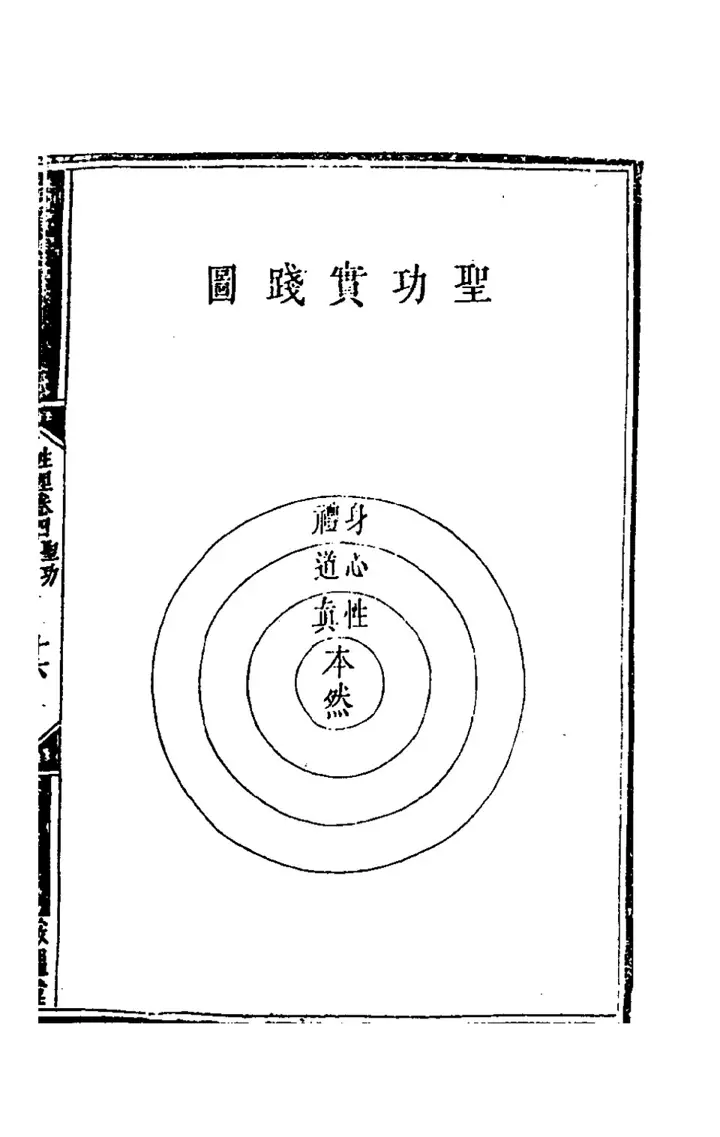
Heaven and earth above and below, humans and things outside and inside, are all what the root-suchness flows forth into; but only the sage can tread it in real practice and so reach that state. The sage is one who takes the Continuing Nature as his nature. The Continuing Nature is merged and made one with the root-suchness of the Real Ruler; only because it is merged and one can he tread it in real practice. Someone asks: "If it is already merged and one, what need is there of real practice?" I reply: "Real practice means flowing everywhere together with the Real Ruler's root-suchness and reaching every place. Only when it reaches every place does it fully realise the substance and function of merging into one; and only when it fully realises that substance and function can it be called merging into one. The merging of the Former Heaven is merging in empty stillness; the merging of the Latter Heaven is merging in real practice. Real practice and empty stillness are not two states: where real practice is, there empty stillness is. The sage, knowing that the multitude are incapable and yet deeply hoping that they may become capable, points out within their incapacity the road of real practice: first, ritual (li); second, the Way (dao); third, the Real (zhen). Ritual is the rule of deportment in responding to everyday affairs; it is practised in the body. The Way is the direction of setting things aside and returning to the Real; it is practised in the heart. The Real is the reality in which one fits exactly with the root-suchness, and which makes ritual and the Way what they are; it is practised in the nature. To practise it in the nature is to practise it in the root-suchness. These three are not things the nature originally lacks, set up by force to show people; the sage, according to the pattern that the root-suchness flows forth into people and that people inherently possess, divides it into its stages and points them out. Where the root-suchness flows into the human body, there are heaven-ordained ranks and sequences: this is called ritual; to fulfil ritual is to practise the root-suchness that flows into the body. Where the root-suchness flows into the human heart, there are innate knowledge and innate ability: this is called the Way; to fulfil the Way is to practise the root-suchness that flows into the heart. Where the root-suchness flows into human nature, there are whole substance and great function: this is called the Real; to return to the Real is to practise the root-suchness that flows into the nature. Therefore I say: where real practice is, there empty stillness is, and it is not the empty stillness of heterodox teachings." Note (Hei of Qingyuan): "Creation transforms from nothing into something, and its merging finally returns to emptiness; human affairs transform from something into nothing, and their merging must be trodden in reality. If anything is not real, the substance is not yet merged; if anything is not trodden, the function is not yet one. Merging and real practice lie only in the ordinary things of daily life; those who think them remote and far away are wrong."
天地上下、人物表裏,皆本然之所流行也,而惟聖人能實踐以趨其境。聖人以繼性為性者也。繼性者,渾同於真宰之本然,惟渾同,故能實踐之也。說者曰:「既渾同矣,又何事實踐?」曰:「實踐者,謂其與真宰本然流行周遍而無所不到也。惟無所不到,而後盡乎渾同之體用也;盡乎渾同之體用,而後可以云渾同也。先天之渾同,渾同於虛寂;後天之渾同,渾同於實踐。實踐與虛寂非兩境也,實踐之所在,即虛寂之所在也。聖人知衆人之不能,而又深望於衆人之能之也,乃於不能之中,而指示以實踐之路:一曰禮,二曰道,三曰真。禮者,日用肆應之儀則也,實踐之於其身;道者,却物還真之趨向也,實踐之於其心;真者,即本然吻合而為禮與道之實際也,實踐之於其性。實踐之於其性,即實踐之於其本然矣。此三者,非性之所本無而強為設立以示人者也,聖人因其本然流行於人而為人所固有之條理,等分其次第而指示之也。本然流行於人之身者,有天秩天敘焉,所謂禮也,盡其禮,即為實踐其流行於身者之本然矣;本然流行於人之心者,有良知良能焉,所謂道也,盡其道,即為實踐其流行於心者之本然矣;本然流行於人之性者,有全體大用焉,所謂真也,返於真,即為實踐其流行於性者之本然矣。故曰:實踐之所在,即虛寂之所在,而非異學之虛寂也。」
Note by a later commentator: 清源黑氏 (Hei of Qingyuan)
清源黑氏曰:「造化自無化有,而其渾同終歸於虛;人事自有化無,而其渾同必踐於實。一有不實,體即未渾;一有不踐,用即未同。渾同實踐,只在日用尋常之間,而人以為遠渺者,非也。」
AIScan vol. 5, p. 33–37Transcribed from the scan by AI (Claude), checked as described on the About page.
4 uncertain readings in this passage
- 衆聖人知衆人之不能or 眾· variant · as printed (p. 35)
- 却道者,却物還真之趨向也or 卻· variant · as printed (p. 35)
- 敘有天秩天敘焉or 叙· variant · as printed (p. 36)
- 渺而人以為遠渺者· variant · printed with 氵+眇 variant form (p. 37)
AIBook 4 · 10 · Sages, worthies, the wise and the ignorant (opening, incomplete)
聖賢智愚圖說 聖賢智愚之分
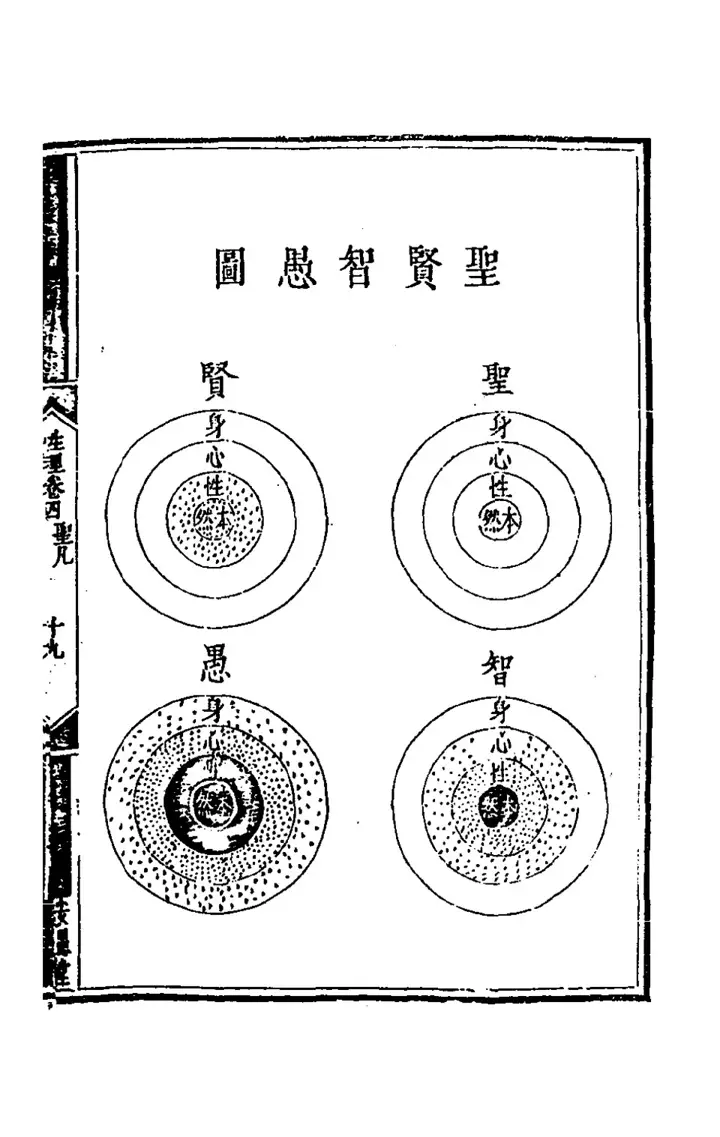
The distinction among sages, worthies, the wise and the ignorant is made by the principle and vital energy of the Former Heaven, and also by the knowing and doing of the Latter Heaven. The principle and vital energy of the Former Heaven are fixed by heaven; people have no share in them. The knowing and doing of the Latter Heaven are a matter of freedom; people can have a share in them. Therefore the distinction among sages, worthies, the wise and the ignorant is half by heaven's fixing and half by freedom. To say that the distinction of these four grades comes entirely from heaven's fixing is wrong; to say that it is not fixed by heaven and comes entirely from freedom is also wrong. When human affairs and heaven's affairs are graded together, high and low are decided. Someone asks: "Vital energy is divided into clear and turbid, so one may say that the vital energy of the Former Heaven differs; but does its principle also differ? Why do you say they are distinguished by the principle and vital energy of the Former Heaven?" I reply: "When nature and principle of the Former Heaven were first divided, they shared one root [the text breaks off here at the end of p. 39] [Continuing the reply:] "...source; but once there is division, then although their principle has no 'this' or 'that', it does have an order of rank. The order of rank is simply the boundary of what has been divided. If we speak of the time before division, there was originally no order of rank at all. But since the first manifestation has already occurred, and within that first manifestation nature and principle have been divided and analysed, how could we not speak in terms of what has rank? Principle is divided into ranks and vital energy has clear and turbid, and what is called 'fixed by Heaven' lies here. The matter of Heaven is fixed beforehand and the matter of man divides again afterwards; this is why sage, worthy, wise and ignorant finally complete their divisions and their grades do not overstep one another. The matter of man is knowing and doing. Although knowing and doing belong to the human affairs of the Latter Heaven, the reason they differ in depth and shallowness, in ease and effort, lies again in whether the vital energy endowed in the Former Heaven is clear or turbid. Within the clear there is the utmost clear: this is the vital energy endowed to the sage, and in it wind predominates. Clear, but not attaining the utmost of clarity: this is the vital energy endowed to the worthy, and in it water predominates. Clear, but standing at the next degree of clarity: this is the vital energy endowed to the wise, and in it fire predominates. Where clarity accounts for one or two parts in ten and turbidity for eight or nine, this is the vital energy endowed to the ignorant, and in it earth predominates. 'The ignorant' means ordinary people, not the class of the utterly obstinate who cannot be approached. The sage, from his most clear vital energy, knows and acts: true knowing and real doing, merged into one body with the root-suchness. The worthy and the wise each know and act from the vital energy they were endowed with. The worthy aspire to the sage and the wise to the worthy, and their knowing and doing each stop at their own capacity. The worthy can only tread the order of their nature, and have not yet merged with the root-suchness; the wise can only tread the order of their heart, and in the portion of nature something remains unfulfilled. The ignorant know and act from vital energy with little clarity and much turbidity: their knowing does not go beyond custom and their doing does not go beyond old rules; they can only tread the order of the body, and are unenlightened as to both heart and nature, and cannot even recognise from what cause the order of the body arises. This is why the ignorant finally remain ignorant." Someone objects: "If the knowing and doing of sage, worthy, wise and ignorant each follow the vital energy endowed in the Former Heaven, making them easy or laboured, deep or shallow, then human affairs are all bound by the affairs of Heaven. There is only what Heaven fixes and no freedom at all; why then say 'half fixed by Heaven, half by freedom'?" I answer: "Within what Heaven fixes there is freedom, and that freedom lies in the subtle beginnings of things; within freedom there is further freedom, and that freedom lies in the working of the striving heart. What is meant by freedom within what Heaven fixes? Within what Heaven fixes there is principle and there is vital energy. Principle is Heaven; vital energy is the self. Where vital energy is, there the self is, and having a self is the root of freedom. What is meant by freedom within freedom? Nothing is undertaken except through the working of the striving heart, and nothing is accomplished except through it. To know and act each according to one's endowed vital energy is what Heaven fixes within freedom; to know and act by carrying to the limit what one's heart strives to surpass is further freedom within freedom. What the heart strives to surpass, even the endowed vital energy cannot confine; even if the endowed vital energy does in the end confine it, the heart never wishes to be so confined. Thus the working of the striving heart has no limit. The striving heart belongs neither to the principle of the Former Heaven nor to its vital energy; how can one not say it belongs to the freedom of the Latter Heaven? Carried to the extreme, the most obstinate and ignorant take pleasure in defying principle and think approaching principle wrong, and push what they know and do even beyond the bounds of humankind; this too is the working of the striving heart, so that its being freedom is all the more beyond doubt. Hence it is said: the division into sage, worthy, wise and ignorant is half fixed by Heaven and half by freedom." Note (Hei of Qingyuan): "That sage, worthy, wise and ignorant are divided by principle, vital energy, knowing and doing is an unalterable teaching. Yet vital energy does not overcome principle, and principle is not confined by vital energy: is a human being a plant, to limit himself within his knowing and ability? The striving heart rests on the temperamental nature, and it is what makes the 'fatness' (the thickening, i.e. the settled grade) of sage, worthy, wise and ignorant. Striving toward the sage, one becomes a sage; sinking toward the ignorant, one becomes ignorant. But the ignorant do not recognise their own ignorance; the four diagrams are set out separately so that each may recognise himself, and so know to exert himself."
聖賢智愚之分也,分以先天理氣,亦分以後天知行。先天之理氣,天定者也,人之所不得而與;後天之知行,自由者也,人之所可得而與也。是故聖賢智愚之分也,半以天定,半以自由。謂是四品之分皆出於天定者,非也;謂非天定而皆出於自由者,亦非也。人事與天事合而品之,高下判焉矣。說者曰:「氣分清濁,謂先天之氣有不同可也,乃其理亦有不同者乎?而何謂分之以先天之理氣也?」曰:「先天性理始分之際,同一本原,而但其既有分也,則其理雖無彼此,而却有次第。次第,即其所分之界限也。若自其未分以前論之,則原未嘗有次第也。既已首顯矣,又於首顯之中分析其性理矣,則安得不即其有次第者論之?理分次第,氣有清濁,而其所為天定者,在此矣。天事定之於前,而人事又分之於後,此聖賢智愚所以終成其分,而其品不相越也。人事者,知與行也。知行雖屬於後天之人事,而其所以有深淺安勉之不同者,則又皆由於先天禀賦之氣有清與濁也。清之中有至清焉,此聖人所禀賦之氣也,其氣以風勝。清矣,而不得其清之至焉,此賢人所禀賦之氣也,其氣以水勝。清矣,而又居乎其清之次焉,此智者所禀賦之氣也,其氣以火勝。清之數居其十之一二,濁之數居其十之八九,此愚者禀賦之氣也,其氣以土勝。愚者,衆人之謂也,非至頑而不可近之一類也。聖人本其最清之氣而為知為行焉,真知實行,與本然渾同於一體者也。賢與智各本其所賦之氣而為知為行焉。賢希聖,智希賢,其知行皆各如其本量而止。賢則但能踐其性之條理,而未得渾同於本然;智則但能踐其心之條理,而於性分有所未盡。愚者本其清少濁多之氣而為知為行焉,其知不過風俗,其行不過舊規,但能踐其身之條理,而於心性二者皆未明也,且並未能識其身之所以為條理者出於何因也,此愚之所以終成其為愚也。」
說者曰:「聖賢智愚之知行,皆各因乎先天禀賦之氣而以為安勉,而以為淺深,是人事皆天事之所縛也。但有天定,絕無自由,而何謂半以天定、半以自由耶?」曰:「天定之中有自由焉,其自由在幾微之間;自由之中有自由焉,其自由在勝心之用。何謂天定之中有自由?葢天定之中有理有氣,理即天也,氣即己也,氣之所在即己之所在,有己即自由之根也。何謂自由之中有自由?凡事莫不起於勝心之用也,亦莫不成於勝心之用。各因乎其所禀賦之氣而以為知行,是自由之中有天定也;各極其心之所勝而以為知行,是自由之中又有自由也。心之所勝,即禀賦之氣亦不得而限域之;即禀賦之氣終得而限域之,而心終不欲為其限域也,是則勝心之為用無止境也。勝心不屬於先天之理,不屬於先天之氣,而得不謂其屬於後天之自由乎?極之至頑至愚之人,以背理為可樂,以近理為不然,而極其所知所行,且出於人類之外,亦此勝心之為用,則其為自由也愈無疑矣。故曰:聖賢智愚之分,半以天定,半以自由也。」
Note by a later commentator: 清源黑氏 (Hei of Qingyuan)
清源黑氏曰:「聖賢智愚,分以理氣知行,不易之論也。然而氣不勝理,理不囿於氣,人豈草木而自限於知能耶?勝心本乎氣性,乃所以成聖賢智愚之肥也。勝於聖則成聖,勝於愚則成愚。然而愚不自識其為愚也,四圖分著,令自認取,可以知勉矣。」
AIScan vol. 5, p. 38–45Transcribed from the scan by AI (Claude), checked as described on the About page.
9 uncertain readings in this passage
- 性「先天性理始分之際· damaged · 天 and 性 worn/broken in C; read with 1923 p192 and Wikisource (p. 39)
- 天「先天性理始分之際· damaged · worn in C; confirmed by 1923 (p. 39)
- 為其所為天定者or 謂 (W)· witness-differs · C and 1923 both 所為; W 所谓. Kept as printed (p. 40)
- 己氣即己也or 巳/已· variant · printed with the closed 巳 form, as often in this block (also 即己之所在、有己); read 己 'self' from sense; 1923 has 己 (p. 43)
- 得而得不謂其屬於後天or 不得 (W)· witness-differs · C and 1923 read 而得不謂…乎 (rhetorical); W 而不得不谓 (p. 44)
- 肥成聖賢智愚之肥也· unclear · clearly printed 肥 in C, 1923 and W, but the sense ('fatness') is strained; possible early corruption (e.g. for 分/機); kept (p. 45)
- 衆衆人之謂也or 众· variant · print form 衆 kept (p. 41)
- 禀先天禀賦之氣or 稟· variant · 禀 throughout this range, kept as printed (p. 40)
- 却而却有次第or 卻· variant · kept as printed (p. 40)
AIBook 4 · 11 · The layers of veiling and obstruction
障礙層次圖說 愚障於身,智障於心,賢障於性
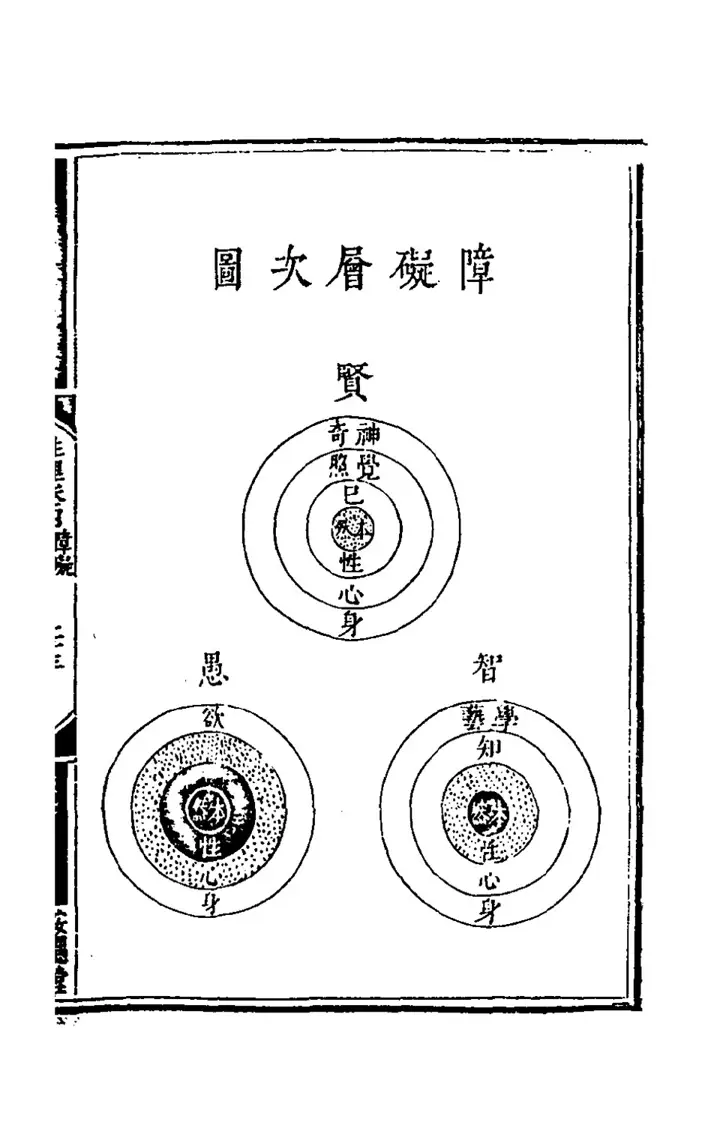
What makes Heaven Heaven is the human being; what makes the human being human is Heaven. Without cause there arise veils and obstructions, and the self and the Real Ruler are then separated and no longer communicate. So the human being is daily within Heaven yet does not know how close Heaven is; Heaven is daily within the human being yet finds no way to be united with him. Everywhere is the root-suchness, everywhere is obstruction. It is not that everywhere is obstruction; everywhere one makes one's own obstruction. So the Real Ruler is never for a day not in communication with me, yet I am never for a day able to communicate with the Real Ruler. Not only the ignorant are veiled; even the wise do not escape it. Not only the wise are veiled; even the worthy do not escape it. But what veils the worthy differs from what veils the wise, and what veils the wise differs from what veils the ignorant. Though the veils differ, the separation from the Real Ruler and the failure to communicate are the same. The veil of the ignorant lies in the body, the veil of the wise in the heart, the veil of the worthy in the nature. To be veiled in the body is to be veiled by what the body seeks. What the body seeks is sound, colour, smell and taste, and so sound, colour, smell and taste all become veils; how would one know that sound, colour, smell and taste are all the root-suchness? To be veiled in the heart is to be veiled by what the heart relies on. What the heart relies on is learning, hearing, study and art, and so these all become veils; how would one know that learning, hearing, study and art are all the root-suchness? To be veiled in the nature is to be veiled because the nature has not yet reached transformation. The nature is the Lord's root-suchness, yet carrying the name and portion of a self. While the nature has not yet merged, the name and portion of the self still remain. It is not that there are no wondrous marvels, but the marvels are in me and not in the Lord; it is not that there is no illuminating awareness, but the awareness is in me and not in the Lord; and so the marvels and the illuminating awareness all become veils. How would one know that, when effort has reached this point, one still takes the marvels and illuminating awareness of the root-suchness as obstructions to the root-suchness? This is what is meant by 'everywhere is the root-suchness, everywhere becomes obstruction'. For the sage, everywhere is obstruction and everywhere is the root-suchness. The nature is what the root-suchness itself manifests; if the nature of the root-suchness is returned to the root-suchness, what obstruction is there? The heart is what the root-suchness forms by its flowing; if the heart that the root-suchness has flowed into is returned to the root-suchness, what obstruction is there? The body is what the root-suchness forms by flowing according to its original upright pattern; if the body of the root-suchness exactly fulfils the intent of the root-suchness's flowing, what obstruction is there? So one dwells daily amid sound, colour, smell and taste, and only then can the ears, eyes, mouth and nose of the root-suchness fully exercise the use of ears, eyes, mouth and nose: this is no obstruction. One daily pursues learning, hearing, study and art, and only then can the intelligence and wisdom of the root-suchness fully accomplish the work of intelligence and wisdom: this is no obstruction. There is no day on which one does not display the power of marvels and illuminating awareness, and only then can the whole substance and great function of the root-suchness fully realise the wonder of the whole substance and great function: this is no obstruction. The sage gathers up the obstructions of the worthy, the wise and the ignorant and returns them to the root-suchness; and further transforms those obstructions so that not even a trace of the return to the root-suchness remains. Note (Hei of Qingyuan): "Between heaven and earth there is nowhere that is not where the Real Lord is: where then do obstructions dwell? There is nothing that is not what the Real Lord manifests: what then can obstructions be called? There are originally no obstructions; they arise from human consciousness. A veil is like paper screening the sun; an obstruction is like a wall cutting off a lamp. Remove the wall and the paper, and the sun and the lamp still shine on me. Yet through paper something can still be seen, while behind a wall the whole is dark. Alas, how can one find a person without obstruction, with whom to speak of the subtle meaning of non-obstruction?"
天之所以為天,即人也;人之所以為人,即天也。無端而有障礙焉,我與真宰遂相隔而不相通,則人日在天之中,而不知其天之切近也;天日在人之中,而無從得其相合。處處皆本然,處處皆障礙。非處處皆障礙,處處皆自為障礙也。夫是以真宰無日不與我相通,而我無日得與真宰相通矣。不惟愚者有所障也,即智者亦不免焉;不惟智者有所障也,即賢者亦不免焉。但賢者之所障,不同於智者之所障;智者之所障,不同於愚者之所障。所障雖有不同,而其與真宰相隔而不相通則同。愚者之所障在於身,智者之所障在於心,賢者之所障在於性。障在於身者,障於其身之有所求也。身之所求者在聲色臭味,則聲色臭味皆障矣,夫安知聲色臭味之皆本然乎?障在於心者,障於其心之有所恃也。心之所恃者在聞見學藝,則聞見學藝皆障矣,夫安知聞見學藝之皆本然乎?障在於性者,障於其性之未至於化也。性者,主之本然,而有我之名分也。性未渾入,則我之名分尚存,未嘗無神奇也,而其神奇在我而不在主;未嘗無覺照也,而其覺照在我而不在主,則神奇覺照皆障矣。夫安知功力至此,猶然以本然之神奇覺照,而為本然之障礙乎?所謂處處皆本然,處處皆成障礙者,此也。聖人則處處皆障礙,處處皆本然矣。性者,本然之所自顯也,以本然之性而還之本然,何障焉?心者,本然之所流行而成焉者也,以本然所流行之心而還之本然,何障焉?身者,本然按原有之端莊而流行以成焉者也,以本然之身而適盡乎本然所流行之意,何障焉?夫是以日在聲色臭味之中,而本然之耳目口鼻始得以盡其耳目口鼻之用也,非障也;夫是以日講夫聞見學藝之事,而本然之聰明睿知始得以盡其聰明睿知之功也,非障也;夫是以無日不顯有神奇覺照之能,而本然之全體大用始得以盡其全體大用之妙也,非障也。聖人者,統賢智愚三者之障礙而還之於本然者也,又化賢智愚三者之障礙而並不存一還於本然之跡者也。
Note by a later commentator: 清源黑氏 (Hei of Qingyuan)
清源黑氏曰:「天地間無處非真主之所在,障礙何居?無物非真主之所顯,障礙何名?本無障礙,乃自人之意識而起障礙也。障如紙遮日,礙如壁隔燈。去其壁紙,日燈仍照我也。然紙猶有可見,壁則全體俱昧矣。噫!安得無障礙其人也,與言無障礙之精義乎?」
AIScan vol. 5, p. 46–51Transcribed from the scan by AI (Claude), checked as described on the About page.
3 uncertain readings in this passage
- 此處處皆成障礙者,此也· witness-differs · C and 1923 者此也; W omits 此 (p. 49)
- 並而並不存一還or 竝· variant · print form 竝-like; given as 並 (p. 51)
- 跡本然之跡者也or 迹 (W)· variant · kept 跡 as printed (p. 51)
AIBook 4 · 12 · Doubt and belief as burdens on virtue
疑信累德圖說 身疑、心疑、性疑
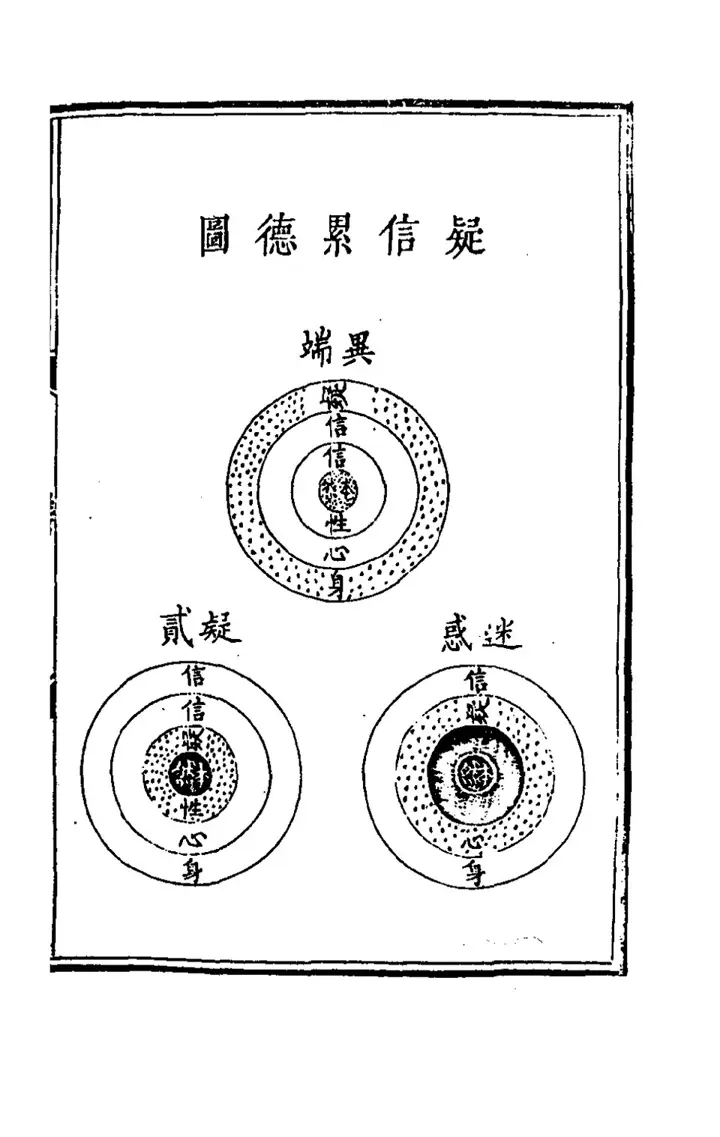
Erlifu (爾里父) said: "Though the eyes are full of things, no doubt arises; though heaven and earth are all rolled up, no belief arises." Does this saying not mean that when the Real is united with the Real, without sound and without smell, there is no use for doubt or belief? Not only is there no use for doubt; doubt has nowhere to come from. Not only is there no use for belief; belief has nowhere to arise from. The beginnings of doubt and belief are silent, neither arising nor ceasing; what flaw could there be in such virtue? Below this, however, one cannot be without doubt and belief. Doubt is departure: to depart from what is right is to approach what is wrong. Belief is settling: to settle in the pure is to be far from the mixed. What doubt and belief bear upon Heaven and man, nature and mandate, is no small matter. The ignorant do not know how to use doubt, nor how to use belief; their doubt and belief are not worth discussing. Those who doubt much and believe much, applying their hearts at the edge of the precipice, are for the most part of the class of the worthy and the wise. Their doubt and belief do not go beyond the three domains of body, heart and nature. Belief is a fine virtue. If what one believes is right, then whether one believes in the body, in the heart or in the nature, it is all good and needs no discussion. Doubt is dangerous. To take doubt as doubt is a shallow affliction; to take doubt as belief is a deeper affliction. The worthy and the wise mostly take doubt for belief. When doubt is taken as doubt, it can still be turned back and returned to belief; when doubt is taken for belief, it grows deeper the longer it lasts and there is never a day of turning back. Yet doubt too differs in depth. Doubt that stops at the body is shallow; doubt that enters the heart is deep; doubt that arises in the nature is an affliction beyond cure. What is bodily doubt? In the ready responses of daily life, turning against the order proper to the body and setting up some novelty never seen in the canon: this is bodily doubt. Bodily doubt is also a burden on virtue, but it can still wait to be turned back. What is doubt of the heart? In the dark and silent search for the Real, turning against the order proper to the heart and delighting in branching and side paths, like a traveller who points his carriage south and drives his wheels north: this is doubt of the heart. Doubt of the heart is a deep burden; yet if there comes a day of sudden awakening, the doubt can still be turned back. Turning back the doubt and returning it to belief, the heart can still be put to use; the affliction does not reach the incurable, and there is still room to step back while waiting for the return. What is doubt of the nature? The day when body and heart have both arrived is precisely the time when the order of the original nature appears: spiritual penetration reaches everywhere and illuminating awareness is complete everywhere. This is exactly the moment when one returning to the Real lets go of his hold at the cliff's edge; no place is more perilous. And at this point a doubt arises: 'Is this my power, or the Lord's power? Does my power stand over against the Lord? Or am I the Lord?' Standing at the most perilous point from which there is no turning, to harbour this wavering, unsettled guess: how could the Real Ruler allow so great a rebel to come before Him? If one then tries to turn back, there is no further room for retreat, and there is no more time to wait. This is why doubt arising in the nature cannot be cured. The deeper the effort, the more dangerous the terrain; the nearer to the Lord, the more the doubt cannot be turned back. All this is the fault of the worthy and the wise who misuse their intelligence. Erlifu's saying may truly be called a mirror for returning to the right and returning to the Real. Note (Hei of Qingyuan): "Doubt is not believing; to believe is not to doubt. The lowest ignorant know nothing of it; the worthy and the wise understand it themselves. In the root-suchness there is no doubt or belief at all; how could virtue be burdened? But if one wishes to believe yet does not believe, and doubt gives birth to more doubt, doubt and belief become locked together: then the worthy doubt and the wise doubt too; doubt burdens virtue, and belief too burdens virtue. How deep is his warning to students!"
爾里父曰:「滿眼是物,亦不起疑;天地皆捲,亦不起信。」斯言也,殆謂真與真合,無聲無臭,而無所庸其疑信也乎?不惟無所庸其疑也,疑亦無從而有;不惟無所庸其信也,信亦無自而生。疑信之端,寂無起滅,而其德何間然?下此,則不能無疑信矣。葢疑者,離也,離於是者近於非;信者,定也,定於純者遠於雜。疑信之所關於天人性命者,不淺也。愚人不知用疑,亦不知用信,其疑信不足論。其多疑多信,而用其心於顛危之介者,大抵皆賢智之流亞也。而其疑信,不出身、心、性三者之境。夫信,美德也。若其所信者是,則無論其信於身、信於心、信於性,皆美而無庸以置論也。疑則危矣。以疑為疑者,其為患猶淺;以疑為信者,其患更深。賢智之類,大都皆以疑為信者也。以疑為疑者,其疑猶可反之而歸於信;以疑為信者,其疑愈久愈深,而終無自反之一日也。然而其疑亦有淺深之別:疑止於身者,其疑淺;疑入於心者,其疑深;疑起於性者,其疑之為患也,不可救矣。何謂身疑?日用肆應之際,背其身之條理,而更立一新奇不經見者焉,是之謂身疑。身疑亦德之累也,然而猶可以有待而反也。何謂心疑?冥漠尋真之際,背其心之條理,而喜趨於岐途旁逕,如行路者南轅而北其轍焉,是之謂心疑。心疑則其為累深矣,然而苟有猛省之一日,則其疑猶可得而反也。反其疑而歸之於信,則其心猶可得而用也,其患不至於無救也,亦後有餘步焉以待其反也。何謂性疑?身心兼到之日,正本性條理發現之時也,神通無所不至,覺照無所不週,此正歸真者懸崖撒手時也,危莫危於此地矣。而乃於此起一疑焉,曰:「我之能耶?主之能耶?其我之能與主對耶?抑我即主耶?」臨至危無轉之地,而有此猶豫莫定之猜,真宰豈容此巨逆者臨於其前耶?將自反,而後復無餘步以為退身之地矣,且其為時亦無待矣。此疑起於性者之無可救也。功愈深則其境愈險,愈近主則其疑愈無可廻,此皆賢智而悞用其聰明者之過也。爾里父之言,真可謂返正歸真之鑑矣。
Note by a later commentator: 清源黑氏 (Hei of Qingyuan)
清源黑氏曰:「疑,不信也;信則不疑。下愚罔知,賢智自明。究其本然,絕無疑信,何有累德?如欲信不信,疑更生疑,疑信錮結,則賢疑,智亦疑;疑累德,信亦累德。其警戒學人者,深矣。」
AIScan vol. 5, p. 52–57Transcribed from the scan by AI (Claude), checked as described on the About page.
5 uncertain readings in this passage
- 捲天地皆捲or 卷 (W)· witness-differs · C and 1923 捲 (p. 53)
- 間而其德何間然?or 閒· unclear · clear in print; punctuation is editorial: read 何間然 'what flaw', then 下此 opens the next sentence (W punctuates 其德河间?然下此) (p. 53)
- 岐喜趨於岐途旁逕or 歧 (1923)· variant · C prints 岐, 1923 歧; same word (p. 55)
- 週覺照無所不週or 周· variant · kept as printed (p. 56)
- 悞賢智而悞用or 誤· variant · kept as printed (p. 56)
AIBook 4 · 13 · The branching of compliance and defiance
順逆分支圖說 顯順逆,所以顯真宰
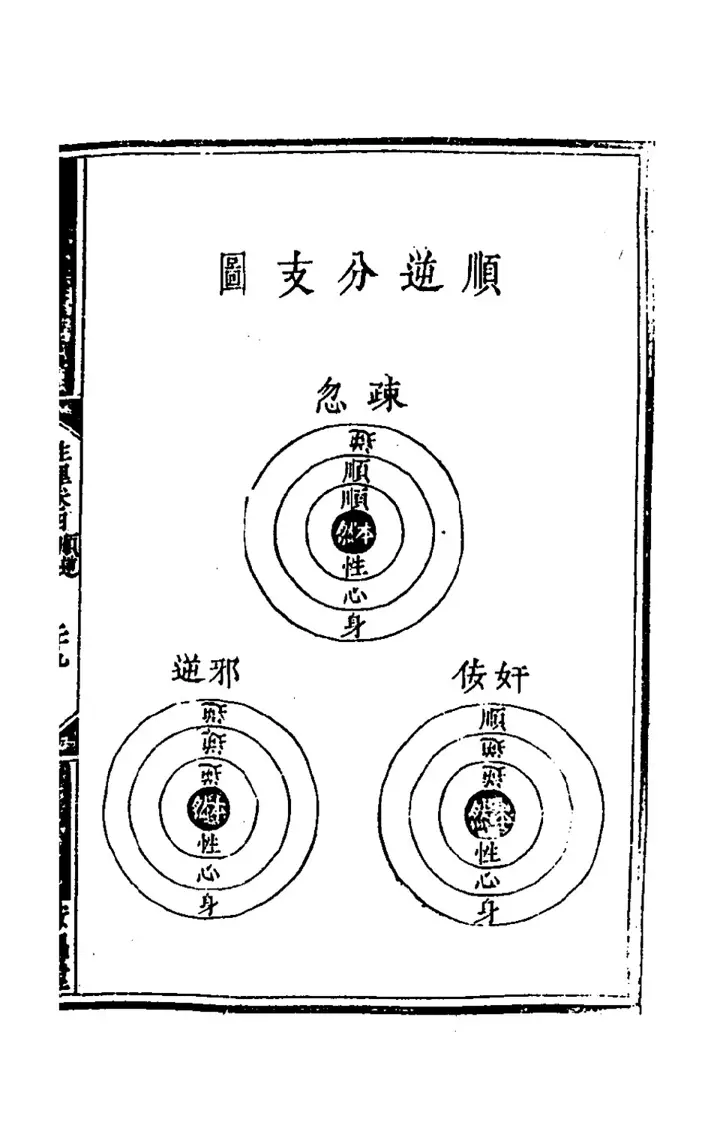
To rely on heavenly principle and not follow the selfishness of human desire is called compliance (shun); to be wholly given to human desire and not accord with the rightness of heavenly principle is called defiance (ni). Compliance and defiance are the one great gateway from which all good and evil, public and private, crooked and upright, loyal and sycophantic branch off and divide into streams. Because there is compliance and defiance, human affairs are uneven; without compliance and defiance, creation would not be wondrous. Within compliance and defiance lodge the levers of creation. The human body and heart are formed by the gathering of the four agents. The natures of the four agents oppose and offend one another, so that defiance predominates and compliance is the lesser share. In the gathering of the four agents, the hinge of compliance and defiance is already laid down early; and when it issues in deeds, becoming compliance or defiance, the marvel of creation is plain to see. Without compliance, defiance would not stand out; without defiance, compliance would not be evident. Only when compliance and defiance stand side by side can one distinguish which is compliance and which defiance. When compliance and defiance are manifest, the boundary between heavenly principle and human desire becomes clear and nothing obscures it; when that boundary is manifest, the mysterious wonder of the Real Ruler's root-suchness shines out all the more and is displayed before everyone's eyes and ears. To manifest compliance and defiance is to manifest the Real Ruler: such is the wonder of the levers of creation. Only the sage is without compliance and without defiance. It is not that he has none; his compliance is compliance and his defiance too is compliance, for the sage is not one whom the four agents can bind. Below him, who can do this? So there are those born compliant and those born defiant; there are those who seem not compliant but truly are, and those who seem not defiant but truly are. To be defiant first and compliant afterwards is a gain compared with being compliant first and defiant afterwards; to seem not compliant but truly be so, compared with seeming not defiant but truly being so, differs by more than heaven from earth. Even within compliance there are hundreds and thousands of different gateways, so within compliance there must be discussion of this and that; even within defiance there are hundreds and thousands of different streams, so within defiance there are still differences of fine and coarse. All is confused and mixed, and each claims to be right. How would one know that the compliant are few and the defiant many? How would one know that the truly compliant may wish to borrow the name of defiance to hide their compliance, not wishing to show the name of the compliant? How would one know that the truly defiant cleverly borrow the name of compliance to hide their defiance, not wishing openly to bear the title of the defiant? Compliant for a morning, defiant for a thousand ages: this is one who cleverly borrows the name of compliance to hide his defiance, yet in the end his defiance cannot be hidden. Why? Because the Real Ruler cannot be deceived. Defiant for a morning, compliant for a thousand ages: this is one who borrows the name of defiance to hide his compliance, yet in the end his compliance cannot be extinguished. Why? Because the Real Ruler will certainly not be blind and betray such a person. So not only is the mysterious wonder of the Real Ruler's root-suchness manifest through human compliance and defiance; the illuminating awareness of the Real Ruler's root-suchness also becomes all the more evident through them. Hence it is said: to manifest compliance and defiance is to manifest the Real Ruler. But rather than manifest the Real Ruler by defiance, how much better to manifest Him by compliance! It rests with each person to weigh his course and choose for himself the road of honour. Note (Hei of Qingyuan): "Without yin and yang there is no way to complete the work of creation; without compliance and defiance there is no way to display the wonder of illuminating awareness. Why then punish defiance? Knowing that compliance cannot be concealed and defiance cannot be hidden, one knows that there is nowhere the Real Lord is not; and yet to remain stuck in defiance is a deluded heart. Punishment is the punishing of the deluded heart; punishment is illuminating awareness itself."
依乎天理,而不隨夫人欲之私,曰順;純乎人欲,而不合乎天理之正,曰逆。順逆兩端,固一切善惡、公私、邪正、忠佞所以分支別派之一大總門也。有順逆則人事不齊,無順逆則造化不妙,順逆之中,造化機權之所寓也。葢人之身心,四行相聚而成。四行之性,相反相犯,逆之數居多,順之數居少。四行相聚之中,順逆之機緘已蚤伏於此;及其發諸事為,而為順焉、逆焉,造化之奇顯然矣。葢無順則逆不彰,無逆則順不著,順逆並列,而乃可分其若者之為順、若者之為逆也。順逆顯,則天理人欲之界愈較然而無所蔽矣;天理人欲之界顯,則真宰本然之元妙愈粲然而衆著於耳目之間矣。顯順逆,所以顯真宰也,此造化機權之妙也。惟聖人無順無逆。非無順逆也,順固順,逆亦順也。葢聖人非四行所得而縛焉者也。下此則何能焉?是故有生而順者,有生而逆者,有似不順而實順,有似不逆而實逆者。先逆而後順,較之先順而後逆者,為有得也;似不順而實順,較之似不逆而實逆者,相去不啻天壤也。同一順也,而順有百千之各異其門,是以順之中不能無彼此之論也;等一逆也,而逆有百千之各異其派,是以逆之中仍復有精粗之不一也。紛紛錯雜,各自謂是。夫安知順者之少,而逆者之多乎?夫安知真順者且欲借逆之名以藏其順,而不欲露其順者之名乎?夫安知真逆者巧借順之名以藏其逆,而不欲顯居其逆者之號乎?順在一朝,逆在千古者,此巧借順之名以藏其逆者也,而其逆卒不可藏,何也?真宰不可得而欺也。逆在一朝,順在千古者,此假借逆之名以藏其順者也,而其順卒不可滅,何也?真宰必不昧昧焉辜負其人也。若是,則不惟真宰本然之元妙因人之順逆而顯,即真宰本然之覺照,亦莫不因人之順逆而益彰矣。故曰:顯順逆,所以顯真宰也。然而與其逆也顯真宰,何如其順也顯真宰?是在人之審處焉,而自取一尊爵之路矣。
Note by a later commentator: 清源黑氏 (Hei of Qingyuan)
清源黑氏曰:「非陰陽,無以成造化之功;非順逆,無以顯覺照之妙。然而懲治其逆,何也?知夫順之不可揜,逆之不可匿,如此則知無往而非真主之所在矣,而復錮滯於逆,是其心迷也。懲治,懲治心迷也。懲治,即覺照也。」
AIScan vol. 5, p. 58–63Transcribed from the scan by AI (Claude), checked as described on the About page.
3 uncertain readings in this passage
- 已機緘已蚤伏or 巳· variant · printed with closed 巳 form; 蚤 = 早, kept (p. 59)
- 元真宰本然之元妙or 玄· variant · 元 for 玄 (Kangxi taboo avoidance), kept as printed (also 之元妙因人) (p. 60)
- 揜知夫順之不可揜or 掩 (W)· variant · kept as printed (p. 63)
AIBook 4 · 14 · The stages of cultivation and advance
修進功程圖說 正身、清心、盡性
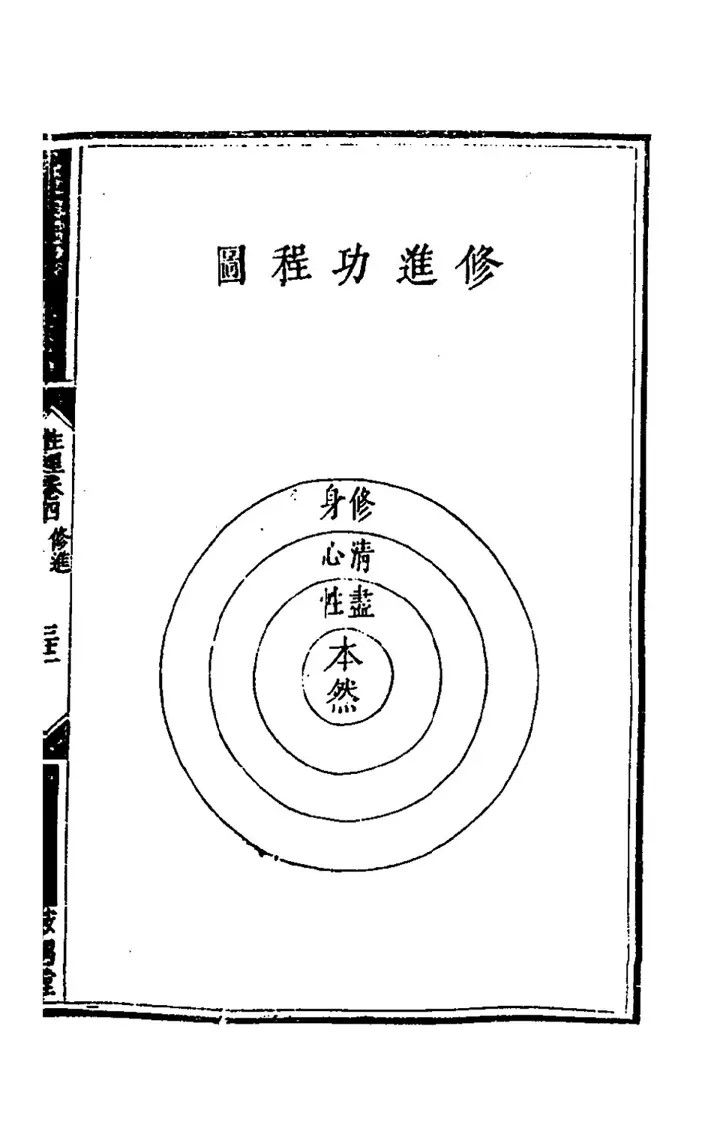
At birth, without appetites a person cannot grasp the wonder of sound, colour, smell and taste; without disciplined practice he cannot gradually return to the reality of the root-suchness. Is the wonder of sound, colour, smell and taste not itself the reality of the root-suchness? Yet while practice has not arrived, every sound, colour, smell and taste is enough to burden body, heart, nature and mandate; once practice has arrived, everywhere is sound, colour, smell and taste and everywhere is the root-suchness. Never leaving ears, eyes, mouth and nose, one is everywhere beyond seeing and hearing; everywhere seeing, hearing, tasting and smelling, one is everywhere the movement and stillness of the root-suchness. How great is the bearing of practice on body, heart, nature and mandate! What are its stages? First, rectifying the body; second, clarifying the heart; third, fulfilling the nature. When the body is rectified, it becomes a mirror facing the root-suchness squarely; when the heart is clarified, it becomes a light reflecting back the World of Principle; when the nature is fulfilled, it becomes the principle of the unity of Heaven and man. How is the body rectified? There are the five duties of the sacred teaching: remembrance (nian), to know where one returns; prayer (li), to walk the road of that return; giving (she), to be rid of attachment; fasting (zhai), to cut off things; assembly (ju, the pilgrimage), to return to the Real. Within these practices lies a pointing: the outward setting points to an inner meaning. Among the five duties, the pointing in prayer is the most profound: in rising, standing, kneeling and sitting one quietly sees the root-suchness nature of things and self. Seeking the pointing in each duty, and tightening one's practice through the pointing, the body can be rectified. How is the heart clarified? It is clarified by not being disturbed by outward things, and still more by inner virtue being unobscured. The heart has seven layers in which seven virtues are lodged, and it also has five faculties, each wondrous in its use. What are the heart's five faculties? The heart has a wondrous eye that can see formless colour; a wondrous ear that can hear soundless speech; a wondrous nose that can smell the fragrance of the wondrous world; a wondrous mouth that can taste the savour of the Lord's delight; a wondrous discernment that can understand the principle of fine and coarse. When the use of these five faculties is fulfilled and nothing is lacking in the seven virtues, the heart can be clarified. How is the nature fulfilled? It is fulfilled in the heart's capacity to know, and still more in the form's capacity to enact. When the heart takes reflecting back as knowing, no principle is left out; when the form takes responsive compliance as enacting, the form returns to the formless. Knowing the whole substance and also the great function, my nature is illumined and the myriad natures are not outside it; enacting what ought to be and also why it is so, one unfolds it to the full, and nothing separates one from the profound [Heaven]. Form and colour are nature. Those who do not know take form and colour as mere form and colour; those who know see form and colour as all heavenly nature. Until form and colour are enacted, one cannot speak of nature; once they are enacted, one need not speak of nature either. Form is not other than nature, nature is not other than form, and then the nature can be fulfilled. From rectifying the body to clarifying the heart, from clarifying the heart to fulfilling the nature: this is the cultivation of ordinary people, from outer to inner, cultivated by degrees. When the nature is fulfilled the heart becomes clear of itself, and when the heart is clear the body becomes upright of itself: this is the cultivation of the sage, from inner to outer, cultivated without waiting on anything. But the sage's cultivation is not something I dare hope for. Note (Hei of Qingyuan): "Sound, colour, taste and smell are forms made wondrous by the root-suchness. If one takes them by principle, the forms are the root-suchness; if one takes them by desire, even the root-suchness becomes mere form. So one daily chases sound, colour, taste and smell and is utterly unaware of what is the root-suchness in them, because appetite has obscured it. Disciplined practice is the great method of opening what is obscured and clearing what is blocked, so as to return to the root-suchness."
人之生也,無嗜欲則不能領畧聲色臭味之妙,無功修則不能漸還夫本然之真。夫聲色臭味之妙,何嘗非本然之真?然而功修未至,則一聲一色一臭一味,皆足以為身心性命之累;功修既至,則處處皆聲色臭味,處處皆本然矣。處處不離耳目口鼻,即處處皆不覩不聞矣;處處皆視聽嘗嗅,即處處皆本然動靜矣。功修之所關於身心性命者,豈淺鮮哉!其功程奈何?一曰正身,一曰清心,一曰盡性。身正,則其身為本然正面之鏡;心清,則其心為返照理世之光;性盡,則其性為天人合一之理。身何以正?有聖教之五事在:念,以知所歸也;禮,以踐所歸之路也;舍,以去愛也;齋,以絕物也;聚,以歸真也。工夫之中,具有指點之義,因外境以指點其內義也。五事惟禮中指點更為深長,起立跪坐之間,靜見物我本然之性。由每事以尋求其指點,因指點以綿密其功夫,身於是乎其可正矣。心何以清?清於外境之無所擾,尤清於內德之無所蔽。心有七層,寓以七德,復有五官,各妙其用。何謂心有五官?葢心有妙眼,能見無形之色;心有妙耳,能聽無聲之語;心有妙鼻,能嗅妙世之香;心有妙口,能嘗喜主之味;心有妙識,能了精粗之理。盡此五官之用,而復於七德無虧欠焉,心於是乎其可清矣。性何以盡?盡於其心之能知也,尤盡於其形之能踐。心以返照為知,則理無遺理;形以順應為踐,則形歸無形。知其全體,復知其大用,則我之性明,而萬性不外於是;踐其當然,復踐其所以然,則發揮盡妙,而於穆於此不隔。夫形色,即性也。不知者以形色為形色,而知者則視形色皆天性。形色未踐,無言性也;形色能踐,亦無言性也。形不異性,性不異形,而性於是乎其能盡矣。由正身以至於清心,由清心以至於盡性,此常人之修進也,自外而內者也,修之以其漸也。性盡而心自清,心清而身自正,此聖人之修進也,自內而外者也,修之以無待也。然而聖人之修進,非所敢望也。
Note by a later commentator: 清源黑氏 (Hei of Qingyuan)
清源黑氏曰:「聲色味臭,乃本然所妙之相也。能以理取之,則相即本然;若以欲取之,則本然亦相。是故日逐於聲色味臭,而杳不知其所為本然者,嗜欲蔽之也。功修者,開蔽通塞以還本然之大法也。」
AIScan vol. 5, p. 64–69Transcribed from the scan by AI (Claude), checked as described on the About page.
4 uncertain readings in this passage
- 畧領畧聲色臭味or 略· variant · kept as printed (p. 65)
- 覩皆不覩不聞or 睹· variant · kept as printed (W 不睛, OCR error) (p. 65)
- 跪起立跪坐之間· variant · print form of 跪 with slightly irregular right component; 1923 跪 (p. 66)
- 喜能嘗喜主之味· unclear · clearly printed in C and 1923; sense 'the savour of the Lord's delight' (or 'of delighting in the Lord') is a crux of interpretation, not of reading (p. 67)
AIBook 4 · 15 · The whole being returns to the Real
全體歸真圖說 以無所歸為歸
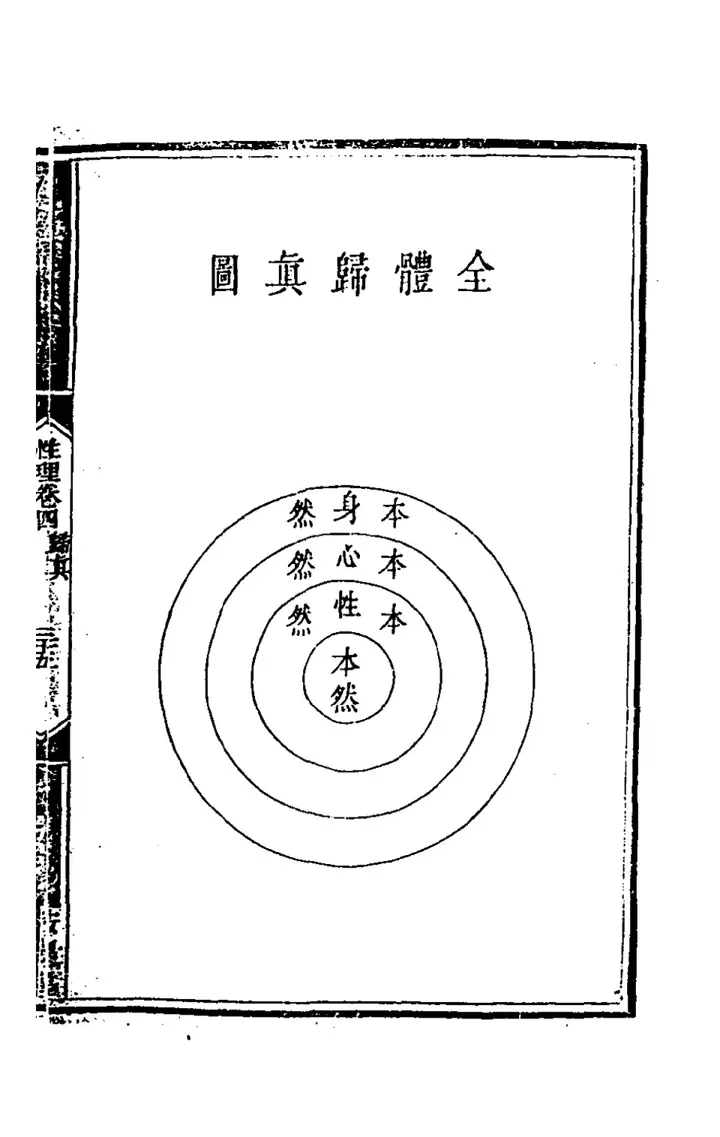
The Real cannot lightly be spoken of as a return. To seek return on a day when nothing has yet been cultivated, there is no road to the Real; to seek return on a day when one has cultivated but not yet been transformed, returning to the Real still involves a self. Without a road one cannot speak of return; with a self one likewise cannot speak of return. To speak of return on the day one knows one is returning, knowing the return is not return. There is that to which one returns and there is one who knows the return: this makes two, and with two one cannot speak of return. To speak of return on the day one returns of oneself without knowing there is a return, one still knows that one does not know; and knowing that one does not know is still a kind of knowing, and with knowing one cannot speak of return. What then shall one who returns to the Real do? I say: when seeking return on a day when one does not know where to return, use cultivation; cultivation serves to grind and wash away the vital energy and substance of the Latter Heaven. When seeking return on a day when one is about to return, one must cast off cultivation. For if one cultivates without knowing how to cast it off, all one's cultivation becomes an obstacle to returning to the Real; and if one knows to cast it off but cannot cast it off completely, the casting off itself becomes an obstacle to returning to the Real. Thus the more one seeks return, the less one can return. What is the way of casting off? I say: forget the very thing to which you most urgently wish to return. Forget your cultivation, and forget the Real as well. Forgetting is the hinge of return. Where then does one forget? Right in the place of seeing, hearing, speaking and acting. For the ground of seeing, hearing, speaking and acting is where one can turn against the Real, remember the Real, or forget the Real. If in seeing one insists on seeking what accords with the Real's way of seeing, one's seeing is already not the Real; if in hearing one insists on seeking what accords with the Real's way of hearing, one's hearing is already not the Real. The heart that seeks accord is itself the obstacle of seeing and hearing; with an obstacle how can one speak of return? If in speaking and acting one insists on seeking accord with the Real, one's speaking and acting are already not the Real. The heart that seeks accord is itself the obstacle of speaking and acting; with an obstacle how can one speak of return? Thus the more one seeks return, the less one can return. How then does one forget? Forget the principle by which there is seeing, and forget that I have seeing; forget the principle by which there is hearing, and forget that I have hearing; forget the principle by which there is speaking and acting, and forget that I speak and act. To know that one forgets is still not to be spoken of as forgetting; one must forget that by which one forgets, and further forget the forgetting of that by which one forgets; only then is it true forgetting. In true forgetting there is no self and no other. With no self and no other, even the trace of return is erased; and when the trace of return is erased, that is the wondrous state of returning to the Real. So one takes non-cultivation as cultivation, non-advance as advance, and again non-attainment as attainment, and only then can one take non-return as return. This is the meaning of the whole being returning to the Real. Note (Hei of Qingyuan): "The Macrocosm begins in the Undesignated; the Microcosm ends in selflessness. Heaven and man are one: this is the very Beginning without designation. Yet returning to the Real is not easily spoken of: one must forget cultivation, forget knowing, forget self, forget other; everything forgotten, the root-suchness alone lies clear and deep. To have nothing at all to return to is at last to return. Someone asked: 'If forgetting goes this far, is it not close to deadness, withering and extinction?' No! What a thing to say! From my bodily form the substance and function of the root-suchness shine forth, like fire catching in charcoal, like sunlight shining through glass. How can this be called deadness, withering and extinction?"
真未可以易言歸也。求歸於未有所修之日,則歸真無路;求歸於有所修而未化之日,則歸真有己。無路不可以言歸,有己亦不可以言歸也。言歸於知歸之日,則知歸即非歸也。有為所歸者,有知所歸者,是二之也,二不可以言歸也。言歸於不知有歸而自歸之日,則猶知其有不知也;知其有不知,則亦猶之乎其有知也,有知不可以言歸也。然則歸真者將奈何?曰:求歸於不知所歸之日,則用修,修所以磨洗其後天之氣質也;求歸於將有所歸之日,則又當擺脫其修。葢有所修而不知擺脫,則其修皆為歸真之障;或亦知擺脫矣,而不能擺脫之以至於盡,則其擺脫亦皆為歸真之障。夫是以愈求歸而愈不得歸也。擺脫之道奈何?曰:於其所急欲歸者而忘之,忘乎其修也,而并忘乎其真。忘之者,歸之機也。然則於何地焉忘之?即於其視聽云為處忘之。葢視聽云為之地,可以背真,可以憶真,可以忘真。若視矣,而必求其有當於真之所以為視,則其視已非真矣;聽矣,而必求其有當於真之所以為聽,則其聽已非真矣。求當之心,即視聽之障也,障則何以言歸?云矣、為矣,而必皆求其有當於真焉,則其云者、為者已非真矣。求當之心,即云為之障也,障則何以言歸?夫是以愈求歸而愈不得歸也。忘之者將奈何?忘乎其所以為視之理也,而并忘乎其我之有視;忘乎其所以為聽之理也,而并忘乎其我之有聽;忘乎其所以云為之理也,而并忘乎其我之有云為。知有忘,猶不可以言忘也,而必忘乎其所以忘,而尤必忘乎忘乎其所以忘,而乃可以為真忘也。真忘者,無我無他矣。無我無他,則并泯其歸之跡矣。泯其歸之跡,而乃可以為歸真之妙境也。是則以無所修為修,以無所進為進,仍復以無所得為得,而乃可以無所歸為歸也,此全體歸真之義也。
Note by a later commentator: 清源黑氏 (Hei of Qingyuan)
清源黑氏曰:「大世界始於無稱,小世界終於無我,天人一致,即最初無稱矣。然歸真未易言也,必忘修、忘知、忘我、忘他,一切俱忘,本然獨湛,一無所歸,始為歸也。或曰:『忘至如此,不幾隣於死槁寂滅乎?』惡!是何言也?自我形軀發現本然體用,如火着炭,如日光之映玻璃,云何死槁寂滅?」
AIScan vol. 5, p. 70–75Transcribed from the scan by AI (Claude), checked as described on the About page.
3 uncertain readings in this passage
- 己則歸真有己or 巳/已· variant · printed with 巳 form (twice: 有己亦不可); read 己 'self'; 1923 己 (p. 71)
- 着如火着炭or 著· variant · C and 1923 着, kept (p. 75)
- 隣不幾隣於死槁or 鄰· variant · kept as printed (p. 75)
AI
Key terms in this text
Each term's Arabic or Persian counterpart carries its grounding: the text itself, a published scholar, or AI. Tap one to find it in the text.
Chinese: transcribed by AI (Claude) from the CADAL scans on Wikimedia Commons (public domain), checked against the zh.wikisource text (CC BY-SA); Books 1–5 also collated with the 1923 photoreprint (CADAL, Commons), and the Root Classic with the Chinese printed in Murata, Chittick and Tu (2009); punctuation is editorial. Books 1–5 keep the notes of Hei of Qingyuan (清源黑氏, Hei Mingfeng), a later commentator, apart from Liu Zhi's text. Arabic: Nūr al-Ḥaqq (Ma Lianyuan), al-Laṭāʾif, as printed in Murata, Chittick and Tu, The Sage Learning of Liu Zhi (2009), pp. 103–153 (public domain text; taken from the book's text layer and checked against the page images by AI, page by page; not yet proofread by a person). Characters: Unihan (Unicode licence), cjk-decomp (Apache-2.0), the Kangxi Dictionary (public domain) via Wikisource (CC BY-SA). The English and the term mappings marked AI were written by AI (Claude). Murata's translations are in copyright and are cited, never reproduced. How this text was established.