Liu Zhi 劉智 · c. 1670–after 1724
Nature and Principle in Islam
天方性理
卷一・圖說Book 1: the diagrams explained
Book 1 · 1 · Overview
概言 大世界所以顯著之由
The first juan (volume) recounts in order how the macrocosm came to be manifest. There is a world of principle and a world of images. The world of principle is where images and numbers have not yet taken form but principle is already complete; this is what is called the Former Heaven. The world of images is where heaven and earth have been set up and the myriad things have been born; this is what is called the Latter Heaven. The manifestation of both worlds proceeds entirely from the one Real, yet in their order and their moments there seem to be distinctions. I set out diagrams and give explanations of them so that the general outline may be grasped; look at the text, take in its meaning, and one can awaken to what lies at the bottom of it. The subtlety of the flow of creation and the principle by which humans and things are endowed and completed cannot be seen with certainty apart from this.
第一卷歷叙大世界所以顯著之由。有理世,有象世。理世者,象數未形而理已具,所謂先天是也;象世者,天地既立,萬物既生,所謂後天是也。兩世之顯著,總由一真,而次第時際,若有所別。列圖為說,以識梗槩,觀文會意,可悟底裏。造化流行之妙,人物賦成之理,舍是無以見其真確焉。
AIScan (1923 reprint), p. 68Transcribed from the scan by AI (Claude), checked as described on the About page.
2 uncertain readings in this passage
- 叙第一卷歷叙大世界or 敘· variant · form as printed in the 1923 reprint (C lacks this passage); Wikisource 敘 (p. 2)
- 槩以識梗槩,觀文會意or 概· variant · form as printed in 1923 (also its heading 槩言); Wikisource 概 (p. 2)
AIBook 1 · 2 · The Very Beginning without designation
最初無稱圖說 造化之本然不可以名稱
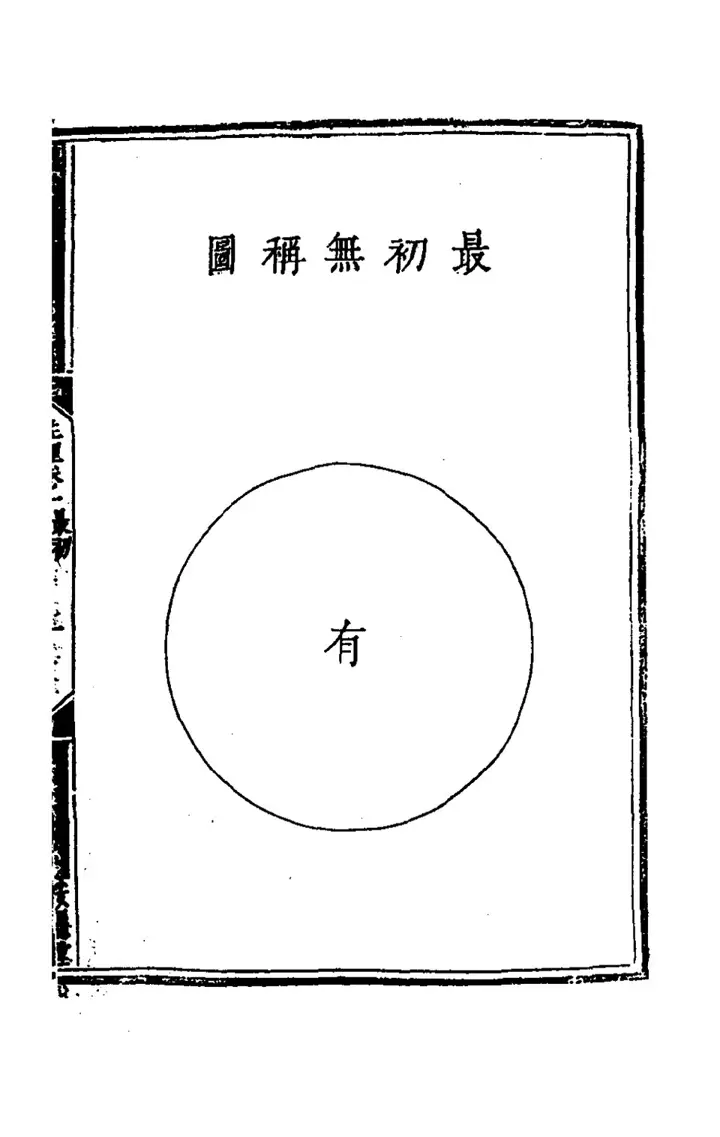
Creation has a beginning, and it must have its very beginning. When images and numbers have not yet taken form but the many principles are already complete, this is the beginning of creation. When there is not yet any principle that can be named, this is the very beginning. The root-suchness of creation cannot be named or designated. The various schools, because it has no designation, go on to call it 'nonbeing' - how can that be allowed? It is said: those who call it nonbeing do not mean empty nothingness; they mean that it has the real and no illusion, has substance and no function. Even so, if it has the real, then the real is being, so why call it nonbeing? If it has substance, then substance is being, so why call it nonbeing? The sages here do not say 'nonbeing'; they say 'without designation'. The scholars of nature and principle here do not merely call it 'being'; they call it 'real being'. Real being is that which stands by itself without any counterpart. Real and illusory are not divided, substance and function are not distinguished; it has nothing at all, and yet in reality there is nothing it does not have. Someone asks: once you call it 'being', being is already a designation - why speak of 'without designation'? The answer: 'being' refers to meaning; 'designation' refers to name. In the realm of the very beginning, the meanings of real, illusory, substance and function are all present, so it is called being; the names real, illusory, substance and function have no exclusive application, so it is called without designation. To call being a designation without examining the difference between name and meaning is a mistake. Someone asks: in the realm of the very beginning there is no emptiness or illusion at all, so it may be called 'the real'; there is no activity at all, so it may be called 'substance'. Why then speak of 'without designation'? For as soon as one says 'real', one is confined to the rank of the real and so is set apart from the illusory; as soon as one says 'substance', one falls into the position of substance and so is cut off from function. That is not the meaning of this diagram. The meaning of this diagram is: at once real and illusory, at once substance and function; the one root and the myriad differentiations, outer and inner, fine and coarse, beginning and end, principle and vital energy (qi), all threaded on one string, while its name does not fall to either side. Therefore it is called 'without designation'. When it moves and becomes manifest, it divides into several grades: first, the grade of non-movement, which is substance; second, the grade of first movement, which is function; third, the grade of the Sovereign, in which substance and function divide; fourth, the grade of the First Mandate, in which the Real Principle appears; fifth, the grade of nature and mandate, in which the myriad principles divide; sixth, the grade of form and vital energy, in which qi and images become manifest. When the six grades are complete, creation is whole. Note (Hei of Qingyuan): 'The very beginning is the beginningless. The beginningless is the beginning of the myriad beginnings, so it is called the very beginning. It cannot be called nonbeing - this distinguishes it from heterodox learning; it cannot be given a name - this blocks one-sided views. The Changes speaks of the Supreme Ultimate, Zhou [Dunyi] speaks of the Ultimateless, the Buddhists speak of the Beginningless, the Daoists speak of the Primal Beginning: all of these speak of the ancestor of the Latter Heaven, whereas this is the root of the Former Heaven.'
造化有初,而必有其最初。象數未形,衆理已具,此造化之初也;當其無理可名,是為最初。其造化之本然,不可以名稱,諸家以其無稱,而遂謂之為無,奚可哉?曰:謂之為無者,非虛無之謂也,謂其有真而無幻也,有體而無用也。雖然,既有真矣,真即有也,又何以謂之無?既有體矣,體即有也,又何以謂之無?聖人於此不曰無,而曰無稱;性理家於此不僅謂之為有,而謂之曰實有。實有者,無對待而自立者也。真幻不分,體用無別,一無所有,而實無所不有也。曰:既謂之有,有即稱也,何言無稱?曰:有者,義也;稱者,名也。最初之境,真幻體用義無不具,故謂之有;真幻體用名無專屬,故謂之無稱。不審乎名與義之別,而謂有即稱也,誤矣。曰:最初之境,毫無虛幻,則稱之為真可也;毫無作用,則稱之為體可也,而何以言無稱?葢纔言真,即拘於其真之品,而遂與幻分矣;纔言體,即落於其體之位,而遂與用判矣,非此圖之義也。此圖之義,即真即幻,即體即用,一本萬殊,表裏精粗,始終理氣,一以貫之,而其稱名不落於一邊,故曰無稱。及其動而顯也,分為數品:一、不動品,體也;二、初動品,用也;三、主宰品,體用分也;四、初命品,真理現也;五、性命品,萬理分也;六、形氣品,氣象著也。六品備,而造化全矣。
Note by a later commentator: 清源黑氏 (Hei of Qingyuan)
清源黑氏曰:「最初,無初也。無初而為萬初之初,故曰最初。不可言無,以別異學;不可名稱,以杜偏見。《易》云太極,周云無極,釋稱無始,老稱元始,皆言後天之宗,此則先天之本。」
AIScan vol. 2, p. 4–8Transcribed from the scan by AI (Claude), checked as described on the About page.
2 uncertain readings in this passage
- 葢而何以言無稱?葢纔言真or 蓋· variant · variant form as printed (p. 6)
- 圖非此圖之義也。此圖之義,即真即幻or 體· witness-differs · C (and Wikisource) 此圖之義 repeated; 1923 reads 此體之義 in the second occurrence; followed C (p. 6)
AIBook 1 · 3 · The Real Substance without attachment
真體無着圖說 體也,不動品也
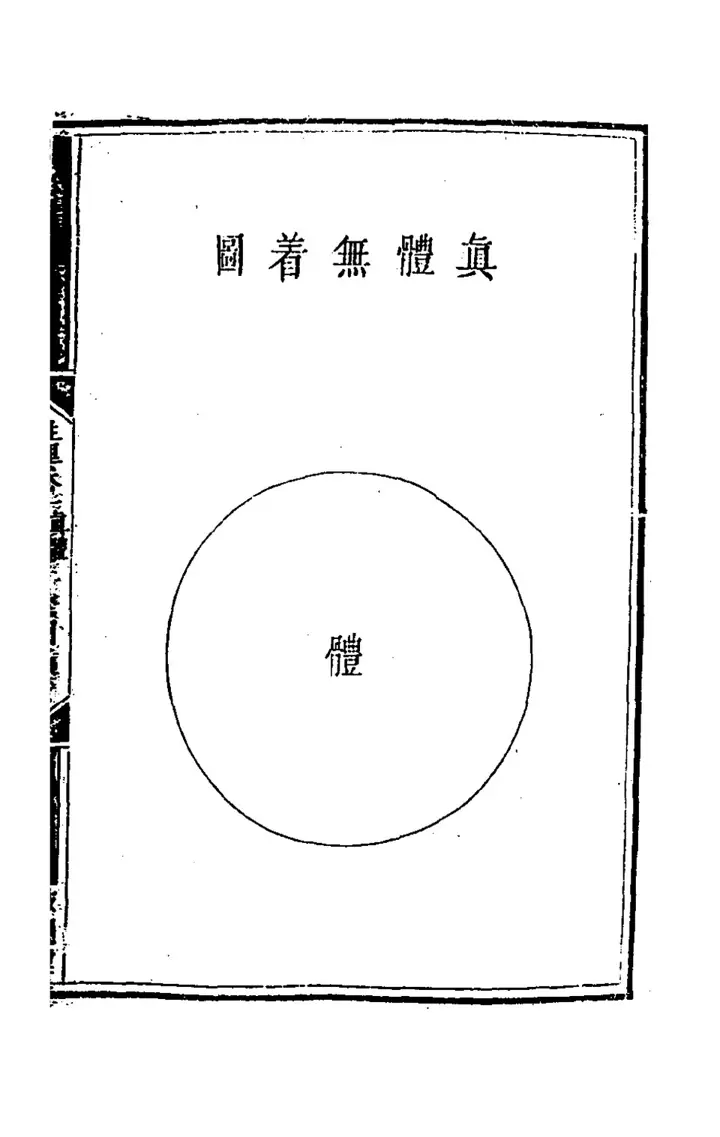
This is the first of the grades into which the first diagram divides: it is substance, the grade of non-movement. Someone objects: 'Where there is substance there is movement; why speak of non-movement?' The answer: 'This substance is the utmost of pure essence and does not fall into place or location. Whatever has vital energy moves, but this substance does not belong to vital energy; whatever has image moves, but this substance does not belong to image; whatever fills and pervades, reaching some places yet unable to reach everywhere, moves, but this substance is neither void nor solid and has no use at all for filling and pervading. That is why it is called the grade of non-movement.' Its grade is named non-movement, yet in reality it is that from which all the myriad movements arise. What moves has attachment; this substance does not move, and so it is without attachment. Not only is it not attached to sound and colour, it is not attached even to unfolding and folding; not only is it not attached to clamour and stillness, it is not attached even to awareness and illumination; not only is it not attached to place and location, it is not attached even to being and nonbeing. All illusory realms are impermanent, but this one Real Substance endures forever and does not decay; everything with form or without form has a beginning and an end, but this one Real Substance is without beginning and without end. Being without beginning, trace it back from before and one cannot find its boundary; being without end, follow it forward from after and one cannot find its conclusion. Where could anyone apply conjecture to it? Someone says: 'Meaning and principle, as things, are also unmoving and without attachment. Might it be that this substance belongs to the unobstructed penetration of meaning and principle, and that is why it is thus unmoving and without attachment?' The answer: 'This substance is the source from which the meanings and principles of past and present come forth, but at this juncture there is not yet any meaning or principle to be sought.' Therefore whoever studies this diagram will not find it by seeking in the place of movement, nor by seeking in the place of attachment. Note (Hei of Qingyuan): 'The Real Substance is real being; this, then, can be designated. Being without attachment is not mysterious nothingness: it is like fire within stone.'
此初圖分品之第一品也,體也,不動品也。說者曰:「有體則有動,何言不動?」曰:「其體也,粹精之至,而不落於方所。凡有氣者則動,而此體不屬於氣;凡有象者則動,而此體不屬於象;凡充周有所及,而有所不能遍及者則動,而此體則非虛非實,而毫無所用其充周,夫是以謂之曰不動品也。」論其品曰不動,而實為一切萬動之所從起。動者有着,而此體不動,則無着也。不惟不着於聲色,並不着於舒卷;不惟不着於喧寂,並不着於覺照;不惟不着於方所,並不着於有無。一切幻境皆無常,而此一真體則常存而不朽;一切有形無形之屬有始有終,而此一真體則無始而無終。無始,則由前遡之而不得其分際;無終,則由後推之而不得其究竟。人將於何而用其擬議也哉?說者曰:「義理之為物也,亦不動而無着者也。或者此體當屬義理之妙通無礙,而故如是其不動無着也乎?」曰:「此體為古今義理所從出之原,而當此之際,則並無義理之可尋也。」是故研究此一圖者,於動處求之不得,於着處求之不得。
Note by a later commentator: 清源黑氏 (Hei of Qingyuan)
清源黑氏曰:「真體即實有也,此則可稱矣。無着非玄無也,如火在石。」
AIScan vol. 2, p. 9–12Transcribed from the scan by AI (Claude), checked as described on the About page.
2 uncertain readings in this passage
- 玄無着非玄無也,如火在石· variant · C prints 玄 with final dot omitted (Kangxi taboo 缺筆); 1923 has full 玄 (p. 12)
- 遡則由前遡之而不得其分際or 溯· variant · form as printed (Wikisource OCR 湖) (p. 11)
AIBook 1 · 4 · The Great Function undifferentiated
大用渾然圖說 初動品,即全體大用
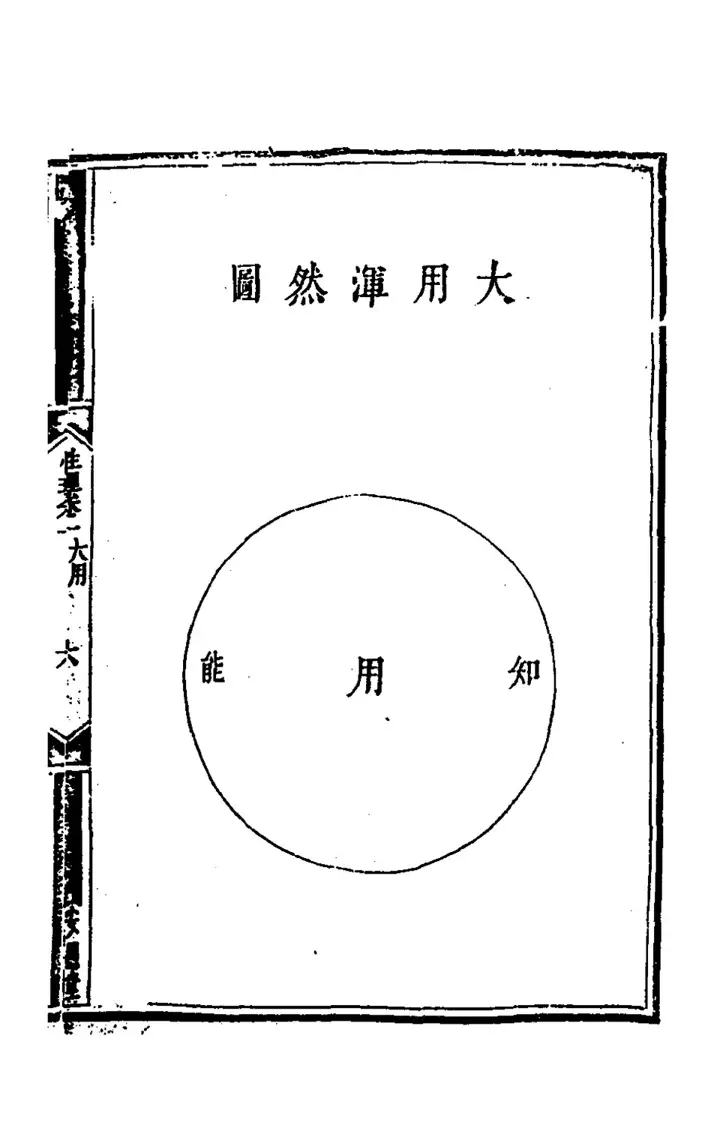
This is the second of the grades into which the first diagram divides. At this juncture the vast, empty substance itself has not moved in the least, yet it already harbours the incipience of its movement. Having no alternative, we name it 'first movement'. The grade of first movement is the Great Function of the whole substance. The Great Function has not yet shown itself at all; it is simply the natural subtlety contained in the substance itself, provisionally named 'function'. Is natural subtlety, then, function? Only in that, where there is natural subtlety, there must be a gathering, stirring incipience of wanting to move; for this reason it is named function. The Great Function is no more than two things: knowing and power. In the natural subtlety there is as yet no knowing, yet it already possesses the subtlety of knowing everything; there is as yet no power, yet it already possesses the subtlety of being able to do everything. 'Knowing' refers to its awareness and illumination; 'power' refers to its arranging. Awareness and illumination are not yet manifest, yet all the kinds of awareness and illumination that come after have their beginnings stored here; arranging leaves no trace, yet all the kinds of arranging that come after have their meanings concealed here. Knowing with nothing known, power with nothing done: this is the moment when function has not yet separated from its substance. Jami says: 'The meaning of knowing is governing, except that at this time its grade as Lord has not yet been distinguished; the meaning of power is making and completing, except that at this time the incipience of its making and completing has not yet appeared. The grade of the Great Function comprehends all the proper movements of being Lord and all the possible movements of being a thing, stored undifferentiated within it.' Jami's account may be said to grasp the essentials of this diagram. Note (Hei of Qingyuan): 'Substance is still, function moves; substance knows, function is able. The still substance is about to become manifest; the moving function is on the verge of arising. "Awareness and illumination not yet manifest" means there is nothing yet of which it is aware; "arranging leaves no trace" means there is nothing yet that it arranges. At this juncture it is like fire within charcoal.'
此初圖分品之第二品也。當斯之際,空空洞洞之本體,毫未有動,而已寓乎其動之機,不得已而名之曰初動。初動之品,即全體大用也。大用毫未發露,不過即其本體所含自然之妙,而姑以用名之。夫自然之妙,豈即是用?但既有自然之妙,必翕翕乎有欲動之機,於是乎以用名之也。大用不過知、能二者。自然之妙,尚未有知,而已具有無所不知之妙;自然之妙,尚未有能,而已具有無所不能之妙。知者,言乎其覺照也;能者,言乎其安排也。覺照未顯,而後此萬種之覺照,皆於此裕其端;安排無跡,而後此萬種之安排,皆於此藏其義。知無所知,能無所能,葢用而未離其體之候也。查密氏曰:「知之義,主持之謂也,苐此時猶未析其為主之品;能之義,作成之謂也,苐此時猶未見其作成之機。大用之品,葢總包乎為主一切當然之動,及為物一切能為之動,而渾然裕乎其中。」查密氏之說,可謂扼此一圖之要已。
Note by a later commentator: 清源黑氏 (Hei of Qingyuan)
清源黑氏曰:「體靜用動,體知用能。靜體將著,動用幾生。覺照未顯,無所覺照也;安排無跡,無所安排也。當此之際,如火在炭。」
AIScan vol. 2, p. 13–16Transcribed from the scan by AI (Claude), checked as described on the About page.
4 uncertain readings in this passage
- 苐作成之謂也,苐此時猶未見or 第· variant · C prints 苐 (both occurrences); 1923 第 (p. 15)
- 苐主持之謂也,苐此時猶未析or 第· variant · C prints 苐; 1923 第 (p. 15)
- 葢能無所能,葢用而未離or 蓋· variant · variant form as printed (p. 15)
- 葢大用之品,葢總包乎or 蓋· variant · variant form as printed (p. 15)
AIBook 1 · 5 · Substance and Function begin to divide
體用始分圖說 次動品,主宰之品顯
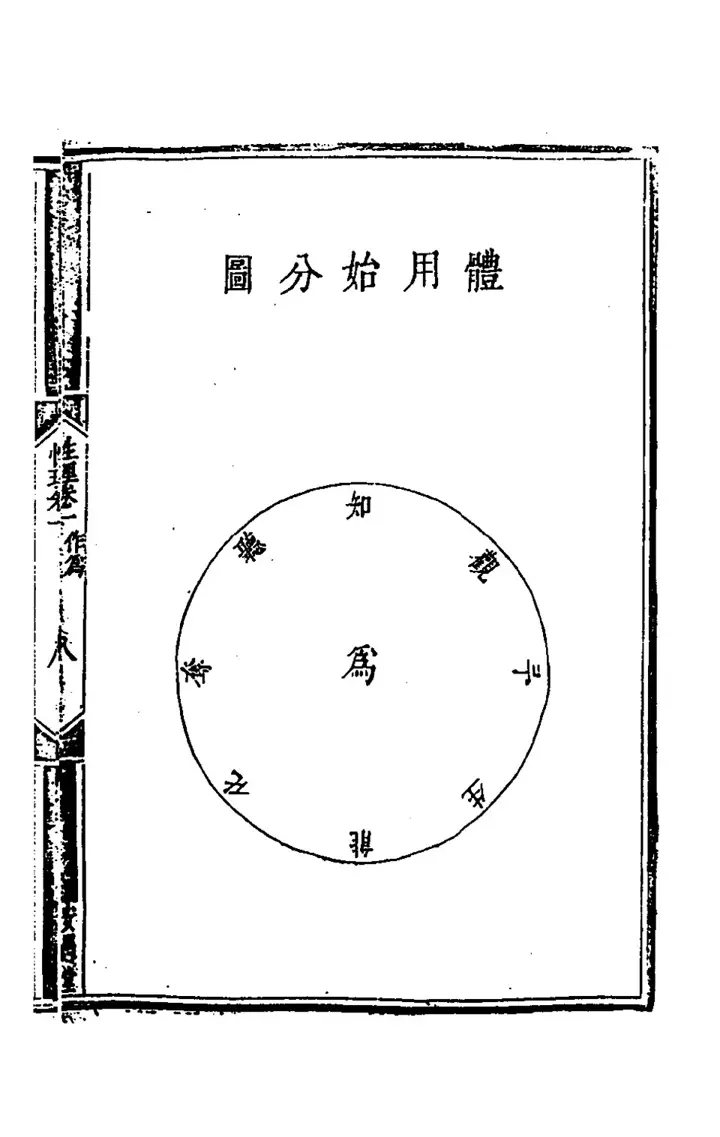
This is the third of the grades into which the first diagram divides. Function is contained in substance, and at this juncture there is a slight incipience of showing itself; this is the grade of second movement. Doing nothing at all, it already holds in store the means of all doing. Spoken of in sum, these are knowing and power; spoken of in detail, they are giving life, transforming, bestowing, taking away, and all kinds of arranging and disposing. When function and substance are not yet divided, this is called the first manifestation; when function and substance first divide, this is called the second manifestation. The first manifestation is like the fire's own brightness: the brightness is one with the fire and does not reach far. The second manifestation is like the fire's outward light: though the light does not leave the fire, it can illuminate everything. At this juncture the grade of the Sovereign becomes manifest. For doing is done by the Sovereign; because there is doing, one knows that there is a Sovereign. Once the grade of the Sovereign is manifest, all the means of doing rise steadily from the inside out to the surface. Taking the Great Function of knowing and power and following it to the end, there is what is called beauty and what is called majesty. Beauty means harmony and accord: all the kinds of arranging, all the kinds of naming, all the kinds of meaning and principle belong to harmony and accord. Majesty means awe and severity: all self-strength, all constant victory, all everlasting vigour belong to awe and severity. The Sovereign's function of self-strength remains only within Himself and is not put to use; were it used, heaven and earth would be destroyed and the world would perish, for this function of self-strength does not allow a single thing to remain. Those who understand, pondering this realm, call it the Predetermination, for the Sovereign, about to create things, first stores up this Great Function beforehand. It is also called the Ink Pool, meaning that the patterns of heaven and earth and the principles of the myriad things are all first gathered in essence in the ink pool. Jami says: 'This grade is the Real One comprising all the movements that imprint traces from the root; it is the outward aspect of real being.' 'Imprinting traces from the root' means that the Real Sovereign bestows what His own substance possesses upon things, as a seal leaves its impression. Note (Hei of Qingyuan): 'The still realm is vast and calm; the incipience of movement surges up. Substance is the Real; function is the Sovereign. Only because there is the Real Sovereign is there creation. From the inside reaching to the outside, like fire giving rise to flame, from which ten thousand lamps may be lit. The name "Predetermination" and the image of the "Ink Pool" are refined and beautiful indeed.'
此初圖分品之第三品也。用含於體,而當此之際,稍稍有發露之機,是為次動品。一無所為,而已裕能為之具,總言之曰知能,析言之則生、化、予、奪及一切安排、布置之類也。用與體未分之時曰首顯,用與體始分之時曰次顯。首顯如火之本明,明與火一,而未及於遠;次顯如火之外光,光雖不離於火,而却能無所不照。當此之際,主宰之品顯焉。葢為者主宰為之也,因為而知其為主宰也。主宰之品顯,則一切能為之具,皆蒸蒸乎由裏而達之於表矣。總知能之大用而究竟之,則有所為美者焉,有所為尊者焉。美者,和順之謂也,凡一切萬種之安排、萬種之稱名、萬種之義理,皆屬於和順;尊者,威嚴之謂也,凡一切自强、一切常勝、一切永健,皆屬於威嚴。主宰自强之用,但存於己,而無所用之,用則天地毀、世界壞矣。葢以此自强之用,乃不容存一物者也。識者玩味此境,謂之曰前定,葢主宰將欲造物,而先裕此大用於其先也。又稱之曰墨池,謂天地之文章、萬物之義理,莫不先聚精於墨池之中也。查密氏曰:「此品即真一包含一切本為授跡之動,是為真有之表也。」本為授跡云者,葢謂真宰以其本體之所有,而賦於物,如印跡然也。
Note by a later commentator: 清源黑氏 (Hei of Qingyuan)
清源黑氏曰:「靜境溶溶,動機勃勃。體即真也,用即宰也。惟有真宰,乃有造化。由裏達表,如火生熖,萬燈可分。前定之稱,墨池之喻,精乎美矣。」
AIScan vol. 2, p. 17–20Transcribed from the scan by AI (Claude), checked as described on the About page.
8 uncertain readings in this passage
- 却而却能無所不照or 卻· variant · C and 1923 print 却; Wikisource 卻 (p. 18)
- 其因為而知其為主宰也or 之· witness-differs · C clearly 其; 1923 and Wikisource 知之為主宰; followed C (p. 18)
- 葢主宰之品顯焉。葢為者or 蓋· variant · variant form as printed (p. 18)
- 强凡一切自强、一切常勝or 強· variant · 强 as printed, all three occurrences of 自强 in this passage (p. 19)
- 葢世界壞矣。葢以此自强or 蓋· variant · variant form as printed (p. 19)
- 葢謂之曰前定,葢主宰將欲or 蓋· variant · variant form as printed (p. 19)
- 葢本為授跡云者,葢謂真宰or 蓋· variant · variant form as printed (p. 20)
- 熖如火生熖,萬燈可分or 焰· variant · C prints 熖 (火+舀); 1923 prints 焰; Wikisource 焰 (p. 20)
AIBook 1 · 6 · The Real Principle flowing forth
真理流行圖說 真宰發現之首品,名曰代理、大筆、道
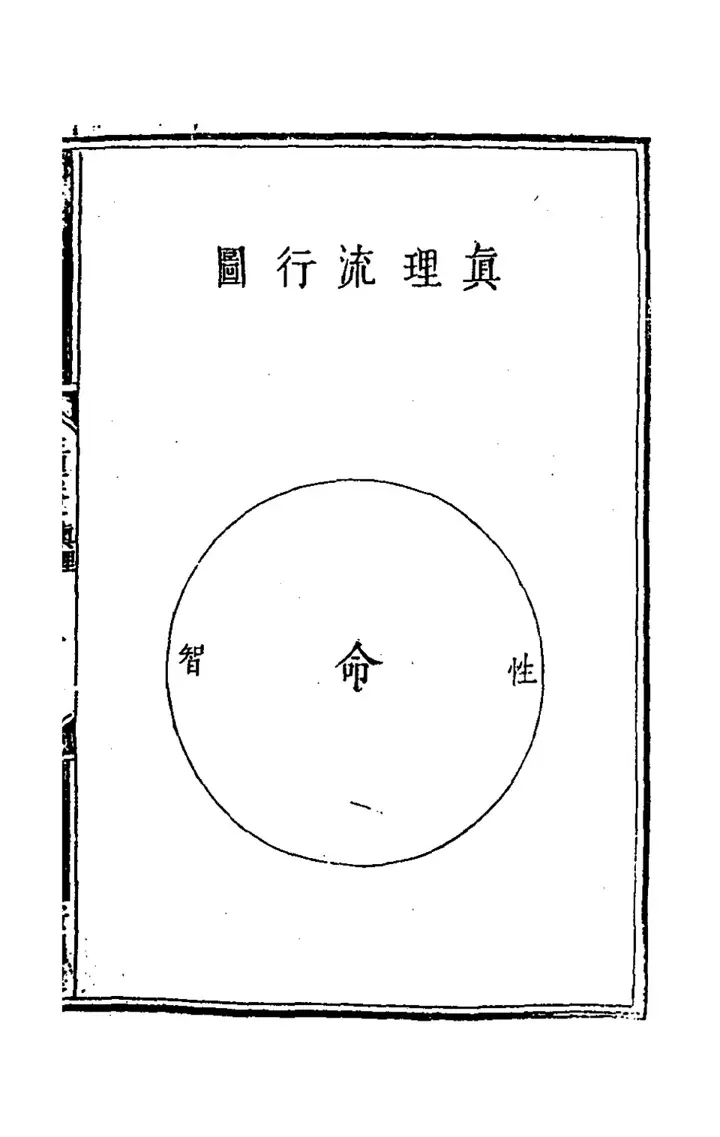
This is the fourth grade in the division of grades of the first diagram. The mandate (ming) means the solemn, unceasing flowing-forth; it is the first grade of the Real Ruler's manifestation. It is not substance, not function, and not action either. For that which is manifested and becomes the mandate is the Real Ruler's manifestation: once it has been manifested, one can no longer call it the Ruler, yet neither can one hastily call it a thing. At this moment of solemn flowing-forth, the Real Ruler manifests, entirely within this first grade, the wonder of lacking nothing that is within its own substance. The first grade is the one comprehensive mandate of all the mandates of all ages. All later creation and transformation is this first grade manifesting, one by one, what the Real Ruler has manifested. The first grade is the Real Ruler's first grade, but it may not be called the Real Ruler. Whatever the first grade has is wholly what the Real Ruler has; the principles and images contained in the first grade are wholly the principles and images contained in the Real Ruler. All later affairs of creation are the first grade's affairs, and the Real Ruler seems to take no part in them. Therefore it is here named the Deputy Principle (dai li). Taking what is present within its flowing-forth, it is divided in two: one is nature (xing), one is intellect (zhi). Nature is the transformation of what in the Great Function was called knowing; intellect is the transformation of what in the Great Function was called ability. Nature and intellect are the knowing and ability of the Real Ruler. This nature is the head of all spiritual awareness through the ages; this intellect opens the beginning of all activity through the ages. Nature and intellect together are the capacity that carries out creation on the Ruler's behalf. Hereafter all things possessing spirit begin rooted in this nature: humans, spirits, birds and beasts, and the like. Hereafter all things possessing action begin rooted in this intellect: heaven, earth, the myriad things, and the like. For this reason the first grade is also named the Great Pen, meaning that all principles and images through the ages are written out from this Great Pen. It is also named the Way, for it is the road by which principles and images, past and present, go out and return. The Real Ruler's initiation of transformation never fails to arise from this station; and the return of the myriad transformations to the Real never fails to return by this station. A discerning one says: the myriad transformations return to the Real by way of this station; is there anything in this station that does not return to the Real together with the myriad transformations? Upon reaching this station, it too has returned to the Real; why then must one distinguish it as the first grade? Note (Hei of Qingyuan): When the Real Ruler manifests, the Great Mandate comes forth. The Real Ruler is knowing, the Great Mandate is ability; the Real Ruler is stillness, the Great Mandate is response. At this moment it is like a thought in the mind, like fire in hot water. Lianxi's (Zhou Dunyi's) Ultimateless, Qingni's Great Way, and Muni's (the Buddha's) Great Awakening all take this as their master.
此初圖分品之第四品也。命者,於穆流行之義,乃真宰發現之首品也。非體也,非用也,亦非為也。葢發現之而為命者,真宰之發現也;既發現矣,欲復稱之為主宰不得也,遽欲稱之為物亦不得也。當此於穆流行之際,真宰以其本體中無所不有之妙,盡發現於此首品之中。首品者,千古群命之一總命也。後此之造化,皆此首品以真宰之所發現者而一一發現之也。首品為真宰之首品,而但不得以真宰稱之。首品之所有,一皆真宰之所有;首品所含之理象,一皆真宰所含之理象。後此造化之事,皆首品之事,而真宰若不與其事矣。故於此名之曰代理。即其流行中之所有者而兩分之:一為性,一為智。性即大用中所謂知之所化也,智即大用中所謂能之所化也。性智即真宰之知能也。此性為千古一切靈覺之首,此智開千古一切作用之端。性智二者,代行造化之本領也。後此凡屬有靈之物,皆根此性而始,人、神、鳥、獸之類是也;後此凡屬有為之物,皆根此智而始,天、地、萬物之類是也。以故首品又名曰大筆,言千古一切理象皆從此大筆寫出者也。又名曰道,葢為古今理象往返之道路也。真宰之起化,莫不從此境而起;及萬化之歸真,亦莫不從此境而歸。識者曰:萬化從此境而歸真矣,此境有不偕萬化而同歸於真者乎?迨至此境,亦歸真矣,而又何必別其為首品也乎?
Note by a later commentator: 清源黑氏 (Hei of Qingyuan)
清源黑氏曰:「真宰發現,大命出焉。真宰為知,大命為能;真宰為寂,大命為感。當此之際,如念在心,如火在湯。濂溪無極,青尼大道,牟尼大覺,皆主乎此。」
AIScan vol. 2, p. 21–25Transcribed from the scan by AI (Claude), checked as described on the About page.
3 uncertain readings in this passage
- 群千古群命之一總命or 羣· witness-differs · C prints 群; 1923 prints 羣 (p. 22)
- 青濂溪無極,青尼大道or 仲· unclear · clearly printed 青尼 in C and 1923; referent uncertain (possibly corrupt), kept as printed (p. 25)
- 葢又名曰道,葢為古今or 蓋· variant · 葢 form as printed (kept, matching tf1) (p. 24)
AIBook 1 · 7 · The first division of nature and principle (1)
性理始分圖說 人性九品,物理九品(一)
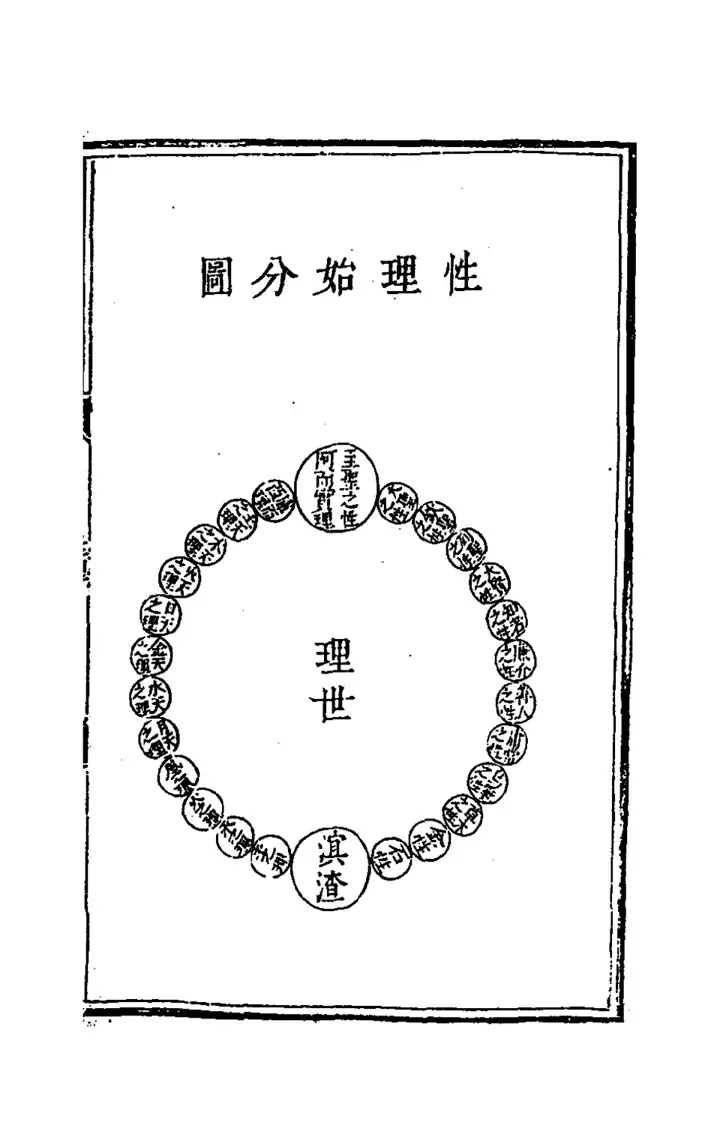
This is the fifth grade in the division of grades of the first diagram. It is where, within the Great Mandate of the First Manifestation, signs of division brightly appear. Colour and image have not yet taken form, yet their principles are already fully and densely present. Whatever is to be human or thing, sage or ordinary, high or low, and all the principles and vital energies that the World of Images possesses, all here seem to show one undivided trace. The root-suchness within the Great Mandate of the First Manifestation is called nature and called intellect. What is here called nature arises rooted in the nature within the Great Mandate: it is that by which humans are so. What is here called principle arises rooted in the intellect within the Great Mandate: it is that by which things are so. That by which humans and things are so both come from one source, with no difference. Why then is that by which things are so called principle, while that by which humans are so is alone called nature? Nature is what has spiritual awareness; naming its spiritual awareness distinguishes it from things. Nature is that by which humans are so, and human nature has, broadly, nine grades. Principle is that by which things are so, and the principles of things likewise have, broadly, nine grades. The first of natures, nearest to the Real Ruler, is the nature of the Utmost Sage; next the nature of the great sages; next the nature of the revered sages; next the nature of the ranked sages; next the great worthies; next the knowing; next the upright and scrupulous; next the good; next the ordinary: nine grades in all. The first of the principles of things, conforming to the Real Principle, is the principle of the 'Arsh (a-er-shi). The 'Arsh contains eight heavens and holds their function together; it is the greatest of the grades of heaven. Next is the principle of the Kursi (ku-er-xi). The Kursi contains seven heavens and carries out their function on its behalf, and it too lies within what the 'Arsh contains. Next the principle of the heaven of Saturn (earth-star), next that of the heaven of Jupiter (wood-star), next that of the heaven of Mars (fire-star), next that of the sun, next that of the heaven of Venus (metal-star), next that of the heaven of Mercury (water-star), next that of the moon: nine grades in all.
此初圖分品之第五品也。自首顯大命中,灼灼乎有分析之兆者也。色象未形,而其理森然已具。凡為人、為物、為聖、為凡、為上、為下,及象世所有一切之理氣,靡不於此境若見一渾然之跡焉。首顯大命中之本然,曰性,曰智。此之所謂性者,根於大命中之性而起,人之所以然也;此之所謂理者,根於大命中之智而起,物之所以然也。人與物之所以然,皆同出於一原,無有別也。乃物之所以然則稱之曰理,人之所以然獨稱之曰性者,何也?性則其靈覺者也,稱其靈覺,以別於物也。性者,人之所以然也,而人性大概之品有九;理者,物之所以然也,而物理大概之品亦有九。性之最初而近於真宰者,至聖之性也;其次大聖之性,其次欽聖之性,其次列聖之性,其次大賢,其次知者,其次廉介,其次善人,其次庸常,凡九品。物理之最初而合於真理者,阿而實之理也。阿而實包含八天而總持其用,天品之至大者也。其次則庫而西之理。庫而西包含七天,代行其用,而亦在阿而實所含之內也。次土天之理,次木天之理,次火天之理,次太陽之理,次金天之理,次水天之理,次太陰之理,凡九品。
AIScan vol. 2, p. 26–29Transcribed from the scan by AI (Claude), checked as described on the About page.
Book 1 · 8 · The first division of nature and principle (2)
性理始分圖說 鳥獸草木金石之本然,四行之理,溟涬為氣(二)
When the natures and principles of humans and heavens were complete, from the surplus of human nature there were further transformed the root-suchnesses of all birds and beasts; from the surplus of the root-suchness of birds and beasts, the root-suchnesses of all plants and trees; from the surplus of the root-suchness of plants and trees, the root-suchnesses of all metals and stones. These several classes too flowed forth out of the nine grades of human nature. Human nature has growth, has perception, has spiritual intelligence: it obtains the whole of nature. The nature of birds and beasts has growth and perception but no spiritual intelligence. The nature of plants and trees has growth only. And the nature of metals and stones has only firmness and fixity. From the surplus of the principles of the nine heavens were transformed the principles of the four elements: wind, fire, water and earth. The principle of heaven is to revolve without ceasing; the principles of wind, fire, water and earth likewise all revolve without ceasing, only the principle of earth shows a slight tendency to firmness and congealing. All of these divided in sequence and flowed forth. Then the surplus of all this flowing-forth and division, taken together, became the primordial murk (ming-xing): this is what is called vital energy (qi). Vital energy is the root of all forms and images. Someone asks: 'At the first division of nature and principle there are these differing grades and this unequal order of before and after. Did creation do this with a purpose, or without purpose, simply letting things be as they are of themselves?' The answer: 'The Real Principle, flowing forth to this extreme, must indeed let things be so of themselves; yet since, among them, high and low and their order never deviate by a hair, there is a fixed governance that arranges them. Therefore to call it purposive action will not do, and to call it non-action will not do.' Note (Hei of Qingyuan): The one reality divides into the myriad; the myriad differences have one root: this is what is called 'the Ultimateless and yet the Supreme Ultimate'. Colour and image have not yet taken form, yet principle is already complete, like ideas in consciousness. The primordial murk (ming-zha) is the very first of the Latter Heaven, and also the utmost point at which the transformations of the Former Heaven are exhausted and return to the root.
人天之性理既備,復自人性之所餘剩,而化一切鳥獸之本然;自鳥獸本然之所餘者,而化一切草木之本然;自草木本然之所餘者,而化一切金石之本然。此數等者,又自九品人性中而流行以出者也。人之性,有生長,有知覺,有靈慧,得其性之全;鳥獸之性,有生長,有知覺,無靈慧;草木之性,僅有生長;而金石之性,則僅有堅定而已。自九天之理之所餘,而化風、火、水、土四行之理。天之理,運行不息者也;風、火、水、土之理,亦皆運行不息,而惟土之理則微覺其堅凝也。皆次第分析而流行以出者也。由是而總一切流行分析之所餘者,為溟涬焉,則所謂氣者是也。氣則萬有形象之本也。說者曰:「性理之始分也,有如是諸品之不同、先後之不一,其造化有所為而為之者乎?抑無所為而聽其自然者乎?」曰:「真理流行而至於此極,當亦聽其自然而然;而但其中高下次第,不致有絲毫之隕越,則是有一定之主持而安排者也。是故謂之為有為,不可;謂之為無為,不可。」
Note by a later commentator: 清源黑氏 (Hei of Qingyuan)
清源黑氏曰:「一實萬分,萬殊一本,所謂無極而太極也。色象未形而理已具,若意識然。溟渣為後天之最初,亦即先天化窮返本之極致。」
AIScan vol. 2, p. 29–31Transcribed from the scan by AI (Claude), checked as described on the About page.
1 uncertain reading in this passage
- 涬之所餘者,為溟涬焉or 渣· variant · C body clearly 溟涬 (氵+幸); C diagram, C note and 1923 read 溟渣 (p. 30)
AIBook 1 · 9 · Vital energy manifest, principle hidden
氣著理隱圖說 元氣發露,亦分六品
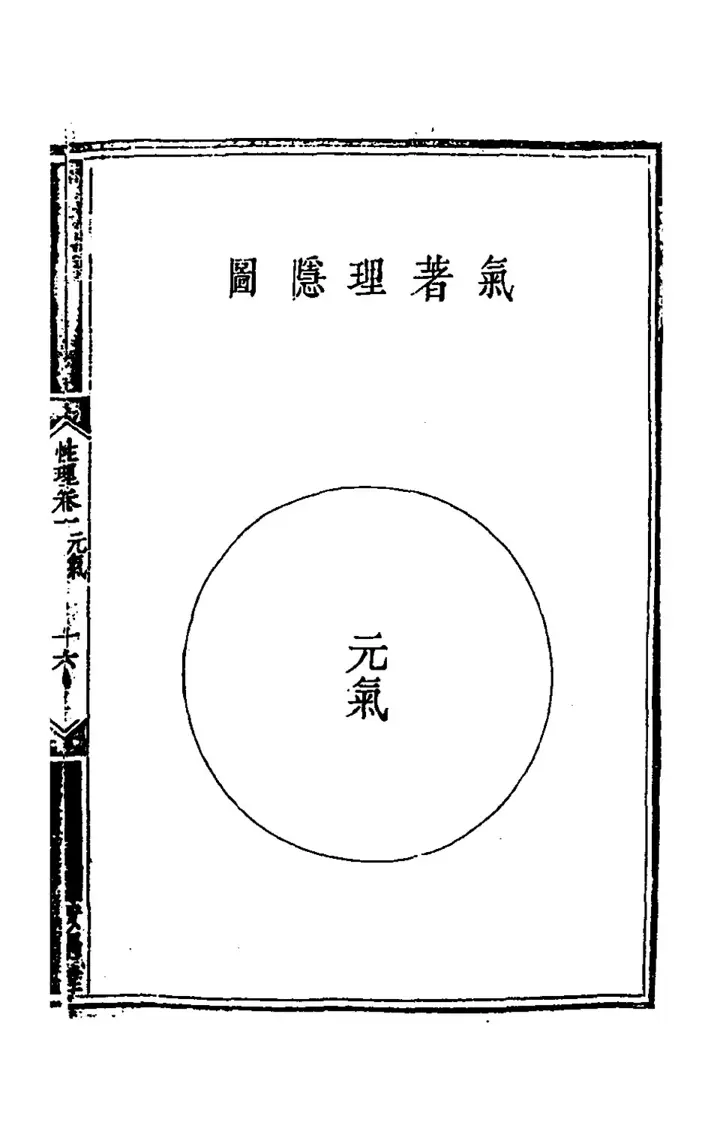
This is the sixth grade in the division of grades of the first diagram. When the pure and refined grades of the Former Heaven have flowed forth to this point, there first appears an image of undivided chaos: this is what is called primal vital energy (yuan qi). The wonder of the Former Heaven, without colour or image, ends here; the traces of the Latter Heaven, with colour and image, begin here. This station is, one might say, the great pivot that receives the flow and spreads transformation. Although primal vital energy is the outer surface of the solemn flowing-forth, as a thing it is not outside nature and principle, nor outside the Great Mandate of the First Manifestation, nor outside the Complete Substance and Great Function. At the time of the Very Beginning without designation, the root-suchness of primal vital energy was already lodged within it. But at the very beginning, division had not taken form; flowing forth to this point, its root-suchness is revealed: it is the juncture at which what was within reaches the outside. As a thing it seems turbid yet is clear, seems a trace yet is subtle. In order of sequence it is the surplus of all the flowing-forth of the Former Heaven; yet when it is revealed, everything the Former Heaven possessed, humans together with their natures, things together with their principles, is revealed in consequence of this revelation of primal vital energy. Even what in the Very Beginning was called the Complete Substance and Great Function is likewise revealed in consequence of the revelation of primal vital energy. It is turbid, yet the clear cannot lie outside it; it is a trace, yet the subtle cannot depart from it. Therefore one who names it may not name it merely 'vital energy', but must name it 'primal vital energy'. 'Primal' is where all that is pure and refined gathers; 'vital energy' is the vessel in which all that is pure and refined is lodged. The diagram says 'vital energy manifest, principle hidden'. Principle is not hidden because of vital energy. Rather, principle as a thing has little motion and much stillness, while vital energy as a thing has much motion and little stillness. At this time vital energy moves and principle is still; that is why it is called hidden. What is hidden in each case waits for something before it is manifested. The revelation of primal vital energy also divides into six grades: first, the grade of undivided sameness, which is the positioning of this juncture; second, the grade of initiating transformation, in which yin and yang divide; third, the grade of broadening transformation, in which the four images become manifest; fourth, the grade of correct positioning, in which heaven and earth are fixed; fifth, the grade of proliferation, in which the myriad things are born; sixth, the grade of completion, in which humankind comes forth. When the six grades are complete, the work of primal vital energy is finished. Note (Hei of Qingyuan): The Real Principle is the net-cord of all spirits, and nature and principle divide from it; primal vital energy is the net-cord of all forms, and colour and image become manifest by it. Before this there was principle without trace, and vital energy was hidden in principle; after this there is trace and principle, and principle is hidden in vital energy. At this time it is like writing contained at the tip of the brush; when yin and yang divide and the four images become manifest, the writing has come down onto the page. This is the Supreme Ultimate.
此初圖分品之第六品也。先天精粹之品,流行至此,始覺其有渾淪之象,則所謂元氣也。先天無色無象之妙,至此而終;後天有色有象之跡,於此而始。此其境殆承流宣化之一大機柱也。元氣雖於穆流行之表,而其為物也,却不在性理之外,並亦不在首顯大命之外,並亦不在全體大用之外。當其最初無稱之時,元氣本然已寓乎其中。但最初之時,分析未形,而流行至此,本然發露,葢由裏而達於表之會也。其為物也,似濁而清,似跡而妙。論其次第,乃先天一切流行之所餘;而及其發露也,則凡先天一切之所有,人與其人之性,物與其物之理,無不於此元氣之所發露而因之以發露焉。即最初中所謂全體大用者,亦莫不於此元氣發露時而因之以發露焉。是濁也,而為清之所不能外;跡也,而為妙之所不能離。是故名之者,不得僅名之為氣,而必名之曰元氣也。元者,一切精粹之所聚;氣者,一切精粹所寓之器。圖稱氣著理隱者,理非因氣而隱也。葢理之為物也,動少而靜多;氣之為物也,動多而靜少。當斯時也,氣動而理靜,夫是以謂之為隱。隱者,各有所待而顯耳。元氣發露,亦分六品:一、渾同品,即此際位分也;二、起化品,陰陽分也;三、廣化品,四象著也;四、正位品,天地定也;五、蕃庶品,萬物生也;六、成全品,人類出也。六品備,而元氣之能事畢矣。
Note by a later commentator: 清源黑氏 (Hei of Qingyuan)
清源黑氏曰:「真理為萬靈之綱,而性理由分;元氣為萬形之綱,而色象以著。前此有理無跡,氣隱於理;後此有跡有理,理隱於氣。斯時也,若文字含於筆端;至陰陽分、四象著,則文字落於方策矣,是為太極。」
AIScan vol. 2, p. 32–36Transcribed from the scan by AI (Claude), checked as described on the About page.
1 uncertain reading in this passage
- 却其為物也,却不在性理or 卻· variant · 却 form as printed (p. 33)
AIBook 1 · 10 · The first division of yin and yang
陰陽始分圖說 元氣起化品:陰陽根於性智之所餘
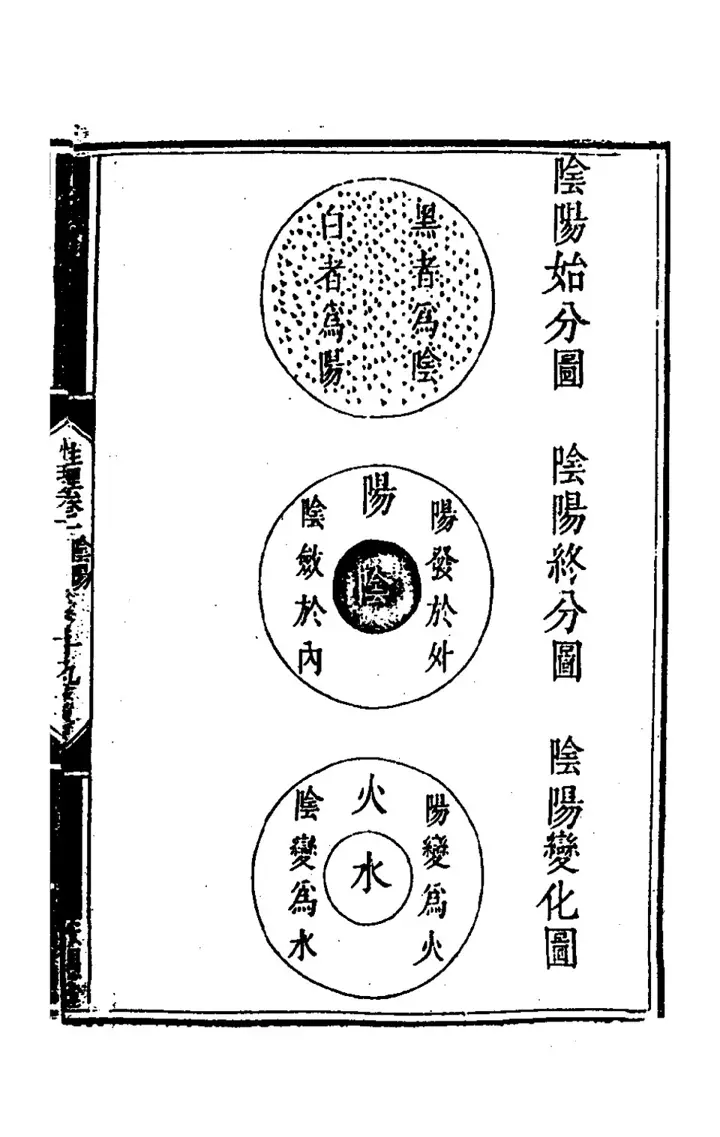
This is the grade of primal vital energy initiating transformation. Primal vital energy is the primordial murk of the solemn flowing-forth, and what it holds in store is all the surplus of nature and intellect within the Great Mandate of the Former Heaven. Its division into yin and yang still proceeds from what it received of the surplus of nature and intellect. Intellect is the beginning of action and the source of the delight in motion; so what primal vital energy received from the surplus of intellect must have an impulse delighting in motion, and it moves because it cannot but move. Nature rests and does not move along with it; so what primal vital energy received from the surplus of nature likewise does not move along. The surplus of nature and intellect, one moving and one not moving, thereupon produced within it an image of twofold division. What moves is called yang; what does not move is called yin. This is how the one vital energy transformed into a twofold division. When they first divided, the two were intermixed and not far apart. Later, yang gathered in one place and swiftly tended toward the outside; yin gathered in one place and faintly tended toward the inside. The surplus of intellect transformed into yang; the surplus of nature transformed into yin. Thus the root of yin and yang arises from the surplus of nature and intellect. Someone asks: 'When the Former Heaven speaks of principle, nature precedes intellect; when the Latter Heaven speaks of vital energy, intellect precedes nature. In the flowing of primal vital energy, is this not putting first what came after and putting after what came first?' The answer: 'In the time of the Former Heaven, when principle prevails, intellect is stored in nature and nature in fact encloses intellect. In the time of the Latter Heaven, when vital energy prevails, nature is stored in intellect and intellect in fact encloses nature. Hence the main line of yang arises from the surplus of intellect and stands first; the main line of yin arises from the surplus of nature and stands after. This too is an order of before and after that proceeds as it cannot but proceed.' Note (Hei of Qingyuan): This is the Changes' 'The Changes have the Supreme Ultimate, which gives birth to the Two Modes.' Yin is still and yang moves, but who has glimpsed its root? Yin on the left and yang on the right, but no one has recognized the error. Now it is said that they are rooted in nature and intellect and issue toward outside and inside, and all the meanings become clear. Looking at the diagram, it is like the image of muddy water not yet settled and already settled, and the principle becomes still clearer. Yin and yang divide at the same moment; the explainer's talk of an order of before and after is a mistake.
此元氣起化品也。元氣為於穆流行之溟渣,而其中所含裕者,皆先天大命中性智之所餘。其分陰分陽,仍即本其有得於性智之所餘者而分之也。智乃有為之始,而喜動之端,則元氣中所得於智之餘者,自必有喜動之機,而動乎其不得不動也。性則安之,不與俱動,則元氣中所得於性之餘者,亦自不與俱動也。性智所餘,一動一不動,遂於其中有兩分之象矣。於其動者謂之陽,於其不動者謂之陰,此一氣化而為兩分之由來也。其初分也,二者互雜,不甚相離。及其後也,陽積於一處,而駸駸乎有向表之機;陰積於一處,而隱隱乎有向裏之勢。智之所餘化而為陽,性之所餘化而為陰,此陰陽之根起於性智之所餘也。說者曰:「先天之言理也,性先於智;後天之言氣也,智先於性。元氣之流行也,不亦先其所後而後其所先乎?」曰:「先天理勝之時,智藏於性,而性實包乎智;後天氣勝之時,性藏於智,而智實包乎性。此陽之大端起於智之所餘而居於先,陰之大端起於性之所餘而居於後,亦先後次第行乎其不得不然者也。」
Note by a later commentator: 清源黑氏 (Hei of Qingyuan)
清源黑氏曰:「此『易有太極,是生兩儀』也。陰靜陽動,孰窺其本?左陰右陽,莫識其非。茲曰根乎性智,發乎表裏,則諸義釋然矣。觀其圖,若泥水未澄、已澄之象,理更分明。陰陽分於同時,而說者言先後次第,悞矣。」
AIScan vol. 2, p. 37–40Transcribed from the scan by AI (Claude), checked as described on the About page.
2 uncertain readings in this passage
- 悞而說者言先後次第,悞矣or 誤· variant · C prints 悞 (variant of 誤); 1923 has 誤 (p. 40)
- 駸陽積於一處,而駸駸乎· unclear · worn strokes in C; confirmed by 1923 駸駸 (p. 39)
AIBook 1 · 11 · The four images begin to take form
四象始形圖說 元氣廣化品
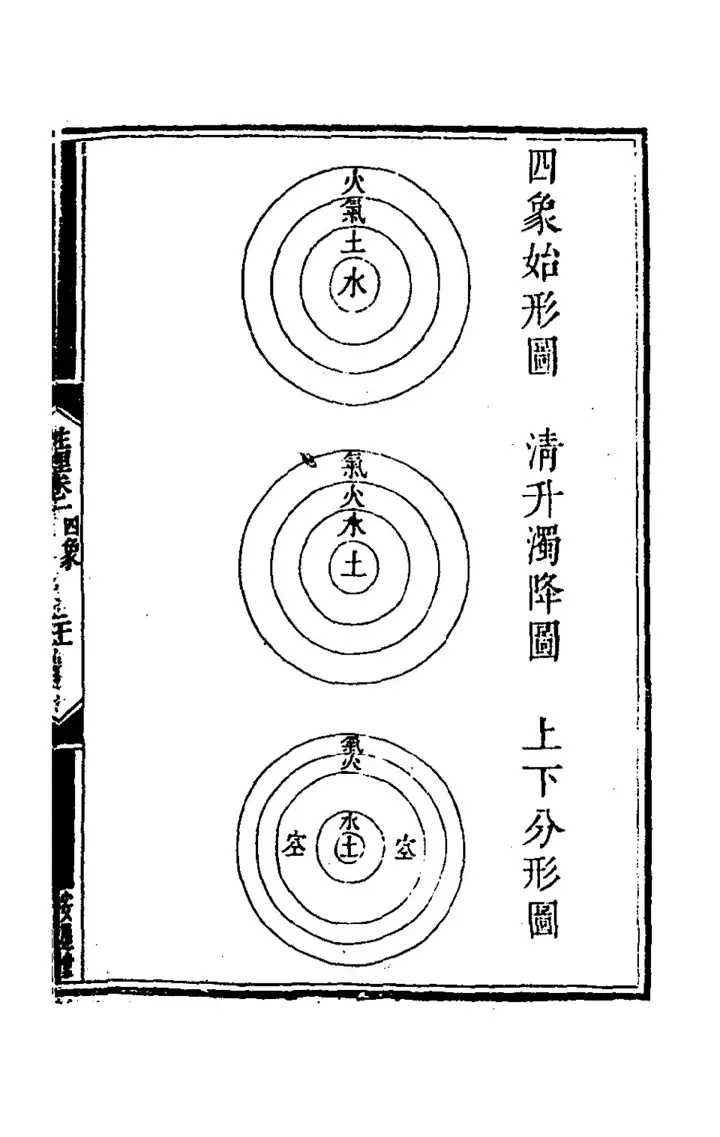
This is the rank of vital energy's broad transformation. At this juncture yin and yang transform into water and fire. When water obtains fire, air (qi) is produced; when fire scorches water, earth is produced. Thus water, fire, earth and air: the four images are formed. Someone asks: "Why do yin and yang transform into water and fire?" I reply: "Yang is rooted in the wisdom within the First Mandate, and wisdom is in turn rooted in the capacity within the Great Function; wisdom and capacity both shine outward. This is why yang transforms into fire, for fire is what shines outward. Yin is rooted in the nature within the First Mandate, and nature is in turn rooted in the knowing within the Great Function; nature and knowing both illuminate inward. This is why yin transforms into water, for water is what illuminates inward." Water, receiving the blaze of fire, produces air; air is the subtle transformation of water that seeks to rise. Although the body of water tends downward, it contains true yang within, so that on receiving the blaze of fire its air strives straight upward. Fire, contending with water, produces earth; earth is the residual trace of fire that seeks to fall. Although the body of fire tends upward, it contains true yin within, so that in contending with water its earth cannot but fall. Of the four, water, fire, earth and air, the high contain a tendency to attach below and the low contain a cause for attaching above. They are called the four origins (siyuan) because they are the ancestral origin of all forms and colours. Their root meaning is the four singles (siji): 'single' means unpaired, that is, each of the four images forms its own line alone, without a partner. Hereafter, when metal and wood are produced, there will be paired lines. Note (Hei of Qingyuan): "Yin and yang transforming into water and fire is like the knowing and capacity of the Former Heaven transforming into nature and wisdom; water and fire interlacing to produce air and earth is like nature and wisdom flowing forth to produce principle and qi. Fire is rooted in wisdom and capacity, so its flame shines outward and blazes upward; yet it contains true yin within, so below it is quenched by water and its ashes become earth. Water is rooted in nature and knowing, so rivers illuminate inward and moisten downward; yet it contains true yang within, so above it is warmed by fire and steams up as air. At first fire was above and water below, and earth, being turbid yin, passed through the air and went down; earth having gone down, the clear yang air went up. Next, earth, being heavier than water, in turn sank beneath the water; air, being lighter than fire, in turn rose past the fire. Air and fire rose day by day, earth and water sank day by day, and so an empty interval was marked off between them."
此元氣廣化品也。當斯之際,陰陽化而為水火,水得火則生氣,火暴水則生土,是故水、火、土、氣,四象成焉。說者曰:「陰陽何以化而為水火?」曰:「陽根於初命中之智,而智又根於大用中之能,智與能皆外明者也,此陽之所以化而為火,火外明者也。陰根於初命中之性,而性又根於大用中之知,性與知皆內照者也,此陰之所以化而為水,水內照者也。」水受火熾而氣生,氣即水之妙化而欲升騰者也。水體雖下,而含有真陽,故受火熾而其氣直欲升騰。火與水搏而土生,土即火之存跡而欲墜落者也。火體雖上,而含有真陰,故與水搏而其土不得不墜落。水、火、土、氣四者,高之中有麗下之義,低之中有附上之因。其稱名為四元,以其為萬有形色之宗元也。其本義為四奇,奇者,單也,謂四象皆單自成行而無配故也。後此金、木生,則為耦行者矣。
Note by a later commentator: 清源黑氏 (Hei of Qingyuan)
清源黑氏曰:「陰陽化水火,即猶先天知能化性智也;水火交錯而生氣土,即猶性智流行而生理氣也。火根智能,故光焰外明而上炎,然內含真陰,故下為水濬而灰燼成土;水根性知,故江河內照而下潤,然內含真陽,故上為火煦而蒸潮為氣。初則火上水下,土為濁陰,故踰氣而下;土下,而清陽之氣上矣。繼之,土重於水,又沉水而下;氣輕於火,又越火而上。氣火日上,土水日下,遂劃留空際矣。」
AIScan vol. 2, p. 41–44Transcribed from the scan by AI (Claude), checked as described on the About page.
4 uncertain readings in this passage
- 麗高之中有麗下之義or 雨 (W)· witness-differs · C and 1923 clearly 麗 'attach'; Wikisource 雨 is an OCR error (p. 43)
- 土水、火、土、氣四者· variant · 土 throughout this page range is often cut with an extra dot (圡-like); normalised silently to 土 (p. 43)
- 焰故光焰外明而上炎or 燄· variant · print form between 焰/燄 (臽 component with fire); adopted common form (p. 44)
- 踰故踰氣而下· variant · cut 踰 with cramped right side; 1923 identical (p. 44)
AIBook 1 · 12 · Heaven and earth settle into place
天地定位圖說 元氣正位品
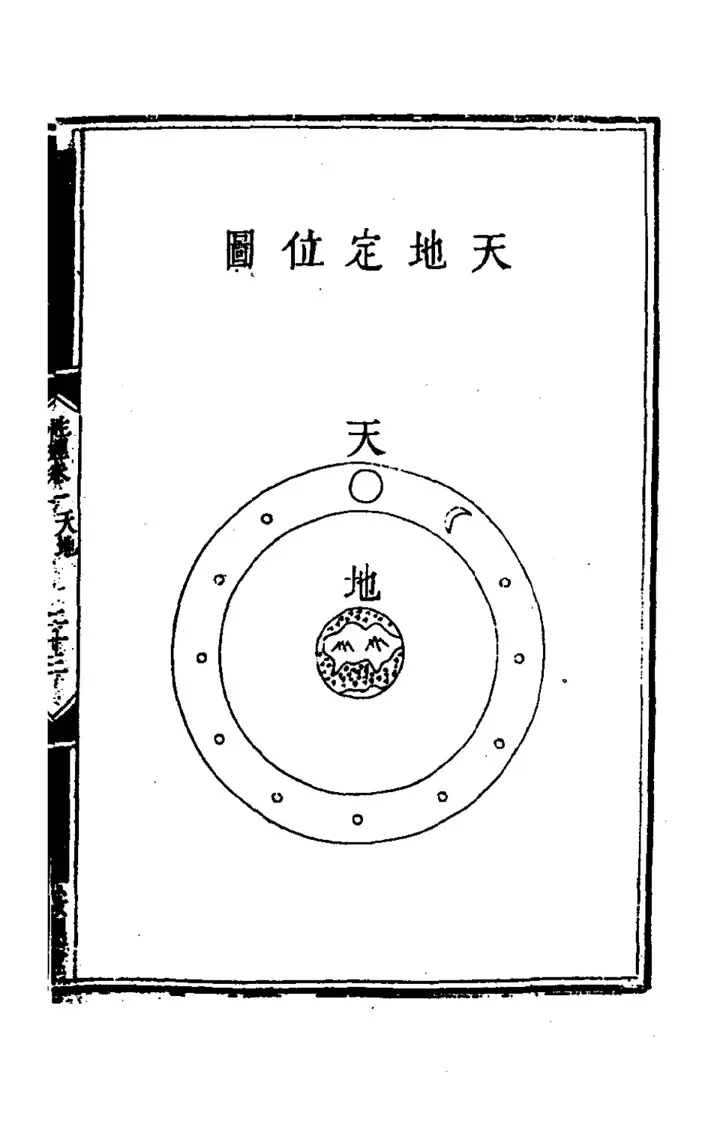
This is the rank of vital energy's settling into position. The air of true yang issues outward and becomes heaven; the substance of true yin gathers inward and becomes earth. Hence heaven envelops earth and earth lodges in the centre of heaven, like the yolk and white of an egg. With heaven and earth settled in position, water and fire are held within them. Heaven is air, and air is water that has received the blaze of fire and mounted upward: this is why heaven is positioned above. Earth is soil, and soil is the trace left when fire contends with water and falls downward: this is why earth is positioned below. To be positioned above and below is to be divided in form into outer and inner. Looking at heaven from the earth, it seems that heaven is high and earth low; but viewed as the whole form of heaven and earth, in truth heaven is outer and earth inner. Fire, having nothing to cling to, attaches itself to heaven. When the body of heaven was first formed, its air flew up in ordered tiers, and fire, following those tiers, scattered into it and became the images of the sun, moon, stars and constellations. Water by nature goes downward and attaches itself to earth. When the body of earth was first fixed, its lie was here high and there low, here firm and there porous, and water, following the highs and lows, the firm and porous, flowed and soaked into it and became the shapes of the rivers, seas, streams and channels. The trace of fire falls downward while its clear part attaches above to heaven; the true yang of water rises upward while its turbid part attaches below to earth. So of the images in heaven and the shapes on earth, none is formed except through the interlacing of water and fire. The reason water and fire cannot but interlace is that within yang there is true yin and within yin there is true yang; yang is not purely yang, nor yin purely yin. Note (Hei of Qingyuan): "When the four images took form, above and below were separated; and when form endures it becomes firm and fixed. But once yin and yang have divided, how can yang still contain yin and yin still contain yang? I answer: water and fire both come from one origin, and in yin and yang neither can wholly prevail. See how fire is dark within and water bright within, and this is plain."
此元氣正位品也。真陽之氣外發而為天,真陰之質內斂而為地,是以天包乎地,而地寄於天之中央,如雞子黃白之形。天地定位,而水火存於其中矣。夫天即氣也,氣即水受火熾而上騰者也,此天之所以定位於上也。地即土也,土即火與水搏而存跡以下墜者也,此地之所以定位於下也。定位於上下者,分形於內外也。由地觀天,似乎天高而地下;而若自其天地之全形觀之,實天外而地內也。火無所着而附於天,當其天體之初成也,其氣飛揚而有次第,火即因其飛揚次第散入其中,而遂成日、月、星、辰之象。水性善下而附於地,當其地體之初定也,其勢或高或下,有堅有泄,水即隨其高下堅泄流浸其中,而遂成江、海、河、瀆之形。火之存跡下墜,而其清者上附於天;水之真陽上升,而其濁者下附於地。是在天之象、在地之形,未有不因水火交錯而成者也。水火之所以不能無交錯者,蓋緣陽之中含有真陰,陰之中含有真陽,而非陽一於陽、陰一於陰者也。
Note by a later commentator: 清源黑氏 (Hei of Qingyuan)
清源黑氏曰:「四象形而上下判,形久則堅定矣。然陰陽既分,何以陽復含陰、陰復含陽?曰:水火總出一元,陰陽必無純勝,觀之火內暗、水內明可知。」
AIScan vol. 2, p. 45–48Transcribed from the scan by AI (Claude), checked as described on the About page.
1 uncertain reading in this passage
- 着火無所着而附於天or 著· variant · print has 着 (p. 46)
AIBook 1 · 13 · The myriad things begin to be born
萬物始生圖說 元氣蕃庶品
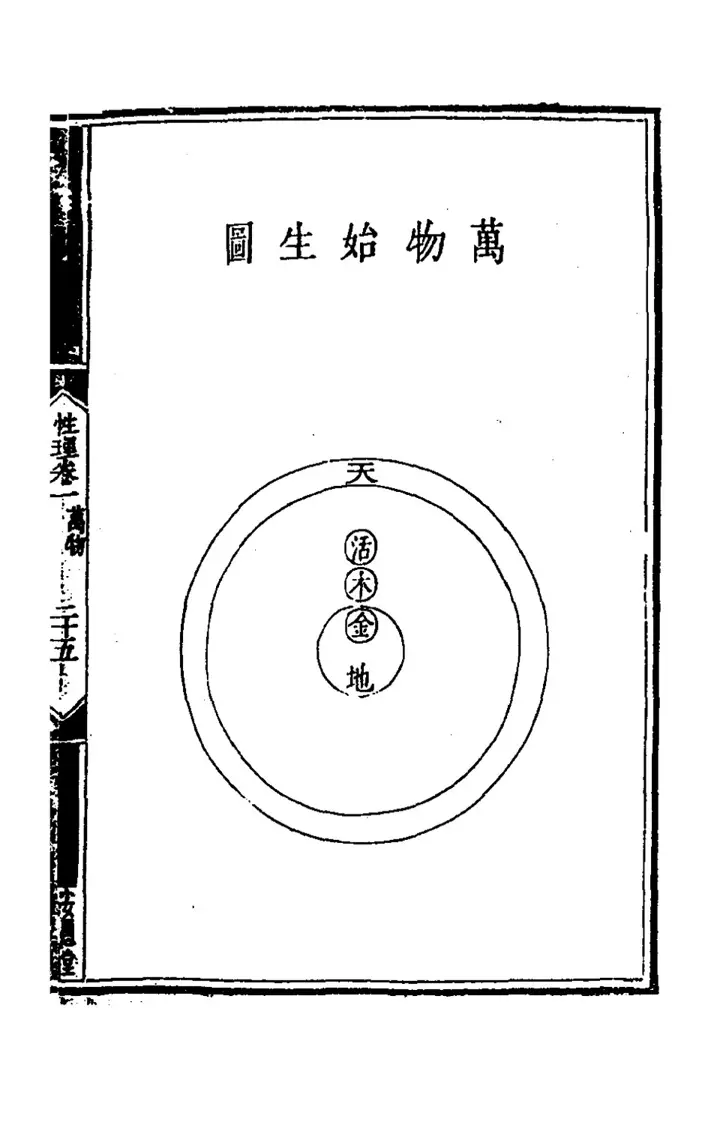
This is the rank of vital energy's proliferation. With heaven and earth settled in position and water and fire interlacing, the work of transformation and nurture begins. The myriad things cannot be transformed and nurtured without a cause: within heaven, earth, water and fire there first coalesce metal, wood and the living, these three, to serve as the guiding cords for transforming and nurturing all that exists. Metal, wood and the living are each formed by some combination. Metal is based on the congealing of earth and water and is completed by receiving the transforming action of air and fire. Wood is based on the bestowal of air and fire and grows by receiving the nourishment of earth and water. The living is based on the convergence of all four, air, fire, water and earth, and overflows to fill the space between. Seen from the transforming and nurturing of heaven and earth, metal, wood and the living are the three children of heaven and earth; seen from the transforming and nurturing of the three, they in turn are the mothers of the forms and colours of all that exists. Thus when the metal-qi flows forth, mountains obtain it and become jade and stone; waters obtain it and become pearls and oysters; soil obtains it and becomes ores of the five metals; birds and beasts obtain it and it becomes their treasures; plants obtain it and it becomes their essences; and all things obtain it and each thereby becomes hard, bright, stable and firm. When the wood-qi flows forth, mountains obtain it and grow fine trees; waters obtain it and grow duckweed and algae; fertile soil obtains it and grows grain; poor soil obtains it and grows grasses. Among these four kinds of growth, those endowed chiefly with earth have solid substance, those endowed chiefly with air are hollow within, those endowed chiefly with water have many flowers, those endowed chiefly with fire have much fruit; but all obtain this wood-qi for their transformation and nurture. When the living-qi flows forth, those born in the mountains are running beasts, whose bodies resemble hills; those born in forests are flying birds, whose feathers resemble branches and leaves; those born in water are scaled and shelled creatures, whose scales and shells resemble ripples; those born in the earth are burrowing insects, whose bodies resemble soil. Among these four kinds of birth, those endowed chiefly with air and fire can fly; those endowed chiefly with earth and water can run; those endowed chiefly with air and earth are mild in nature; those with fire and earth are fierce; those with air and water are greedy; those with water and fire are violent; but all obtain this living-qi for their transformation and nurture. Metal, wood and the living are, within the transforming and nurturing of heaven and earth, its three children; yet afterwards all things depend on them for their beginning, so they are in truth the mothers of the forms and colours of all that exists. Note (Hei of Qingyuan): "The great progenitors of the myriad things are three. Earth joins with water to produce metal; air joins with fire to produce wood; the four qi join together to produce the living kinds. Thus heaven produces one, earth produces one, and heaven and earth together produce one; hence there are only three. The qi of the three enter into all that exists, and each thing is named after the qi that prevails in it: where metal-qi prevails it is called metal, where wood-qi prevails it is called wood, where living-qi prevails it is called bird or beast. Know that within the myriad things there are myriad things. Their birth has a natural order: first metal, then wood, then birds and beasts. The reason is that without metal wood does not grow, and without wood birds and beasts are not nurtured. Moreover, all things are born from the earth, proceeding from below upward: so metal is hidden within the soil, wood appears above the soil, and birds and beasts move and fly in the air. The three carry out the transforming and nurturing of heaven and earth on their behalf; hence they are called the mothers of things."
此元氣蕃庶品也。天地定位,水火交錯,則化育之事起焉。萬物不可以無因而化育也,天地水火之中,先結聚其為金、木、活三者,以為化育萬有之綱。金、木、活三者,皆有所配合而成者也:金者,本地、水之凝結,而得乎氣、火之變化以成;木者,本氣、火之施授,而得乎地、水之滋培以生;活者,本氣、火、水、土四者之湊合,而洋溢充滿於空中者也。自天地之化育觀之,則金、木、活為天地之三子;自三者之化育觀之,則三者又為萬有形色之母。是故金氣流行,山得之為玉石,水得之為珠蚌,土得之為五金之鑛,鳥獸得之而成鳥獸之寶,草木得之而為草木之精,一切萬物得之而各成其為堅、明、定、固也。木氣流行,山得之生嘉植,水得之生萍藻,沃土得之生禾稼,瘠土得之生草毛。四植之中,禀土勝者為堅質,禀氣勝者為中空,禀水勝者多繁花,禀火勝者多果實,而要皆得此木氣以為化育者也。活氣流行,生於山者為走獸,其形體與丘陵似;生於林者為飛禽,其毛羽與枝葉似;生於水者為鱗介,其鱗甲與水波似;生於土者為蟄虫,其形質與土壤似。四生之中,禀氣、火勝者能飛,禀土、水勝者能走,禀氣、土勝者性溫,禀火、土勝者性烈,禀氣、水勝者性貪,禀水、火勝者性暴,而要皆得此活氣以為化育者也。金、木、活三者,在天地化育之中而為三子,而及其後也,萬物莫不資之以為始,則又實為萬有形色之母矣。
Note by a later commentator: 清源黑氏 (Hei of Qingyuan)
清源黑氏曰:「萬物之大宗三:土與水合而生金,氣與火合而生木,四氣共合而生活類。是天生一,地生一,天地共生一,故只有三也。三者之氣,互入於萬有之中,而以其氣勝者為名:金氣勝名金,木氣勝名木,活氣勝名鳥獸。要知萬物中有萬物也。其生也有自然之次第:先金,次木,次鳥獸。所以然者,無金則木不生,無木則鳥獸不育。抑萬物之生,皆從地出,自下而上也,故金藏土中,木見土外,鳥獸則飛行於空。三者代天地之化育者也,故曰萬物母。」
AIScan vol. 2, p. 49–54Transcribed from the scan by AI (Claude), checked as described on the About page.
3 uncertain readings in this passage
- 禀禀土勝者為堅質or 稟· variant · print uses 禀 (示 bottom) throughout (10×), kept as printed (p. 51)
- 鑛土得之為五金之鑛or 礦· variant · print 鑛 (p. 51)
- 虫生於土者為蟄虫or 蟲· variant · print 虫 (1923 also 虫) (p. 52)
AIBook 1 · 14 · The rank of great completion
大成全品圖說 元氣成全品
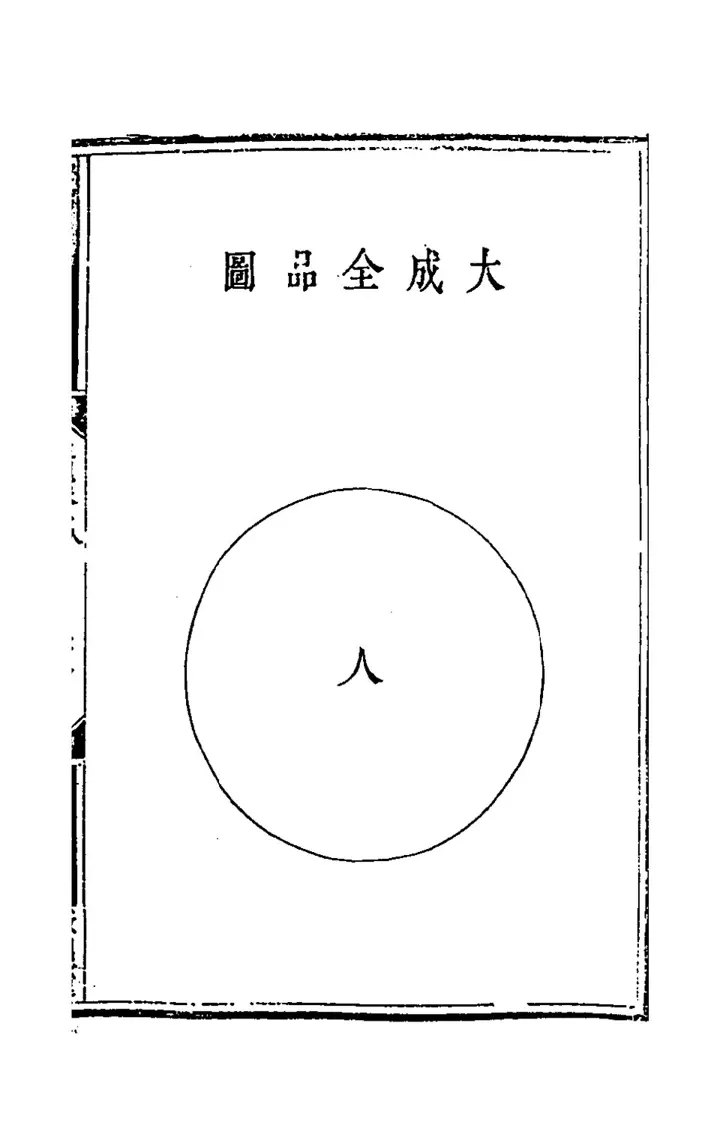
This is the rank of vital energy's completion. When heaven, earth and the myriad things are all in place, the human being is born. The birth of the human is not simply left to the qi of yin and yang rubbing and stirring against one another; there is truly the Real Ruler presiding over it. For if there were heaven and earth but no human, what use would the setting-up of heaven and earth be? If there were the myriad things but no human, to whom would the use of the myriad things return? From this we know that heaven, earth and the myriad things were all produced for the sake of the human. As for the human, the whole substance and great function of the Real Ruler are entirely gathered in him. With a knowing and capacity that are so of themselves, it worked the finest essence of the four elements, air, earth, water and fire, and after forty mornings his body was first completed, its outer and inner parts, frame and apertures, all corresponding to what exists in the world. The human body comprises the bodies of all that exists; the human heart embraces the hearts of all that exists; the human nature contains in undivided form the natures of all that exists. This is why the human is the most spiritual of the myriad things. Discussed by the principle of the Former Heaven, what makes the human human is the seed of all principle and qi; even vital energy issues from this seed. Discussed by the principle of the Latter Heaven, what makes the human human is the fruit of all principle and qi; from the time vital energy divided into yin and yang, running straight through to the end, all its manifestations came about for nothing other than this fruit. The fruit of the Latter Heaven is the seed of the Former Heaven. His frame and apertures lack no excellence, and the most subtle of them are the heart and the nature. The nature has ten virtues: five illuminate outward and five illuminate inward. Seeing, hearing, speaking, smelling and touching are called the five senses; they are distributed from the heart and issue at the surface. Recollecting, deliberating, retaining, awakening and general awareness are called the five powers; they are distributed from wisdom and lodged in the brain. The heart has seven layers, and its feelings are ten: joy, anger, love, aversion, grief, delight, worry, desire, hope and fear. When the ten feelings of the heart issue in accord with the ten virtues of the nature, that is the highest of its ranks. This is what makes the human human. The one who first received creation and became a human body is named Adam (Adan). The multitude of humankind hereafter were all born of Adam; even his mate came forth from his left rib. Adam is the first ancestor of all under heaven for ten thousand generations. Note (Hei of Qingyuan): "The four origins and the three children gathered their essence and formed the human body; the whole substance and great function were entirely gathered and formed the human nature; the Former Heaven and the Latter Heaven were knotted together and formed the human, the most spiritual of the myriad things. Heaven and earth are like a tree and the human is its fruit; the tree is fulfilled in the fruit, and when the human emerged the work of creation was complete. Hence it is called the rank of great completion. The fruit of the Latter Heaven is the seed of the Former Heaven. If one knows that the fruit is no different from the seed, one may come near to knowing how to fulfil one's humanity."
此元氣成全品也。天地萬物具備,則人生焉。人之生也,非一聽於陰陽之氣自相摩盪而成者也,實有真宰主持乎其中。蓋有天地而無人,則天地之設位何用?有萬物而無人,則萬物之取用誰歸?此以知天地萬物之生,凡以為人也。人也者,真宰全體大用畢聚於其中,以自然而然之知能,運氣、土、水、火四行之精粹,閱四十晨而其身始成,表裏體竅,無不與世界所有相印合。人之身,統括一切所有之身;人之心,包總一切所有之心;人之性,渾含一切所有之性。是以人為萬物之靈也。自先天之理論之,人之所以為人,乃一切理氣之種,即元氣亦從此種而發;自後天之理論之,人之所以為人,乃一切理氣之果,元氣自分陰分陽,直貫到底,亦無非為此果而始有諸凡之發露也。後天之果,即先天之種也。體竅無美不備,而其最微妙者,又無過於心、性二者。性有十德:五為外照,五為內照。曰視、曰聽、曰言、曰臭、曰觸,是謂五覺,分於心而發之於表;曰憶、曰慮、曰記、曰悟、曰總覺,是謂五力,分於智而寓之於腦。心七層,而其情有十:喜也、怒也、愛也、惡也、哀也、樂也、憂也、欲也、望也、懼也。心之十情,相合於性之十德而發者,則其品之上焉者也。此人之所以為人也。其始受造化而成其為人之身者,名曰阿丹,後此人類之繁,皆自阿丹生者也,即其配亦自其左肋而出者也。阿丹,天下萬世之元祖也。
Note by a later commentator: 清源黑氏 (Hei of Qingyuan)
清源黑氏曰:「四元三子,萃精而成人身;全體大用,畢聚而成人性;先天後天,締結而成其人,為萬物之靈。天地如樹,人其果;樹全於果,人出而造化之功完焉,故曰大成全品。後天之果,即先天之種。知果不異於種,庶幾知所以盡人矣。」
AIScan vol. 2, p. 55–60Transcribed from the scan by AI (Claude), checked as described on the About page.
2 uncertain readings in this passage
- 觸曰臭、曰觸· variant · cut with abbreviated right component; reading certain (p. 57)
- 萃四元三子,萃精而成人身or 革 (W)· witness-differs · C and 1923 clearly 萃 (p. 58)
AI
Key terms in this text
Each term's Arabic or Persian counterpart carries its grounding: the text itself, a published scholar, or AI. Tap one to find it in the text.
Connections
查密氏Jāmī, named in Book 1lineage
In the explanation of the undifferentiated Great Function (Book 1 · 4) Liu Zhi quotes 'Mr Chami', Jāmī, by name on knowing and power: the same author whose Lawāʾiḥ he turned into Chinese.
大成全品Faṣṣ Ādam: the human who gathers all the namesresonance, not influence
Book 1 ends with the human as the rank of great completion, in whom the whole substance and great function come together. The nearest image in the library is Ibn ʿArabī's Adam, the polished mirror; a resonance, not a claimed source here.
AI
Chinese: transcribed by AI (Claude) from the CADAL scans on Wikimedia Commons (public domain), checked against the zh.wikisource text (CC BY-SA); Books 1–5 also collated with the 1923 photoreprint (CADAL, Commons), and the Root Classic with the Chinese printed in Murata, Chittick and Tu (2009); punctuation is editorial. Books 1–5 keep the notes of Hei of Qingyuan (清源黑氏, Hei Mingfeng), a later commentator, apart from Liu Zhi's text. Arabic: Nūr al-Ḥaqq (Ma Lianyuan), al-Laṭāʾif, as printed in Murata, Chittick and Tu, The Sage Learning of Liu Zhi (2009), pp. 103–153 (public domain text; taken from the book's text layer and checked against the page images by AI, page by page; not yet proofread by a person). Characters: Unihan (Unicode licence), cjk-decomp (Apache-2.0), the Kangxi Dictionary (public domain) via Wikisource (CC BY-SA). The English and the term mappings marked AI were written by AI (Claude). Murata's translations are in copyright and are cited, never reproduced. How this text was established.