Liu Zhi 劉智 · c. 1670–after 1724
Nature and Principle in Islam
天方性理
卷二・圖說Book 2: the great world, its heavens and elements
Book 2 · 1 · Overview of Volume Two
概言 理象不二,當體求之
The second volume sets out what the first volume left unexpressed. Where it speaks of principle, it completes the principle that was not fully spoken of before; where it speaks of images, it completes the images that were not fully spoken of before. Yet principle is not one thing and image another: the image is the principle. To speak of images is precisely the means of making plain what in principle cannot be seen. If those who have a mind for it can seek it in the very substance before them, they will grasp both principle and image. If they cannot seek it in the very substance, then principle and image are far from them; though they leaf through these diagrams and this text every day, it is no more than a skimming, and what benefit is that to nature and mandate?
第二卷,乃發明第一卷未盡之意。其言理也,足乎其前所未盡言之理;其言象也,足乎其前所未盡言之象。然非理自理、象自象也,象即理也。言象,政所以申明其理之所不可見者耳。有心者若能于當體求之,則理象皆得;不能于當體求之,則理象之去人也遠矣,雖日披閱此圖此文,不過涉獵焉已耳,於性命奚裨?
AIScan vol. 2, p. 61Transcribed from the scan by AI (Claude), checked as described on the About page.
3 uncertain readings in this passage
- 政言象,政所以申明or 正 (W)· witness-differs · C and 1923 both print 政 (loan for 正 'precisely'); Wikisource normalises to 正
- 于若能于當體求之or 於· variant · print uses 于 here (twice) though 於 elsewhere; kept as printed
- 也其言理也,足乎· damaged · 也 at foot of first column blotted/doubled by ink; confirmed by 1923
AIBook 2 · 2 · The fourteen grades of nature in the Former Heaven
先天性品圖說 先天之性凡十四品
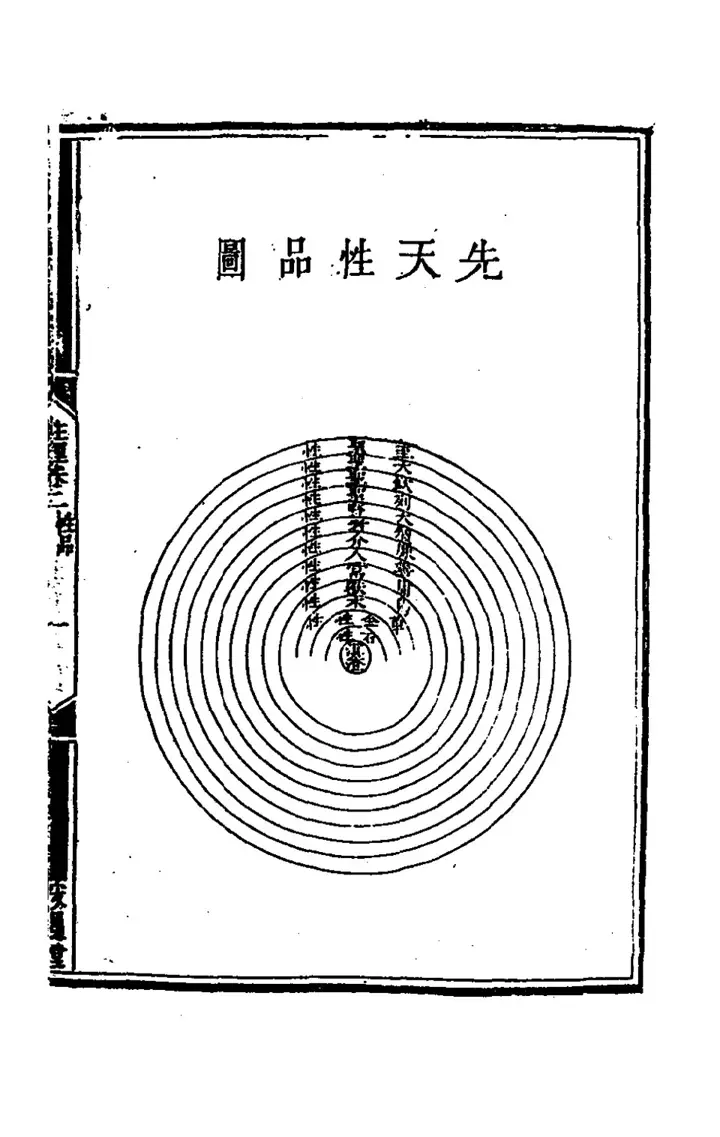
The grades of the Former-Heaven nature were already explained in the Diagram of the Initial Division of Nature and Principle. That a diagram is drawn here again and the account given in detail is because the more detailed the text that investigates principle, the more evident the principle becomes. The nature of the Former Heaven comprises fourteen grades in all. The nature of the Utmost Sage is the Real Ruler's own first manifestation; though it is called the nature of the Utmost Sage, in reality it is the knowing, ability, virtue and nature of the Real Ruler. Below the nature of the Utmost Sage, those that are set out in order by rank all obtain their several natures from the overflowing light of this one nature. Below this one grade, three are called sagely natures, one is called the great worthy, one is called the knowing, one is called the upright; the natures of the good man and of the ordinary man then descend in order after them. The natures of birds and beasts, grasses and trees, metals and ores, and stones come lower still. As for the dregs (mingzi), they are what is left over from all natures and mandates, formed by combining and transforming. From the nature of the Utmost Sage down to the dregs there are fourteen grades in all. The nature of the Utmost Sage is neither the same as nor different from the Original Suchness of the Real Ruler; the remaining grades of nature too are not very far from the Original Suchness of the Real Ruler; and that some reach such dullness that they bear no comparison at all is due to the limits of their rank. When the natures of all the grades have been disclosed in form and color, and number is exhausted and principle reaches its limit, the myriad things return to the root; they must still all go back into the nature of the Utmost Sage, and only then, by way of the nature of the Utmost Sage, return to the Original Suchness of the Real Ruler. This is why the nature of the Utmost Sage is the beginning and end of the myriad natures! Note (Hei of Qingyuan): 'The greater numbers end at nine, the lesser numbers end at five; joining the greater and lesser numbers, the fourteen grades are complete. The principles of the Former Heaven and the images of the Latter Heaven are all numbers without excess or deficiency. But the transformation of the Former Heaven ends in the dregs, and the transformation of the Latter Heaven ends in the three offspring; and man is born after the three offspring, so the human body is the lowest of the low. When lowness reaches its extreme, the end is exhausted and returns to the beginning, and it is united with the Real: this is what is called "wondrously united and congealed."'
先天性品,其說已發明於性理始分圖矣。至此又列圖而詳其說者,研理之文愈詳,而理愈著也。先天之性,凡十有四品。至聖之性,即真宰之自為首顯者也。其名雖曰至聖之性,而其實即真宰之知能德性也。自至聖之性之下,其依次而分著其品第者,皆從此一性之餘光而得各有其性也。此一品之下,以聖性稱者三,以大賢稱者一,以知稱者一,以廉介稱者一,善人、庸常之性,則又依次而遞下者也。鳥獸、草木、金鑛、石類之性,又其下而愈下者矣。溟滓之為物也,一切性命之所餘,相合變化而成者也。自至聖之性以至於溟滓,凡十有四品。至聖之性,與真宰之本然無同無異;其餘性品,亦與真宰之本然不甚相遠;而甚至頑鈍迥不相侔者,則其品第之界限為之也。諸品之性,發露於形色之後,數窮理極,萬有歸根,仍必盡返而入於至聖之性,乃得以因至聖之性而歸於真宰之本然。此至聖之性,所以為萬性之始終也歟!
Note by a later commentator: 清源黑氏 (Hei of Qingyuan)
清源黑氏曰:「大數盡於九,小數盡於五,合大小數而十四品盡之。先天之理,後天之象,皆無過不及之數。然先天之化盡於溟渣,後天之化盡於三子,而人又生於三子之後,則人之身為卑中至卑也。卑至於極,則盡終返始,與真合焉,所謂妙合而凝也。」
AIScan vol. 3, p. 4–7Transcribed from the scan by AI (Claude), checked as described on the About page.
4 uncertain readings in this passage
- 滓溟滓之為物也or 渣 (1923, W)· witness-differs · C clearly 滓 (twice in the 說); 1923 and W 渣; the commentary in C has 渣 (p. 6)
- 滓以至於溟滓or 渣 (1923, W)· witness-differs · as above (p. 6)
- 鑛金鑛、石類之性or 礦· variant · printed 鑛 (metal radical) (p. 5)
- 卑為卑中至卑也· variant · 卑 cut in a 甲-like form throughout the commentary (p. 7)
AIBook 2 · 3 · Knowing-and-ability in the grades of nature
性品知能圖說 品第別之以知能
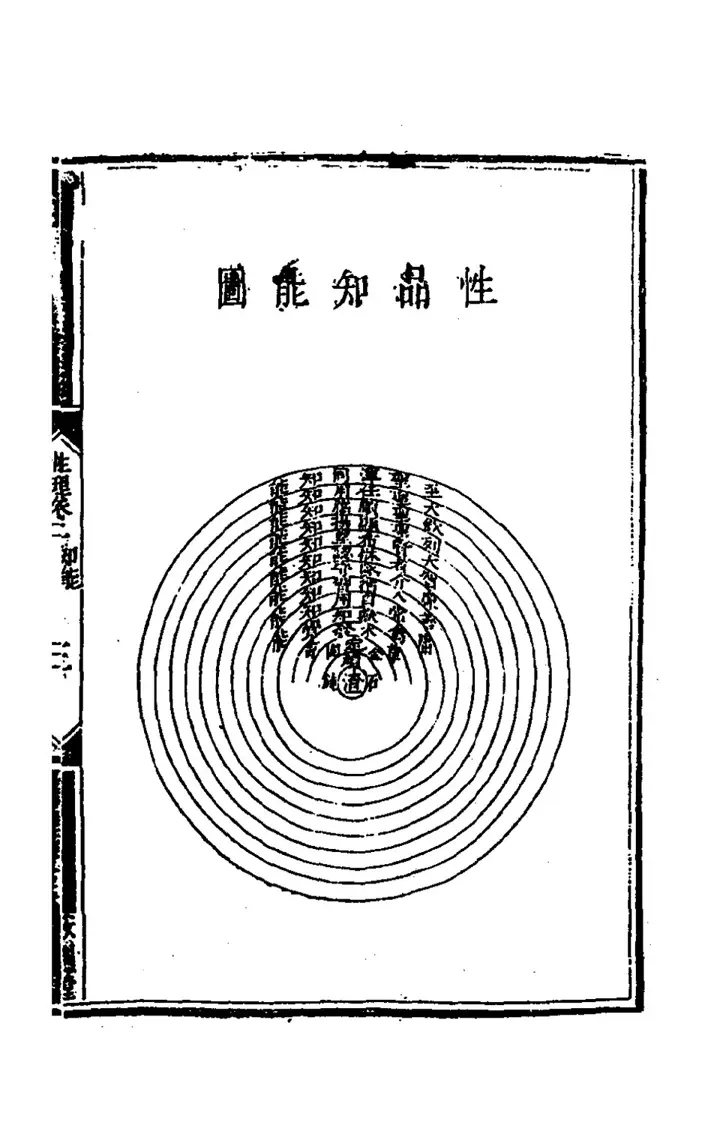
The Former-Heaven nature has fourteen grades in all. What distinguishes them from one another, so that each differs, is the knowing-and-ability (zhineng) within their nature. The knowing-and-ability of this sage is not the same as that of that sage, and so their ranks are clearly divided; the knowing-and-ability of the foolish and unworthy is not the same as that of the worthy and wise; the knowing-and-ability of things is not the same as that of human beings, and so their ranks lie apart by fivefold and countless degrees. The Utmost Sage has merged-identical knowing-and-ability: 'merged-identical' means that his knowing-and-ability is merged with the knowing-and-ability of the Real Ruler into one body, lacking nothing and exceeding in nothing. The great sage has commissioned knowing-and-ability: 'commissioned' means that his knowing-and-ability does not reach the merged identity, yet the knowing-and-ability of the Real Ruler lets him use it. Holding heaven and earth in order, for example, is the knowing-and-ability of the Real Ruler, yet the great sage too can raise the dead to life, move heaven and earth and the like, being allowed its use. The revered sage has responsive knowing-and-ability: being responsive, he cannot use it by commission, but only accords with the operation of the Real Ruler. The line of sages has manifesting knowing-and-ability: 'manifesting' means that whatever they receive of the disclosure of the Real Ruler's knowing-and-ability they proclaim in full to humankind. The great worthy has aspiring knowing-and-ability; the knowing one has realizing knowing-and-ability. 'Aspiring' means that he cannot be a sage yet seeks to reach sagehood; 'realizing' means that he seeks to understand the One Root and to realize it in himself. The upright have steadfast knowing-and-ability; the good man has habitual knowing-and-ability; the ordinary man has self-serving knowing-and-ability. When knowing-and-ability comes to be self-serving, it is very nearly that of a thing. Though things possess knowing-and-ability, it cannot be called knowing-and-ability: in birds and beasts it is called perception, in grasses and trees growth, in metal and stone firmness. It is the same knowing-and-ability, but the class of things received it last, so its grade is lower and it is felt to be gradually further from the Real Ruler. If one erases the traces of their distinction, removes the forms of before and after, and brings them back to the one source, things and human beings are not seen to be very far apart. Note (Hei of Qingyuan): 'Knowing-and-ability is the native endowment of each thing, received from the Creator. The Creator bestows it whole; men and things receive it partially. Yet it is not partial: each use has its fitness. Used fittingly, the partial is whole; used unfittingly, the whole is partial. It only depends on how a person uses it. "Each rectifies its nature and mandate, preserving and uniting the Great Harmony": that is what this means.'
先天性凡十四品,其所以彼此分別而各有不同者,別之以其性中之知能耳。此一聖之知能,不同於彼一聖之知能,而其品第判然分矣;愚不肖之知能,不同於賢知之知能;物之知能,不同於人之知能,而其品第相去倍蓰無算矣。至聖為渾同知能。渾同者,謂其知能與真宰知能渾同一體,無欠無餘也。大聖為任用知能。任用者,謂其知能不及於渾同,而真宰知能却任其所用,如綱維天地者,真宰之知能也,而大聖亦能起死回生、轉移天地等等,任其所用也。欽聖為順應知能。順應則不能任用,而但順應乎真宰之運用也。列聖為顯揚知能。顯揚者,謂其凡有得於真宰知能之發露,而盡以宣化於人類也。大賢為希望知能,知者為體認知能。希望者,謂其不能聖而欲求至於聖;體認者,謂其求明一本而體認之也。廉介為堅守知能,善人為循習知能,庸常為自用知能。知能而至於自用,則幾幾乎其近於物矣。物雖具有知能,而不可以知能稱:禽獸曰知覺,草木曰發生,金石曰堅定,同一知能也,而物類得之於最後,故其品愈下,而遂覺其漸遠於真宰也。若冺其分別之跡,去其先後之形,而復返之於一原焉,物與人未見其甚相遠也。
Note by a later commentator: 清源黑氏 (Hei of Qingyuan)
清源黑氏曰:「知能即各物之本領,受賦於造物者也。造物授之全,人物得之偏,非偏也,用各有宜耳。用之得宜,則偏者全;用之失宜,則全者偏。顧其人之用之何如耳。各正性命,保合太和,此之謂也。」
AIScan vol. 3, p. 8–12Transcribed from the scan by AI (Claude), checked as described on the About page.
3 uncertain readings in this passage
- 算相去倍蓰無算矣or 筭· unclear · small cut; could be read 筭 (variant of 算) (p. 9)
- 冺若冺其分別之跡or 泯; 混 (W)· variant · printed 冺 (ice-radical form of 泯), same in 1923; W 混 is an OCR error (p. 11)
- 却真宰知能却任其所用or 卻· variant · kept as printed (p. 9)
AIBook 2 · 4 · The fourteen layers of form and vessel in the Latter Heaven
後天形器圖說 後天形器凡十四層
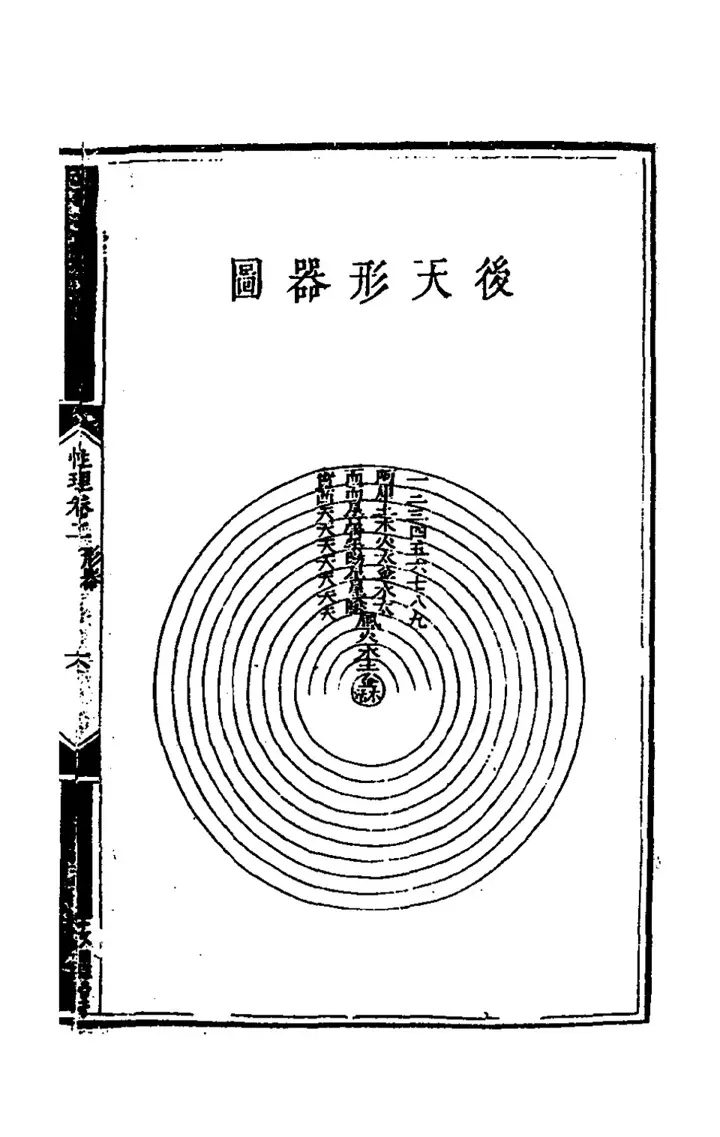
The forms and vessels of the Latter Heaven are fourteen layers in all, matching the number of the grades of nature in the Former Heaven. The layers of the upper realm are nine: these are the positions of the nine heavens. The layers of the lower realm are five: these are the four vital energies and the three offspring born of them. The Arsh (ā'ershi) is the purest, supreme heaven; the heavens hang in position within it like pearls hung in a crystal chamber. The body of this first heaven has form on the side facing downward and no form on the side facing upward. What is formless and faces upward does so because it still belongs to the Former Heaven; what has form and faces downward does so because it is where the Latter Heaven begins. Here positions are divided and heaven is divided into Former and Latter, yet there is no gap between the two realms. Its second layer is called the Kursi (kuerxi), the heaven to which the twenty-eight lunar mansions and the host of stars are fixed; though it has form, its form is truly beyond thought and discussion. When the primal fire burst into the body of heaven and formed images, its force could reach only this far; above this all is so pure that nothing can be fixed there. The seven heavens below each have only a single star fixed to them: Saturn to the third layer, Jupiter to the fourth, Mars to the fifth, the Sun to the sixth, Venus to the seventh, Mercury to the eighth, and the Moon to the ninth. Of the nine heavens, the uppermost is called the first layer and the lowest the ninth, counting from above downward, which is counting them in their proper order. To call the lowest the first heaven and the uppermost the ninth heaven would be counting them in reverse order. Each heaven is given one star because each heaven has its own function, and a star is placed in each as the lever of that heaven's function. Below the nine heavens, next to heaven comes wind, next to wind fire, next to fire water, next to water earth. Earth turns back toward water and congeals together with it, and metal is born. Metal can draw fire downward; when fire descends, vital energy follows it into the earth, and wood is born. Wood can grow and metal can resound; the two come together and are further matched to the stirring of the four vital energies, and the flying, soaring energy of life is born. Wood, metal and life (huo) are the three offspring born of the four vital energies wind, fire, water and earth; the three offspring together make only one of the fourteen layers. Note (Hei of Qingyuan): 'Scripture says: "Only the Arsh carries out the work of creation and nurture on His behalf." The principle of the Arsh is the wisdom of the Former-Heaven nature-and-wisdom; when it comes to rest in things it is called principle. As form, it is formless above and formed below; as vessel, it is empty above and congealed below. For the Former and Latter Heaven receive the current and spread the transformation, and it is the eggshell of the Latter Heaven; at the Kursi it is the white membrane within the shell. The order in which the three offspring are generated is set out here in greatest detail.'
後天形器,凡十四層,其數與先天性品之數相對。上界之層第九,即九天之位也;下界之層第五,即四氣與四氣所生之三子也。阿而實為至清無上之天,諸天之懸位於其中也,猶珠之懸於水晶室也。此第一天之體,一面有形向下,一面無形向上。無形而向上者,以其尚屬於先天也;有形而向下者,以其始入於後天也。此際位分,天分先後,而兩界却無隔絕。其第二層曰庫而西,為二十八宿及群星所麗之天,雖有形,而其形實無容思議者也。當其元火冒入於天體而成象也,其力僅能至此而止,過此以上,則至清而無可麗矣。下此七天,則每一層僅有一星麗之:其三層則土星麗焉,四層則木星麗焉,五層則火星麗焉,六層則太陽麗焉,七層則金星麗焉,八層則水星麗焉,九層則太陰麗焉。天有九,而於其最上者稱為一層,於其最下者稱為九層,葢自上而數及於下也,是為順其次第而數之也。若於其最下者稱為一天,最上者稱為九天,則為逆其次第而數之矣。其每一天安置一星者,葢每一天有一天之功用,各置一星以作本天功用之機權也。九天之下,其次於天者風,次於風者火,次於火者水,次於水者土。土返而向水,遂與水相凝合,而金生焉。金能吸火下降,火降則氣隨入於土,而木生焉。木能生而金能鳴,二者相湊,又以適合於四氣之感,而飛揚生活之氣生焉。木、金、活三者,風、火、水、土四氣所生之三子也,合三子而僅為十四層之一層。
Note by a later commentator: 清源黑氏 (Hei of Qingyuan)
清源黑氏曰:「經曰:『惟阿而實代行化育。』阿而實理,即先天性智之智也,歸之於物,則名曰理。其為形也,上無下有;其為器也,上虛下凝。葢先天後天承流宣化,而後天之卵殼也。至庫而西,則殼內白翳矣。三子生生之次第,於此尤詳。」
AIScan vol. 3, p. 13–17Transcribed from the scan by AI (Claude), checked as described on the About page.
2 uncertain readings in this passage
- 群及群星所麗之天or 羣 (1923)· variant · C 群, 1923 羣 (p. 14)
- 理阿而實理,即先天性智之智也· unclear · reading clear, but the syntax (阿而實理 'the principle of the Arsh') is uncertain; punctuation editorial (p. 17)
AIBook 2 · 5 · The functions of the layers of form and vessel (1)
形器功用圖說 每一層有一層之功用(一)
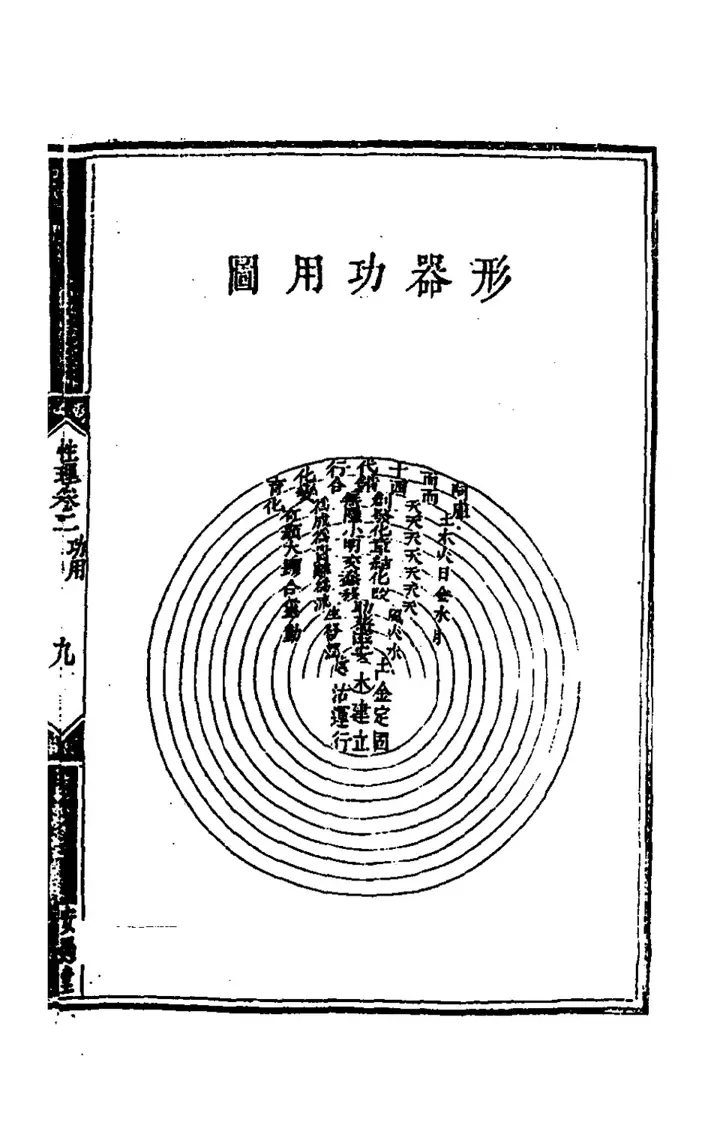
Of the fourteen layers of form and energy, each layer has its own function. The multiplicity of the myriad things and the differences in human affairs are all shone upon and joined together by the functions of these fourteen layers. The Arsh has the function of carrying out the work of creation on the Creator's behalf, because it stands at the very head of the forms and vessels and has received the full power of the Real Ruler's creation and nurture. One face turns toward the world of principle, one face toward the world of images; whenever a thing of the world of principle is about to come into the world of images, it must come by way of this realm before it can become a person or thing of the world of images. The functions of the heavens below it are likewise all obtained from this heaven, so its function is the general governance of the functions of all the heavens. The Kursi has the function of combining and transforming. The functions of the heavens are each fixed and cannot substitute for one another, but this heaven alone can carry out the functions of the other heavens: above, it acts for the Arsh in gathering the motions of all the heavens; below, it acts for the heavens in carrying out the work of each. The reason is that each heaven carries one star and its function likewise returns to a single matter, whereas the stars of this heaven are beyond counting, the twenty-eight lunar mansions and all the host of stars being fixed to it, so its functions too are beyond counting. The heaven of Saturn creates being from non-being: that persons and things are given shape and substance and pass from non-being to being is all the function of this heaven. The heaven of Jupiter brings the hidden into manifestation: that things grow and flourish, that people are talented, quick and eminent, and all auspicious signs and portents, are the function of this heaven. The heaven of Mars turns the small into the great: that persons and things go from small to great and one shelters another, and all bitterness, poison, calamity and prodigy, are the function of this heaven.
形氣十四層,每一層有一層之功用。萬物之紛錯,人事之不同,莫非此十四層功用有以照映而關合之也。阿而實為代行造物之功用,以其居形器之最首,而得夫真宰化育之全能也。一面向理世,一面向象世,凡理世一物欲來於象世,必由此境而來,乃能成其為象世之人物也。其下諸天之功用,亦莫不由此天而得,故其功用為諸天功用之總持也。庫而西為錯合變化之功用。諸天功用皆各有一定,不能彼此相代,而此天獨能代行別天之功用:上代阿而實以總諸天之動,下代諸天以行其本天之用。所以然者,因諸天各載一星,而其功用亦只各歸於一事;此天之星無可數計,二十八宿及一切群星莫不麗於其上,故其功用亦無可數計。土星天則創無為有者也,人物賦形成質、自無趨有,皆此天之功用也。木星天則發隱成顯者也,物之所以生長發達,人之所以才敏茂著,以及一切祥徵瑞應,皆此天之功用也。火星天則化小為大者也,人物自小而大、由此蔭彼,以及一切苦毒災異,皆此天之功用也。
AIScan vol. 3, p. 18–21Transcribed from the scan by AI (Claude), checked as described on the About page.
Book 2 · 6 · The functions of the layers of form and vessel (2)
形器功用圖說 功用者真宰妙用之跡(二)
The heaven of the Sun makes bright, noble and eminent. Its function falls short only of the two heavens of the Arsh and the Kursi, but compared with the six heavens above and below it, it is the most abundant. The six heavens above and below all depend on the force of this heaven's function before they can carry out their own. The reason is that it stands at the very center of the Seven Governors and is truly their ruler; the six heavens above and below are merely its assistants. Thus the life of men and birds, the growth of grasses and trees, the transformation of metals and stones, the abundance of flowers and fruit, the eminence of persons and things, the health and long life of the strong: all are done by this heaven's function. Clouds, rain, thunder and lightning, mist, dew, frost and snow, cold, heat, damp and dryness, the coming and going of the four seasons, the waxing and waning of the myriad things, and every change and action, are all accomplished by the function of this heaven. The heaven of Venus has the function of bonding and parting: the meeting and joining of persons and things, their mutual attraction and pairing, and all sounds and colors, looks, fragrances and odors, tastes and smells, are all done by this heaven's function. The heaven of Mercury transforms the dull into the spiritual: that persons and things go gradually from dullness to spirit and from darkness to brightness, the removal of dirt and stain, and all soaking, moistening and transparency, are all done by this heaven's function. The heaven of the Moon is good at shifting and flowing: all sudden increase and decrease, swift success and failure, the ebb and flow of the tides and the upheavals of affairs, are all done by this heaven's function. The function of wind is to release what is pent up and so assist life; the function of fire is to steam and so assist warmth; the function of water is to moisten and so enrich the savor of life; the function of earth is to bear and carry and so give a secure place. Metal is good at fixing and firming; wood is good at building and establishing; life is good at moving and circulating. With the functions of the upper and lower realms complete, the work of the forms and vessels is finished. Function is the trace of the Real Ruler's wondrous operation; wondrous operation is the lively flowing of the whole substance, not stuck in any one fixed form. If from the forms and vessels one comes to know their functions, and from the functions of the fourteen layers comes to awaken to the whole substance and great function of the Real Ruler, then one may call the forms and vessels forms and vessels, and one may equally call them not forms and vessels. Note (Hei of Qingyuan): 'In man it is called knowing-and-ability, in things function: all is the one wondrous operation of the Real Ruler flowing forth and appearing in the myriad things. The wondrous operation is the same while the functions differ, as the mind moves a single brush yet writes ten thousand different characters. Knowing this, one awakens to the fact that the whole substance and great function of the Real Ruler penetrates and permeates everywhere, and every single thing is the manifestation of the Real Ruler's Original Suchness. How then can it be confined to forms and vessels?'
太陽天則章明貴顯者也。其功用特不及於阿而實、庫而西兩天,然較上下六天為最盛焉。上下六天莫不借此天功用之力,而乃能自行其本天之功用。所以然者,以其位居七政之最中,而實為七政之主宰也,上下六天特其輔佐耳。故凡人禽之生活,草木之長發,金石之變化,花實之蕃碩,人物之貴顯,年力之康壽,皆此天功用為之。即雲雨雷電、霧露霜雪、寒暑濕燥、四時往復、萬物消長,一切變化施為,皆莫不成於此天之功用也。金星天為結交離合之功用,人物交接契合、相感相配,以及一切音聲色貌、香臭氣味,皆莫非此天之功用為之。水星天則化蠢而為靈者也,人物有蠢而漸化於靈者,有暗而漸化於明者,除垢却污,以及一切浸潤透亮之故,皆莫非此天之功用為之。太陰天則善於改移而流動者也,凡一切乍增乍減、倏成倏敗,以及潮汐之消長、事物之變亂,皆莫非此天之功用為之。風之功用為能舒鬱以助生活,火之功用為能薰蒸以助溫煖,水之功用為能滋潤以益生味,土之功用為能負載以奠安處;金則善於定固者也,木則善於建立者也,活則善於運行者也。上界下界之功用全,而形器之能事畢矣。功用者,真宰妙用之跡也;妙用者,全體之活潑流行而不膠於一定者也。因形器以識形器之功用,復因十四層之功用以悟真宰之全體大用,則謂形器為形器可也,即謂形器為非形器可也。
Note by a later commentator: 清源黑氏 (Hei of Qingyuan)
清源黑氏曰:「人曰知能,物曰功用,總一真宰之妙用流行而發現於萬物者也。妙用同而功用異者,若心運一筆而書分萬字也。知此,乃悟真宰之全體大用無不周通貫洽,物物皆真宰之本然顯現也。顧可以形器拘乎哉?」
AIScan vol. 3, p. 21–24Transcribed from the scan by AI (Claude), checked as described on the About page.
5 uncertain readings in this passage
- 電即雲雨雷電· unclear · page break p21/p22: p21 ends 雲雨雷, p22 begins 電 (top of first column slightly worn) (p. 22)
- 暗有暗而漸化於明者· unclear · 暗 cut with an odd phonetic; 1923 暗 (p. 22)
- 固善於定固者也or 困 (W)· witness-differs · C and 1923 固; W 困 is an OCR error (p. 23)
- 洽無不周通貫洽· damaged · character after 貫 is badly damaged (only a small 合-like right part survives); 1923 and W read 洽 (p. 24)
- 章太陽天則章明貴顯or 彰 (W)· witness-differs · C and 1923 章; W 彰 (p. 21)
AIBook 2 · 7 · How principle and image belong together
理象相屬圖說 理與象本相屬
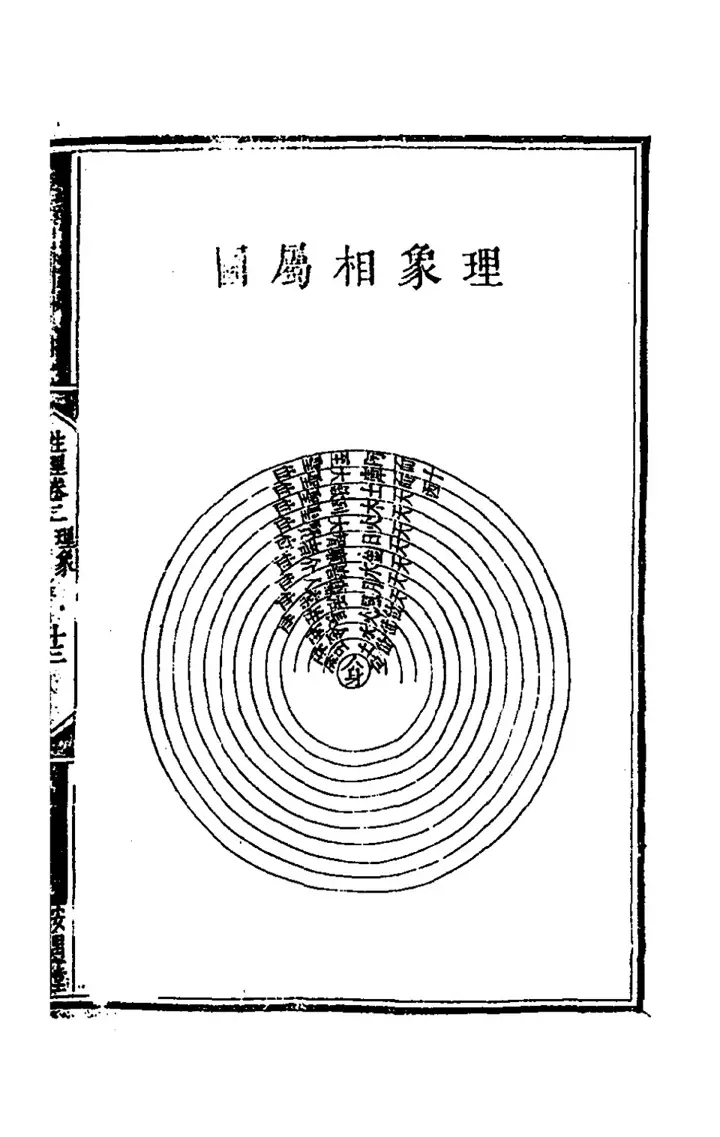
Nature and principle are the Former Heaven; forms and vessels are the Latter Heaven. The nature and principle of the Former Heaven are what the forms and vessels of the Latter Heaven come from; the forms and vessels of the Latter Heaven are where the nature and principle of the Former Heaven are lodged. Hence principle and image belong together from the root. Someone asks: 'The forms and vessels are where nature and principle are lodged; but I do not know how they are lodged. Are nature and principle lodged within the forms and vessels? Or do they not depend on the forms and vessels, but have some other wondrous way of being lodged?' Answer: 'The forms and vessels of the Latter Heaven are the allotted positions of the nature and principle of the Former Heaven. "Allotted position" speaks of where nature and principle are directed; it does not mean that the nature and principle of a given grade are confined within that grade.' Someone asks: 'The images of the various grades are not confused with one another; but I do not know whether the natures of the grades are one merged principle filling the space beyond sight and hearing, or whether each has its own place and so they are not confused.' Answer: 'What distinguishes the nature and principle of the Former Heaven is a distinction of meaning and principle, and meaning and principle have no traces. So though there is division, no trace of division is seen; within the undivided oneness of principle there is of itself a wonder by which nothing is confused. Seen from its profound flowing, penetrating above and below, there is nothing that is not filled by the one principle, and one may call it united without division. Seen from its timely manifestation, sages and ordinary men, persons and things, have never overstepped their place by a hair, and one may call it united yet divided. As for the belonging together of principle and image, it too is only a belonging in meaning, not a confinement in traces.' The Arsh is the position of the Utmost Sage, the Kursi the position of the great sage, the heaven of Saturn the position of the revered sage, the heaven of Jupiter the position of the line of sages, the heaven of Mars the position of the great worthy, the heaven of the Sun the position of the knowing, the heaven of Venus the position of the upright, the heaven of Mercury the position of the good man, the heaven of the Moon the position of the ordinary man. All are assigned positions according to their rank, and each also takes as its position the heaven whose meaning is close to its own nature. The things of the lower realm take their positions each according to the class from which it was born: what exists by having the nature of life follows wind; what exists by having the nature of wood follows fire; what exists by having the nature of metal follows water; what exists by having the nature of stone follows earth. All follow the class from which they were born, and their positions belong together of themselves. In the belonging together of principle and image, sages and ordinary men, persons and things, are not two. Note (Hei of Qingyuan): 'Nature and principle are a wondrous thing, enfolding heaven and wrapping earth, beyond all measure. Not only human nature is so: even down to ants, insects, mosquitoes and gnats, measured by their original capacity, they are no less than human nature, and no less than the whole substance and great function of the Real Ruler. Only, seen where they are manifested, each has a fixed position. Its position is like thought in the mind, which is after all not bound within the mind; like nature in the body, which is after all not confined within the body. Otherwise a five-foot body would have only a five-foot nature. The teaching of belonging by meaning deserves reflection.'
性理,先天也;形器,後天也。先天之性理,為後天形器之所從出;後天之形器,為先天性理之所藏寓。故理與象本相屬也。說者曰:「形器為性理之所藏寓,但不知其為藏寓也,性理即藏寓於形器之間乎?抑不必依附形器,而別有所以妙其藏寓者乎?」曰:「後天之形器,先天性理之位分也。位分者,言乎其性理之所向,非謂某一品之性理即囿於某一品之中也。」說者曰:「各品之象不相淆亂,但不知各品之性為渾同一理而充滿於不可見聞之間乎?抑各有所在而不相淆亂乎?」曰:「先天之性理,其所以分別者,義理之分別也。義理非有跡者也,是以雖有所分,而不見其有分之跡,渾然一理之中,自有不相淆亂之妙。自其於穆流行處觀之,徹上徹下,無非一理之所充周,謂之為合而不分可也;自其以時發現處觀之,聖凡人物未嘗有毫釐之隕越,謂之為合而有分可也。至其理與象之相屬也,亦不過屬於其義,而非域於其跡也。」
阿而實為至聖之位,庫而西為大聖之位,土天為欽聖之位,木天為列聖之位,火天為大賢之位,日天為知者之位,金天為廉介之位,水天為善人之位,月天為庸常之位,要皆因其品第而屬之以其位也,又各以其性與其天之義理相近似者而為位也。下界之物,其性則各從其所生之類而為位也:得活性而有者從風,得木性而有者從火,得金性而有者從水,得石性而有者從土,皆因乎其本生之類,而其位自相屬也。理象之相屬,聖凡人物無二致也。
Note by a later commentator: 清源黑氏 (Hei of Qingyuan)
清源黑氏曰:「性理,妙物也,包天裹地,莫可限量。不惟人性如此,即極之蟻虫蚊蚋,以本量言之,未始不與人性等,未始不與真宰全體大用等。第自其發現處觀之,則各有定位耳。其位也,若意在心,究不拘於心中;若性在身,究不囿於身內。不然,則五尺身當亦五尺性矣。屬義之說可思。」
AIScan vol. 3, p. 25–29Transcribed from the scan by AI (Claude), checked as described on the About page.
6 uncertain readings in this passage
- 分位分者,言乎or 定 (W)· witness-differs · C and 1923 位分者; W 位定者 (p. 26)
- 所而別有所以妙其藏寓· witness-differs · C and 1923 have 所以; W 有以 (p. 26)
- 釐毫釐之隕越or 氂· unclear · the cut looks like a 氂/釐 hybrid (毛-like lower part); adopted 釐 (p. 27)
- 囿性理即囿於某一品· variant · 囿 cut with a narrow enclosure (p. 26)
- 裹包天裹地or 褁· variant · printed 褁 (槖-like form of 裹) (p. 29)
- 虫即極之蟻虫蚊蚋or 蟲 (1923)· variant · C prints a 虫-type short form (with a small 口 on top); 1923 蟲 (p. 29)
AIBook 2 · 8 · The distances of the nine heavens
九天遠近圖說 九天去地之數與星之大小
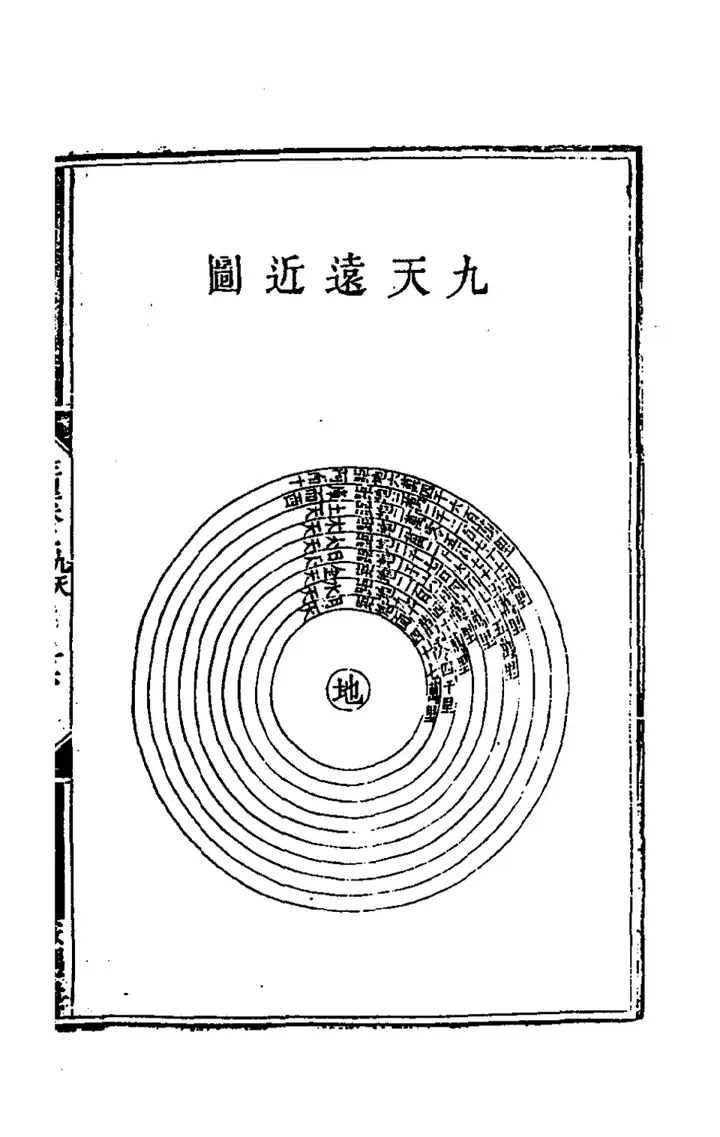
Heaven is divided into nine layers, yet what divides them is formless. That the formless can be known as near or far is because one observes how near or far the star of each heaven is, and from that knows how near or far that heaven is. The heaven of the Moon is about 470,000 li from the earth; the heaven of Mercury about 904,000 li; the heaven of Venus about 2,400,000 li; the heaven of the Sun about 16,000,000 li; the heaven of Mars about 27,400,000 li; the heaven of Jupiter over 126,750,000 li; the heaven of Saturn over 205,750,000 li; the Kursi about 322,770,000 li; and the Arsh is twice as far from the earth as the Kursi. These figures for the distance of each heaven from the earth are fixed as the radius of each heaven. Knowing the radius, one can know the diameter; reckoning from the diameter by 'diameter one, circumference three', one can know the circumference, and how great the whole body of each heaven is, without the slightest error. The distance and size of the heavens are known from their stars, and the stars of each heaven also have a fixed size. The mansions and host of stars of the Kursi fall roughly into seven magnitudes: the first magnitude is 110 times larger than the earth, the second 90 times, the third 70 times, the fourth 53 times, the fifth 35 times [the passage continues on vol. 3 p33]. [Continuing the explanation of the diagram of the distances of the nine heavens:] … those of the sixth magnitude are seventeen times larger than the earth, and the smallest are seven times larger than the earth. Saturn is ninety times larger than the earth, Jupiter seventy-four times larger, Mars one and a half times larger, and the sun one hundred and sixty-five times larger. Venus is thirty-six times smaller than the earth, Mercury more than twenty thousand times smaller, and the moon thirty-eight times smaller. The distances of the heavens and the sizes of the stars are as plain as a row of eyebrows; whoever studies forms and vessels must go on to know what is greater still. The earth lies within the nine heavens like a single grain of sand in a vast wilderness; the nine heavens lie within human nature, and whether they count as great or small there is just as with the earth lying within the nine heavens. Note (Hei of Qingyuan): 'Tracing back to when the primordial vital energy divided into images, there was originally no count of li that could be recorded from earth to heaven; yet the ratio of a diameter of one to a circumference of three does not err. Apply it to the heavens and their distances can be known; apply it to the stars and their sizes can be understood. The worthies of Tianfang made a square rule one foot long and measured out the full dimensions of heaven and earth, and they also wrote treatises on the method of measurement, to put an end to fanciful doubts. Yet this too is measuring vessels with a vessel. If the original nature becomes manifest, it sees the nine heavens as a single grain of sand; what number would then be hard to know? Let the reader not stay at the bottom of the well.'
天分九重,而其所以分則無形者也。無形而得以知其遠近者,葢觀其本天之星之遠近,而因以知其天之遠近耳。太陰天去地約四十七萬里,水星天去地約九十萬四千里,金星天去地約二百四十萬里,太陽天去地約一千六百萬里,火星天去地約二千七百四十萬里,木星天去地一萬二千六百七十五萬餘里,土星天去地二萬五百七十五萬餘里,庫而西去地約三萬二千二百七十七萬里,阿而實去地倍於庫而西去地之數。各天去地遠近之數,葢即其各天半徑之數而定之也。知半徑之數,則可以知全徑之數矣;即全徑之數推之,徑一圍三,便可以知周圍之數,而各天全體之為若干大也,絲毫不爽矣。天之遠近大小,因其星知之,而各天之星則亦有大小一定之體。庫而西之列宿群星,約其大概,分為七等:一等者大於地一百一十倍,二等大於地九十倍,三等大於地七十倍,四等大於地五十三倍,五等大於地三十五倍六等大於地十七倍,至小者大於地七倍。土星大於地九十倍,木星大於地七十四倍,火星大於地倍半,日大於地一百六十五倍,金星小於地三十六倍,水星小於地二萬餘倍,月小於地三十八倍。天之遠近、星之大小,粲若列眉,觀形器者,不可不更知其大者也。地位於九天之中,如大荒中一沙;九天位於人性之中,其為大為小,葢亦猶地位於九天之中也。
Note by a later commentator: 清源黑氏 (Hei of Qingyuan)
清源黑氏曰:「溯自元氣分象,自地至天,原無里数可紀,然徑一圍三,数不爽也。以測天,天之遠近可知;以測星,星之大小可曉。天方名賢造一尺之矩,量盡天地之数,復著測量法譜,以杜荒唐之疑,然亦以器測器也。若本性發現,視九天如一沙,有何難知之數?覽者勿自居井下。」
AIScan vol. 3, p. 30–34Transcribed from the scan by AI (Claude), checked as described on the About page.
4 uncertain readings in this passage
- 圍便可以知周圍之數or 環 (W)· witness-differs · C and 1923 周圍; W 周环 (p. 32)
- 三四等大於地五十三倍or 二 (W)· witness-differs · C and 1923 五十三; W 五十二 (p. 32)
- 数原無里数可紀or 數· variant · C prints the short form 数 three times in this note (里数, 数不爽, 天地之数) but 數 in 難知之數; kept as printed. 1923 has 數 throughout (p. 34)
- 葢葢亦猶地位or 蓋· variant · print form 葢 used throughout this range (kept, as in tf1-tf2); 1923 蓋 (p. 33)
AIBook 2 · 9 · The revolution of the nine heavens
九天旋轉圖說 自然之動、反掣之動
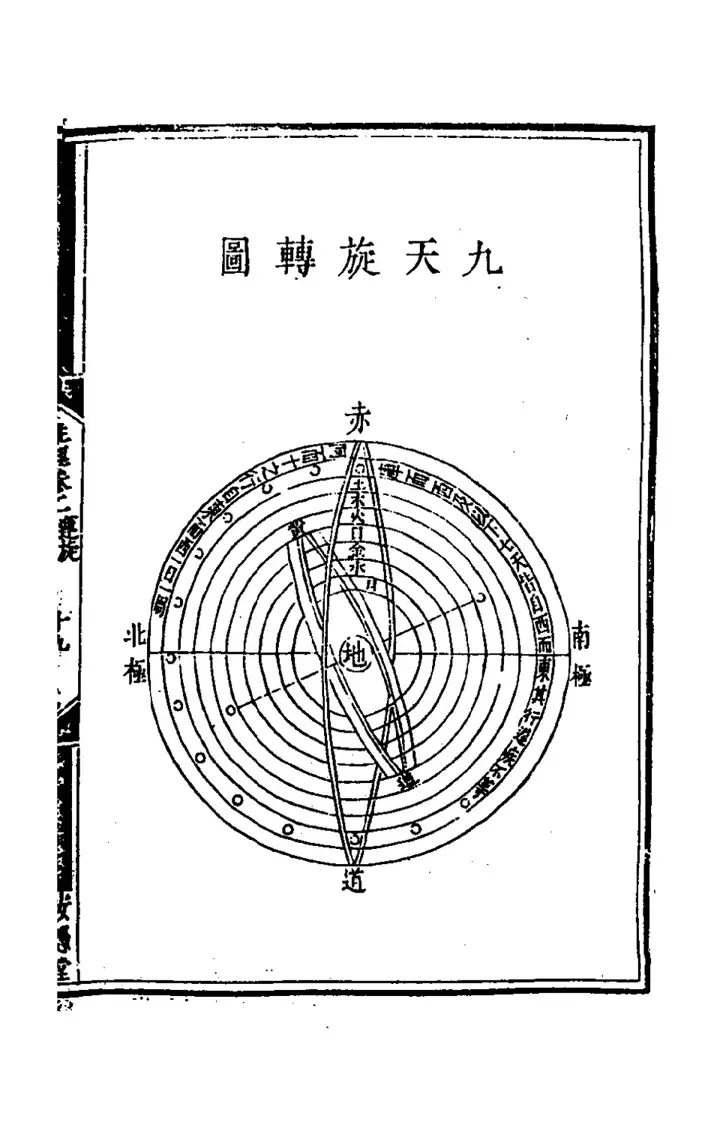
The revolution of the Arsh ('Throne') runs from east to west; this is natural motion. The revolution of the other heavens runs from west to east; this is counter-pulled motion. Once the teaching of the two motions is clear, one knows that the working of the nine heavens' revolution is in every case the doing of the four vital energies as they connect and combine with one another. Why does the Arsh move from east to west? Because the east is the proper seat where living vital energy (qi, air) gathers. The seat of qi is in the east, so the Arsh's revolution starts from the east; starting from the east, it travels toward the west. This is called natural motion. Why do the Kursi ('Footstool') and the seven heavens below it move from west to east? Because the west is the correct position allotted to earth. The root mandate of all eight heavens is bound up with earth, and the correct position of earth is in the west; so their revolution starts from the west, and starting from the west it travels toward the east. Why are the Kursi and the seven heavens below it all bound up with earth? When the primordial fire burst into the bodies of the heavens and they took on their images, the Arsh alone was something the primordial fire could not attach to; the other eight heavens all have it. Earth is the trace that fire leaves behind; therefore all eight heavens are bound up with earth. What is counter-pulled motion? The Arsh revolves from east to west and drags along the eight heavens below it, so that they too have a tendency from east to west. But the eight heavens' own course is in fact from west to east. So although their tendency is pulled along by the Arsh, their own course does not follow it: they have an east-to-west tendency, yet in fact they travel from west to east. This is called counter-pulled motion. Of the nine heavens' revolutions, one is natural motion and eight are counter-pulled motion. Because the two motions never cease, not only do the qi of the east and the earth of the west enter into each other, but the fire of the south and the water of the north are also, through the dragging of this revolution, carried around and spread in. That the four vital energies blend and become the source of the nurturing transformation of all things is in every case the work of the nine heavens' revolving power. This teaching is something those who exhaust principle and investigate things must know. As for talk of the equator and the ecliptic and the names of the south and north poles, these are the common talk of observers of the celestial images, and I will not repeat them. Note (Hei of Qingyuan): 'The teaching of the two motions has been understood only in recent times. The simile of the ant on the millstone grasps only the outward form; does it know that counter-pull and dragging are why the revolutions go as they do? The teaching that the two energies enter each other and that water and fire blend is of great help to the investigation of things.'
阿而實之旋轉也,自東而西,是為自然之動;其餘諸天之旋轉也,自西而東,是為反掣之動。兩動之說明,乃以知九天旋轉之為用,皆四氣互相關合之所為也。阿而實何以自東而西?葢東方者,生氣所聚之專位也。氣之專位在東,故其旋轉自東而起,起於東則行於西矣,是之謂自然之動。庫而西並以下七天何以自西而東?葢西方者,土所分定之正位也。八天之本命皆與土有相關之義,土之正位在西,故其旋轉自西而起,起於西則行於東矣。庫而西並以下七天何以皆與土相關?當其元火冒入於天體而成象也,惟阿而實為元火之所不能麗,其餘八天皆有焉。土者,火之所存跡也,故八天皆與土有相關之義。何為反掣之動?阿而實之旋轉也,自東而西,帶動以下八天,亦有自東而西之勢;而八天本行實自西而東,故其勢雖為阿而實所牽動,而本行却不隨之,雖有自東而西之勢,而實為自西而東之行,是之謂反掣之動。九天之旋轉也,一為自然之動,八為反掣之動。兩動不息,則不惟東方之氣、西方之土互相融入,即南方之火、北方之水,亦莫不因其旋轉帶動而運行布入矣。四氣之所以交融而為化育萬物之原者,皆九天旋轉之力為之也。此其說,窮理格物者所不可不知也。赤道、黃道之說,南極、北極之稱,觀乾象者之所常談焉耳,不復贅。
Note by a later commentator: 清源黑氏 (Hei of Qingyuan)
清源黑氏曰:「两動之說,近代始曉。蟻磨之喻,僅得其形,亦知反掣牽動所以運旋有如是乎?两氣互入、水火交融之說,大有裨於格致。」
AIScan vol. 3, p. 35–39Transcribed from the scan by AI (Claude), checked as described on the About page.
2 uncertain readings in this passage
- 却而本行却不隨之or 卻· variant · form as printed (p. 37)
- 两两動之說,近代始曉or 兩· variant · Hei note prints 两 (twice, also 两氣互入), while the main text prints 兩; kept as printed. 1923 兩 (p. 38)
AIBook 2 · 10 · The proper positions of the four agents
四行正位圖說 氣東、土西、火南、水北;木金子母同宮
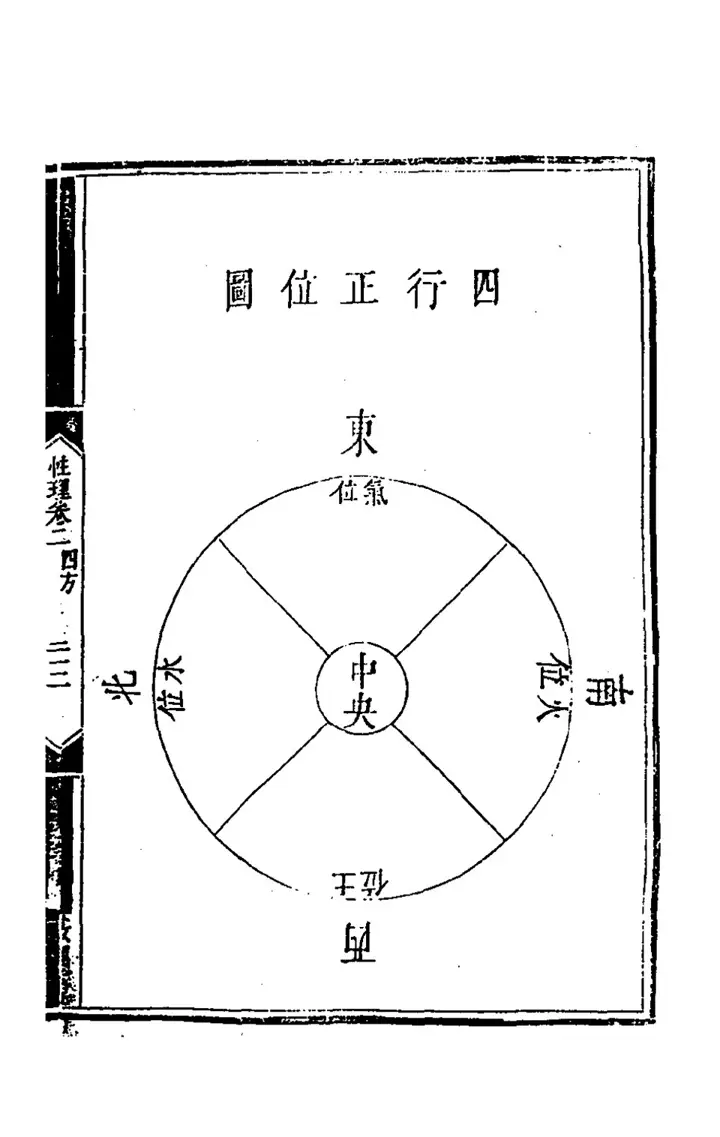
The four agents are the four images. Qi (air) is born from water, and earth comes out of fire: qi, earth, water and fire are the four agents. The four agents are the mother of all things, and each of them has a seat on which it is concentrated. Qi is seated in the east and moves from east to west; earth is seated in the west and moves from west to east; fire is seated in the south and moves from south to north; water is seated in the north and moves from north to south. Each moves out from its own seat until, where everything is filled and no gap remains, the four vital energies mix into one another and roll together into a single qi. If the four moved singly, the myriad things would have no way to be born; because the four mix together, the myriad things are here transformed and nurtured. Someone objects: 'That the south is the correct position of fire and the north the correct position of water is nothing strange. But the east is the correct position of wood, and here you say the correct position of qi is in the east; the west is the correct position of metal, and here you say the correct position of earth is in the west. What does this mean?' I reply: 'Wood is born from water and metal is born from earth. When the four agents first divided, wood and metal did not yet exist; the children had not taken form, and their mothers in fact occupied these places. Qi is the true yang within water that rises upward. Although qi is not called water, it is in fact the essence of water and the mother of wood; therefore its allotted seat is solely in the east. Once wood was born, the child came to share its mother's palace. Metal is the child of earth; before metal was born, its mother's correct position was set solely in the west; once metal was born, the child likewise came to share its mother's palace. That the correct position of wood is in the east and that of metal in the west belongs to the Latter Heaven; that the correct position of qi is in the east and that of earth in the west comes before what comes first. Once the meaning of before and after, child and mother, is clear, the wonderful working of these eastern and western positions yields more the further one seeks it.' Note (Hei of Qingyuan): 'North and south have fixed positions; east and west do not. North and south take the two poles as their fixed positions; east and west take heaven and earth as theirs. For heaven belongs to qi and is the east; if heaven is the east, then earth is the west. Those who match the five agents to directions and allot earth to the centre do not know the teaching that east and west have no fixed positions. The account of wood and metal as child and mother is precise and worth pondering.'
四行,即四象也。氣自水生,土因火出,氣、土、水、火,是為四行。四行為萬物之母,而其每一行各有一專注之位:氣位於東,而其行也自東而西;土位於西,而其行也自西而東;火位於南,而其行也自南而北;水位於北,而其行也自北而南。各自其本位而行,至於瀰滿無隙之處,則四氣互相攙入而滚為一氣矣。四者單行,則萬物無自而生;四者相攙,則萬物於茲而化育焉。說者曰:「南方為火之正位,北方為水之正位,無足異也。至於東方為木之正位,而茲乃曰氣之正位在東;西方為金之正位,而茲乃曰土之正位在西,其義何也?」曰:「木生於水,金生於土。當其四行之始分也,木與金尚未有也,其子未形,其母實居於此。氣者,水中之真陽上升者也。氣雖不名為水,而其實為水之精,木之母也,故其位分專住於東;迨至於木之既生,而其子與母同宮矣。金為土子,金未生而其母之正位專列於西;迨至於金之既生,而其子亦與母同宮矣。木之正位在東、金之正位在西者,其後天也;氣之正位在東、土之正位在西者,先乎其先者也。先後子母之義明,而其位東位西之妙用,愈尋而愈出矣。」
Note by a later commentator: 清源黑氏 (Hei of Qingyuan)
清源黑氏曰:「南北有定位,東西無定位也。南北以二極為定位,東西乃以天地為定位也。葢天屬氣而為東,天為東,則地為西矣。嚮配五行,土中分屬,是未知東西無定位之說也。木金子母,精確可思。」
AIScan vol. 3, p. 40–43Transcribed from the scan by AI (Claude), checked as described on the About page.
2 uncertain readings in this passage
- 滚攙入而滚為一氣or 滾· variant · print form 滚; 1923 滾 (p. 41)
- 嚮嚮配五行· variant · C and 1923 clearly 嚮 (= 向); W 向 (p. 43)
AIBook 2 · 11 · The coming and going of the four seasons (1)
四時往復圖說 四時即四氣輪轉流行而成(一)
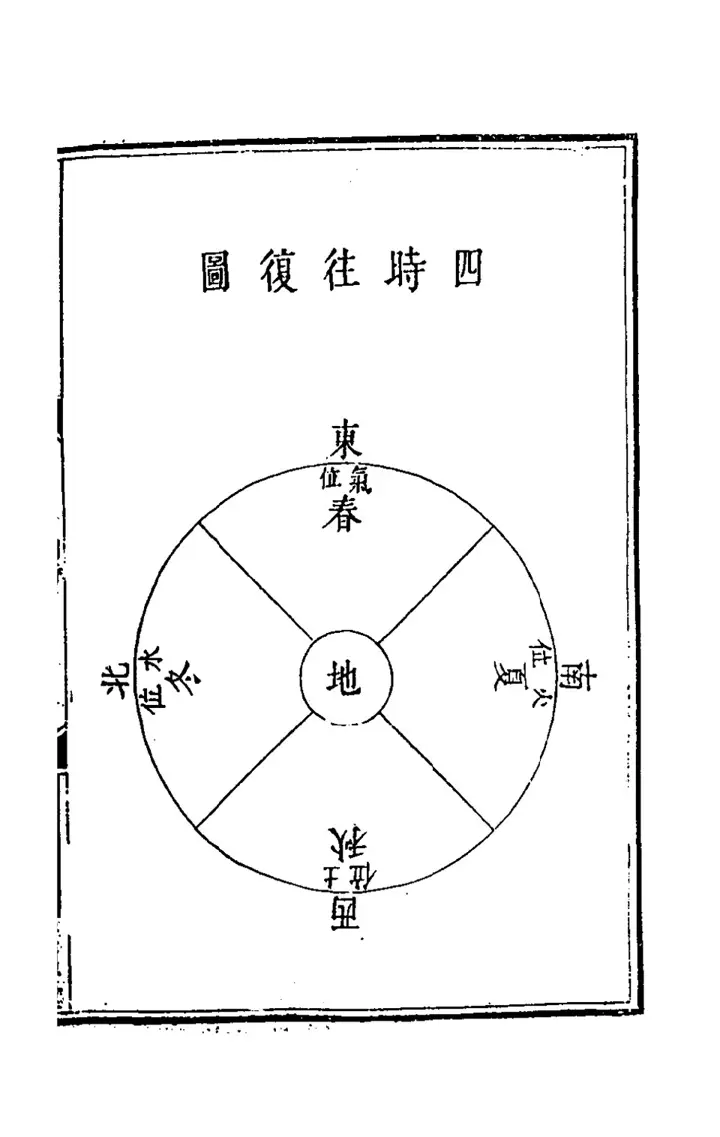
Before the four vital energies existed, there were no four seasons in the void. The four seasons are formed by the four vital energies turning in rotation and flowing. Within this rotating flow, each season is named after the position where one particular energy is most abundant. When the flow reaches the place where the qi of the east is most abundant, the season is spring. Knowing that spring is spring because it is mild and harmonious in this way, one knows that what qi holds within itself is exactly like this. When the flow reaches the place where the fire of the south is most abundant, the season is summer. Knowing that summer is summer because it is blazing and abundant in this way, one knows that what fire holds within itself is exactly like this. When the flow reaches the place where the earth of the west is most abundant, the season is autumn. Knowing that autumn is autumn because it draws in and absorbs in this way, one knows that earth, having given forth, takes in again exactly like this. When the flow reaches the place where the water of the north is most abundant, the season is winter. Knowing that winter is winter because it is hard and congealed in this way, one knows that water, clinging to earth, stores itself away exactly like this. For qi and fire flow by spreading out and rising forth, so as seasons spring and summer both show the image of spreading forth; earth and water flow by gathering in and storing away, so as seasons autumn and winter both carry the sense of gathering and storing. When the force of gathering and storing is spent, the impulse to spread forth arises again; when the impulse to spread forth arises, the qi most abundant in the east begins here once more. This is why the four seasons come and go.
未有四氣之先,空中無四時也。四時,即四氣輪轉流行而成者也。輪轉流行之中,各於其某一氣所專盛之位,而因各以其時專稱之也。流行而至於東方所專盛之氣,則其時為春。知春之所以為春者融和若此,則知氣之所以為氣者,其蘊含適如此也。流行而至於南方所專盛之火,則其時為夏。知夏之所以為夏者炎盛若此,則知火之所以為火者,其蘊含適如此也。流行而至於西方所專盛之土,則其時為秋。知秋之所以為秋者收吸若此,則知土之所以為土者,其既吐而納適如此也。流行而至於北方所專盛之水,則其時為冬。知冬之所以為冬者堅凝若此,則知水之所以為水者,其附土而藏適如此也。葢氣與火之流行,以發越為流行者也,故其為時也,春與夏亦皆有發越之象;土與水之流行,以收藏為流行者也,故其為時也,秋與冬亦皆有收藏之義。收藏之力既盡,則發越之機又起;發越之機起,則東方所專盛之氣又於茲而復始矣。此四時之所以往復也。
AIScan vol. 3, p. 44–46Transcribed from the scan by AI (Claude), checked as described on the About page.
Book 2 · 12 · The coming and going of the four seasons (2)
四時往復圖說 木金二行補先天之所未盡(二)
Someone objects: 'The order of the four seasons is the cycle of the five agents. Yet you say the four vital energies bring it about, and wood and metal take no part in it. Where, then, will you put the two agents wood and metal? Moreover, without wood fire is not produced, and without metal water is not produced. If fire is not produced, how could summer suddenly arrive among the four seasons? If water is not produced, how could winter abruptly appear?' I reply: 'Qi, fire, water and earth belong to the Former Heaven; they are the mothers of wood and metal. Wood and metal belong to the Latter Heaven; they are the children of the four single agents. Suppose that without wood fire were not produced: then before wood was born, where would the fire of the Former Heaven have come from? Suppose that without metal water were not produced: then before metal was born, where would the water of the Former Heaven have come from? The fire and water of the Former Heaven are not produced by wood and metal; rather, the four agents gathered together are in fact the mother of the Latter Heaven's wood and metal. Once wood was born, its power could also assist fire; this is the origin of the saying that wood produces fire. Once metal was born, its power could also assist water; this is the origin of the saying that metal produces water. Because wood assists fire, wood was inserted before fire and people said "wood produces fire"; because metal assists water, metal was inserted before water and people said "metal produces water." This is the wonderful working of the Real Ruler's nurturing transformation: within the pairing of the four vital energies, He also uses the two agents metal and wood to go between them and draw them together, using the Latter Heaven to supply what the Former Heaven left incomplete.' Note (Hei of Qingyuan): 'The four seasons are formed from the four agents. Heaven belongs to qi, which is honoured and first; therefore spring comes first among the four seasons. Next, fire is summer, earth is autumn and water is winter, all in their natural order. Qi and fire reach upward, so in spring and summer the myriad things are born; earth and water reach downward, so in autumn and winter the myriad things come to rest. One birth and one rest: this is how creation is accomplished and how the ceaseless giving of life goes on forever.'
說者曰:「四時之序,五行之所循環也,茲乃謂四氣為之,而木與金不與焉,則將置木金二行於何地乎?且無木則火不生,無金則水不生;火不生,則四時中之夏何以突來?水不生,則四時中之冬何以倏有?」曰:「氣、火、水、土,其先天也,木與金之母也;木金二行,其後天也,四單行之子也。假使無木則火不生,則當木未生之先,先天之火何來?假使無金則水不生,則當金未生之先,先天之水何出?葢先天之火、水不生於木、金,而四行相聚,實為後天木、金之母。迨木既生,而木之力亦能助火,是則木能生火之說也;迨金既生,而金之力亦能助水,是則金能生水之說也。因木有助於火,而以木補入於火之前,曰木能生火;因金有助於水,而以金補入於水之前,曰金能生水者,葢真宰化育之妙用,而於四氣對待之中,又以金木二行為之周旋接引於其間,以後天而補其先天之所未盡也。」
Note by a later commentator: 清源黑氏 (Hei of Qingyuan)
清源黑氏曰:「四時成於四行。天屬氣,為尊為首,故四時先春也;次火為夏,土為秋,水為冬,皆有自然之次第。氣火上達,故春夏則萬物生;土水下達,故秋冬則萬物息。一生一息,所以成造化而永生生也。」
AIScan vol. 3, p. 47–49Transcribed from the scan by AI (Claude), checked as described on the About page.
1 uncertain reading in this passage
- 突夏何以突來or 宊· variant · cut as a 宀-topped form of 突; 1923 突 (p. 47)
AIBook 2 · 13 · The seven regions dividing the earth
七洲分地圖說 七洲上應七政;五大界
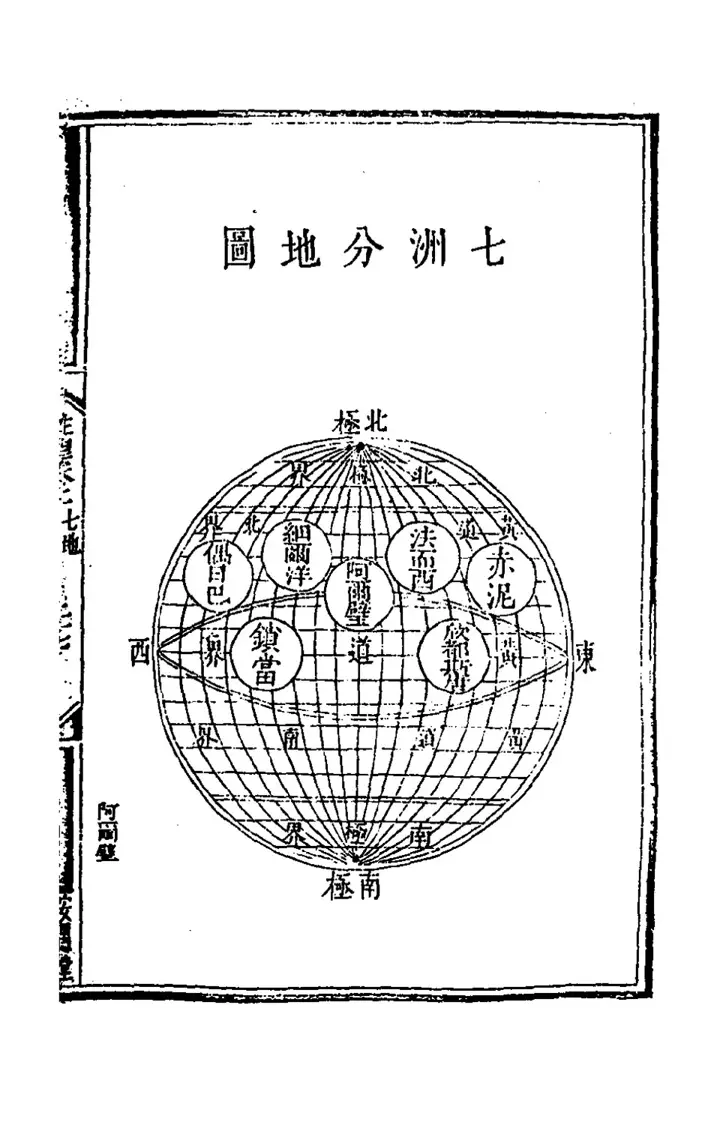
The earth is what takes form when earth and water cling together. Its body is perfectly round and sits in the very centre of the void. Its circumference is ninety thousand li and its depth twenty-eight thousand six hundred li. Its form divides into seven, which are the seven regions: Aerbi, Faerxi, Ouriba, Chini, Xieryang, Xindusitang and Suodang. The seven regions correspond above to the Seven Governors (the sun, moon and five planets). Where a region is the special domain of a given Governor, the character and temperament of its people and creatures resemble the temperament of the star to which it belongs, and the good or ill fortune and the auspicious signs of that region depend on the light that star casts upon it. Aerbi holds first place among the seven regions; humankind was first born there. Its land belongs to the sun; its people are bright, upright and strong-willed, and its products include many treasures. Faerxi belongs to Jupiter; its people are stalwart and capable, and its land has many fine plants. Chini belongs to the moon; its people's aims are easily shifted, and its land is often damp. Ouriba belongs to Mars; its people love argument and delight in contention, and its creatures are often secretly venomous. Xindusitang belongs to Mercury; its people are intelligent and value skill, and its creatures take many strange shapes. Xieryang belongs to Venus; its people are handsome, firm and upright, its products are often beautiful, and its land has many rare products. Suodang belongs to Saturn; it has much salt land and few plants, trees, birds or beasts; its people are dull, obstructed, dark and small, and good at carrying loads; the people of Tianfang call this land the country of servitude. The lands are seven, and they differ in cold, heat, warmth and coolness because the degrees of the ecliptic to which they correspond above are at different distances. Taking the whole earth together, from south to north it divides into five great zones. The first is the ecliptic zone, whose land is very hot because it receives the direct rays of the sun's wheel. Then there are the south polar zone and the north polar zone; these two are very cold because they are far from the sun's wheel. Then there are the zone south of the ecliptic and the zone north of the ecliptic; these two are moderate in cold and heat because they are neither far from nor near to the sun's wheel. The causes of cold, heat, warmth and coolness in the earth's climates all come from the ecliptic of the upper realm casting its light among them. Note (Hei of Qingyuan): 'The three teachings and the maps of the Western Ocean differ in the number of regions, which is hard to settle by reasoning. Yet heaven has seven Governors and earth has seven regions; this is a natural number. That Aerbi occupies the central position is not an arbitrary honour; it can be proved by the absence of shadows at noon.'
地者,土與水相附而成形者也。其體渾圓,而位於空中之中央,周九萬里,其深厚二萬八千六百里。分形有七,是為七洲:曰阿而壁,曰法而西,曰偶日巴,曰赤泥,曰細爾洋,曰欣都斯唐,曰鎖當。七洲上應七政,某一洲為某一政之所專屬者,則其地之人物性情,即與其所屬之星情性相似,而此一洲之祥灾瑞應,即關於此一星之映照。阿而壁當七洲之首位,人類肇生於此,其地為日所屬,人之性情明正自强,其物多寶產。法爾西為木星所屬,其人壯偉能事,其地多嘉植。赤泥為月所屬,其人志趨易移,其地多濡濕。偶日巴為火星所屬,其人好辯喜爭,其物多隱毒。欣都斯唐為水星所屬,其人聰明尚巧,其物多異狀。細爾洋為金星所屬,其人秀美剛直,物多佳麗,而地多奇產。鎖當為土星所屬,多鹵地,草木禽獸稀少,其人鈍窒黑小,善擔負,天方人謂此地為奴役之國。地七,而其中有寒熱溫涼之各異者,以其上應黃道之度數各有遠近之不同也。合大地而總觀之,自南至北分五大界:一黃道界,其地甚熱,以其當日輪之正照故也;一南極界,一北極界,此二界甚寒,以其與日輪遠故也;一黃道南界,一黃道北界,此二界寒熱適中,以其與日輪不遠不近故也。地氣寒熱溫涼之故,皆上界黃道為之映照於其間也。
Note by a later commentator: 清源黑氏 (Hei of Qingyuan)
清源黑氏曰:「三教與西洋地圖洲數互異,難以理白。然天有七政,地有七洲,自然之數也。阿而壁居中位,非故崇也,以日午無影可證。」
AIScan vol. 3, p. 50–53Transcribed from the scan by AI (Claude), checked as described on the About page.
6 uncertain readings in this passage
- 壁曰阿而壁or 璧 (1923)· witness-differs · C bottom component reads as 土 (壁), here and in the diagram (阿爾壁) and Hei note; 1923 prints 璧 (p. 51)
- 灾之祥灾瑞應or 災· variant · print form 灾; 1923 災 (p. 51)
- 映此一星之映照or 眏· unclear · left component cut like 目 (眏); read as 映 (so also 1923); same form at 為之映照 p53 (p. 51)
- 强明正自强or 強· variant · print form 强; 1923 強 (p. 51)
- 隱其物多隱毒· variant · cut in an abbreviated form of 隱 at column foot; 1923 and W confirm 隱/隐 (p. 52)
- 爾法爾西為木星所屬or 而 (1923)· witness-differs · C clearly 法爾西 here (but 法而西 in the list of regions on p51); 1923 and W 法而西 (p. 52)
AIBook 2 · 14 · The four zones dividing the air
四際分空圖說 溫、濕、冷、熱四際;積陽之氣上升
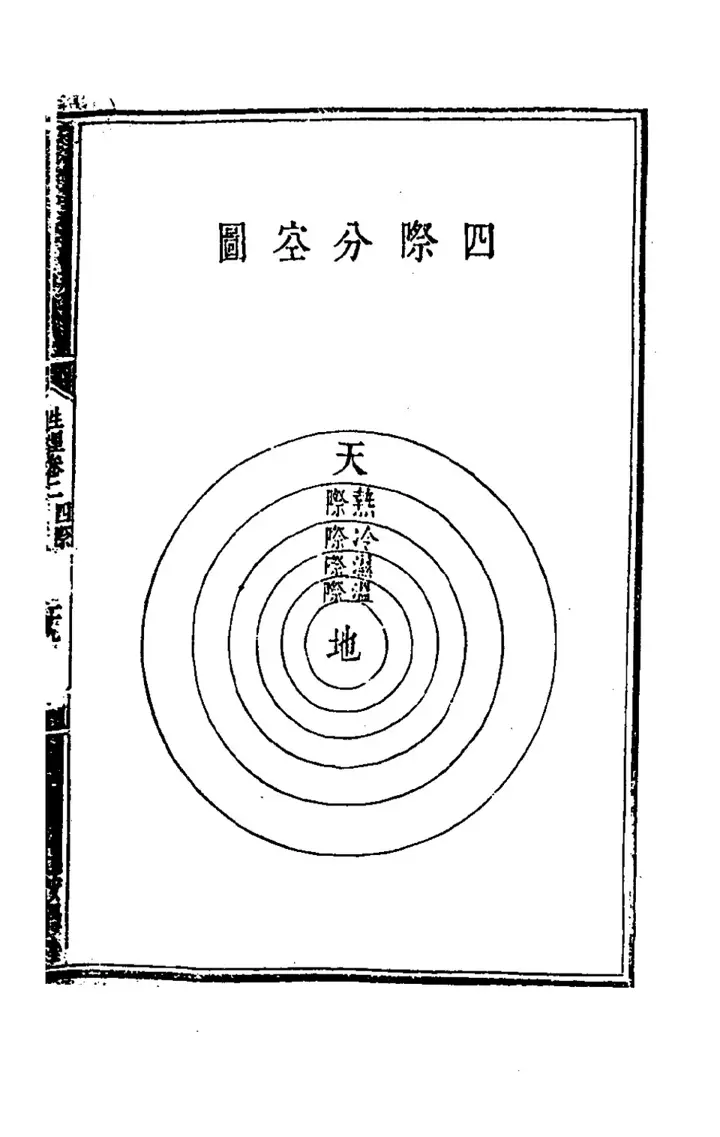
In the void, from earth up to heaven, there are four zones. Nearest the earth is the warm zone; above the warm is the moist zone; above that is the cold zone; nearest heaven is the hot zone. The four zones are formed from the four agents wind, fire, water and earth. The energies of the four zones always act from above downward to nurture the myriad things; none has ever acted from below upward. The energy of the warm zone does not reach the moist zone, and the energy of the cold zone does not reach the hot zone. The warm zone belongs to earth, and its energy is mild and even; the moist zone belongs to water, and its energy is somewhat cool; the cold zone belongs to wind, and its energy is severe and piercing; the hot zone belongs to fire, and its energy is blazing hot. The energies of the four zones are what all things rely upon, so that each, according to its season, can set its nature and mandate right. It is also said: the four zones are the membrane that receives heaven and nourishes earth. It is like the space between skin and flesh: without a membrane to join them, the flesh could not nourish the skin and the skin could not protect the flesh. As for the accumulated yang energy within the earth, at times it rises. Some of it reaches only the warm zone; some passes the warm zone and reaches the moist zone, the cold zone, or the hot zone. Because the heights to which it rises differ, it becomes dust, mist, cloud, rain, hail, sand, shooting stars or comets, taking all these different forms. The accumulated yang energy in the earth is what the sun has shot into it. When it rises, some floats upward and some shoots straight up; of what shoots straight up, some rises slowly and some rises with violent force. What floats upward reaches only the warm zone: energy mixed with earth becomes dust, and energy rising alone becomes mist. What shoots straight up becomes cloud: if the cloud penetrates deep into the moist zone there is rain; if the cloud reaches only the warm zone there is no rain. Of what shoots straight up, what rises slowly carrying earth becomes sand; this energy cannot reach all the way to the moist zone, because its body is heavy. What rises with violent force goes straight into the cold zone, where the cold congeals and freezes it into hail. What rises with violent force and very great strength, like a loosed arrow or a flung pellet, goes straight into the hot zone. The hot zone is the proper seat of fire; the accumulated yang energy, meeting fire's burning once more, turns into a ball of fire and falls: this is a shooting star. This energy occurs on days when yang prevails, so shooting stars are more frequent in summer than in winter. If the accumulated yang energy is extremely fierce and its upward force stronger still, it can shoot to the far edge of the hot zone and come near to heaven. Near heaven, this energy is drawn in by heaven's energy and cannot fall back; it travels along with heaven as comets and the like, and only after a long time does it gradually dwindle and disperse until nothing is left. Note (Hei of Qingyuan): 'The hot zone belongs to fire and the cold zone to wind; one would expect the hot zone to lie below the cold zone. [But] the zone said to belong to water is the warm zone [as printed]; if water and fire dwelt together, each would consume the other and neither would thrive. Only when wind comes between them can water stay moist and fire stay ablaze. Look at the positions of the four agents: fire in the south, water in the north, with qi and earth between them. The idea is the same. This is enough to show how wonderfully the transformation of things is interwoven.'
空中自地至天有四際:近於地者,溫際;上於溫者,濕際;再上者,冷際;近天者,熱際。四際葢本風、火、水、土四行之所結撰而有者也。四際之氣,每自上而下,以為培育萬物之功,從未有自下而上者也。溫際之氣不行於濕際,冷際之氣不行於熱際。溫際屬土,其氣和平;濕際屬水,其氣稍涼;冷際屬風,其氣肅冽;熱際屬火,其氣炎熱。四際之氣,皆萬物之所仰藉,而因時各得以自正其性命者也。又曰:四際者,承天養地之膈膜也,如皮與肉之間,苟無膈膜為之接引,則肉不能養皮,而皮亦不能為肉之衛矣。至於地中積陽之氣,有時而上升也,有僅至於溫際者,有過溫際而至於濕際、至於冷際、至於熱際者。其所升之高下不同,故而為塵、為霧、為雲、為雨、為雹、為沙、為流星、為彗孛,有等等不一之形狀矣。葢地中積陽之氣,乃日所冲射而入者,其升而上之也,有浮游而上者,有直射而上者;其直射也,又有悠然而上者,有奮激而上者。其浮游而上者,僅至溫際,氣夾土者為塵,氣單上者為霧。其直射而上者為雲,雲深入於濕際則雨,雲僅至於溫際則不雨。其直射也,悠然夾土而上者為沙,此氣不能盡至濕際,體重故也。其奮激而上者,直入冷際,冷則其氣凝凍為雹。其奮激而上者,力甚勇,如發矢擲彈,則直入於熱際矣。熱際乃火之本位也,積陽之氣再遇火焚,化為火球而墜之,即為流星。此氣當陽勝之日乃有,故流星夏多於冬。若積陽之氣烈甚,直上之力更勇,則能射入熱際之盡而近於天矣。近天,則此氣為天氣所吸,不得下墜,與天隨行,為彗孛之類,必待久而漸消漸散,以至於無也。
Note by a later commentator: 清源黑氏 (Hei of Qingyuan)
清源黑氏曰:「熱際屬火,冷際屬風,熱際當居冷際之下。曰溫際屬水,水火同居則两相耗而两不生,惟風間之,則水得以常潤,而火因以常熾矣。觀四行方位,火南水北,而氣土間之,亦是其意。此足以見化物錯綜之妙。」
AIScan vol. 3, p. 54–58Transcribed from the scan by AI (Claude), checked as described on the About page.
5 uncertain readings in this passage
- 溫近於地者,溫際or 温· variant · 溫 cut throughout with a 囚-like middle (温 type); normalised to 溫 (p. 55)
- 撰之所結撰而有· variant · printed with 扌 + 巽 form of 撰 (p. 55)
- 膈承天養地之膈膜· variant · right component cut like 鬲 with a 口 top (腡-like); read as 膈, as in 1923; also 苟無膈膜 p56 (p. 55)
- 冲乃日所冲射or 衝· variant · print form 冲 (1923 also 冲) (p. 56)
- 两則两相耗而两不生or 兩· variant · Hei note prints 两 twice; 1923 兩 (p. 58)
AIBook 2 · 15 · The One Thread overflowing
一貫洋溢圖說 真一直貫而洋溢
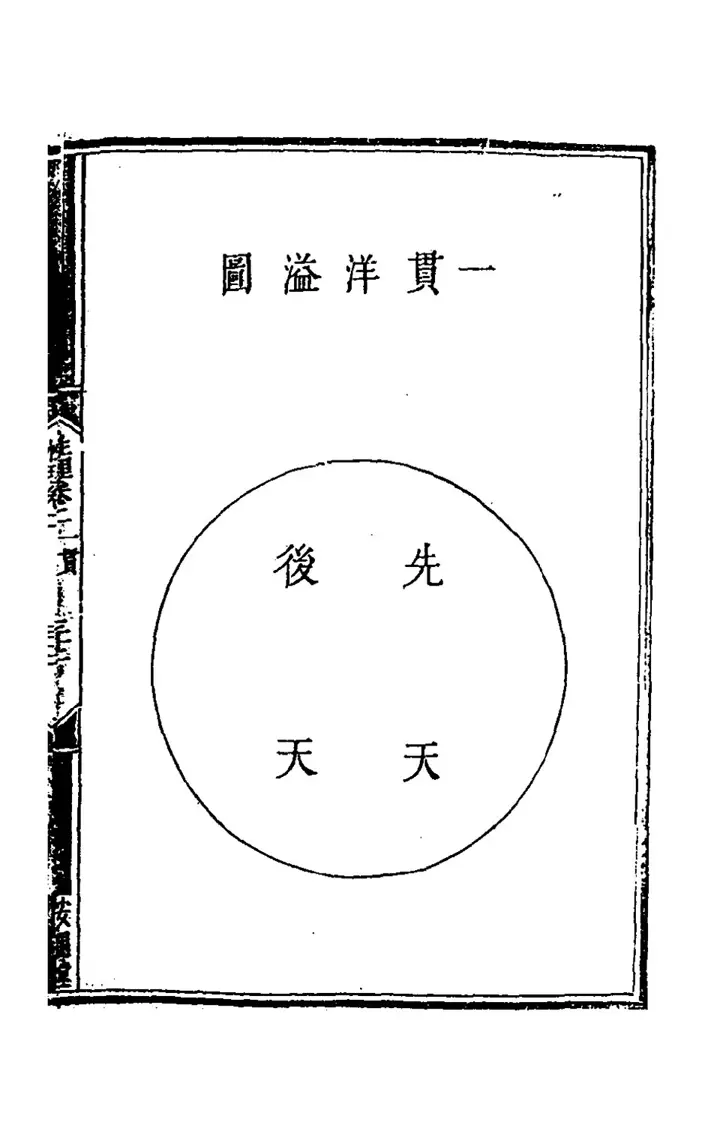
From the dividing of principle and the dividing of form, things proceed until nothing is lacking. Those who observe principle must observe it before forms and colours exist; those who observe form must pursue it image by image, and say that all of this is what the two energies yin and yang of the Latter Heaven have accumulated. To observe it in what comes before and in what comes after is to divide it: principle is principle and qi is qi. But do they know that everything in the universe, whether principle or form, is the Real One threading straight through and overflowing? If it is one, what division is there? If it threads through, what gap is there? If it overflows, what constraint is there? Without division, what is scattered is still gathered; without gaps, what is empty is still full. Threading through vertically, the nine heavens and seven earths are all filled and encircled by the One; threading through horizontally, east, west, south and north are all reached everywhere by the One. The four vital energies are the One flowing and becoming paired opposites; the four seasons are the One's paired opposites becoming flow. Vast and lively, it is not stuck in any fixed form, so why must principle and image be divided in two? Looked at from before, when the One is formless and threads straight through, why should it not be what lies hidden in the formed? Looked at from after, when the One has form and threads straight through, why should it not be what the formless sends soaring? The formless need not belong only to the Former Heaven, and the formed need not belong only to the Latter Heaven; so how can Former Heaven and Latter Heaven be divided? This is why the One Thread overflows and encompasses all without end! Encompassing all without end, what is abundant and never exhausted is simply the ceaseless giving of life. This ceaseless giving of life is the One's attending to the myriad things, and yet not an attending to the myriad things: without the myriad things there would be nothing to sustain human beings, so attending to the myriad things is attending to humankind. Note (Hei of Qingyuan): 'Whether threading horizontally or vertically, it never goes beyond the One Real. "One" means holding to the one; "threading" means containing the myriad. Before the myriad things existed, the One Thread was already established; after the myriad things have taken form, the One Thread remains constant. In truth it is simply the Real Ruler. The words "One Thread" are superfluous.'
自分理分形而至於無所不有也,觀理者必觀之於未有形色之先,觀形者又必逐象求之,而謂是皆後天陰陽二氣之所積也。夫觀之於先、觀之於後者,分之也,理自理而氣自氣也。抑知宇宙內為理為形,皆真一直貫而洋溢者乎?夫一,則何分之有?貫,則何隙之有?洋溢,則何拘泥之有?無分,則散者仍聚也;無隙,則空者仍實也。從直而貫者,九天七地,無非一之所充週;從橫而貫者,東西南北,無非一之所遍暨。四氣者,一之流行而為對待者也;四時者,一之對待而為流行者也。洋洋乎活潑而不膠於一定,而又何理象之必分而二之也乎?由前觀之,一之無形而為直貫者,何必非有形之所隱伏?由後觀之,一之有形而為直貫者,何必非無形者之所飛揚?無形者不必定屬於先天,有形者不必定屬於後天,而又何先天後天之可分也乎?此一貫之所以洋溢彌綸於無盡也歟!彌綸無盡,則優優而不竭者,自生生而不已也。生生而不已者,一之屬意於萬物也,而非屬意於萬物也。非萬物無以為養人之資,屬意於萬物者,屬意於人也。
Note by a later commentator: 清源黑氏 (Hei of Qingyuan)
清源黑氏曰:「橫貫竪貫,總莫越乎一真。一,執一也;貫,含萬也。自其萬有未有之先,一貫已立;自其萬有既形之後,一貫恒然。究其實,只一真宰也。一貫文贅。」
AIScan vol. 3, p. 59–62Transcribed from the scan by AI (Claude), checked as described on the About page.
2 uncertain readings in this passage
- 週無非一之所充週or 周· variant · print 週 (1923 also 週); W 周 (p. 60)
- 竪橫貫竪貫or 豎· variant · C prints 竪; 1923 豎 (p. 62)
AI
Key terms in this text
Each term's Arabic or Persian counterpart carries its grounding: the text itself, a published scholar, or AI. Tap one to find it in the text.
Chinese: transcribed by AI (Claude) from the CADAL scans on Wikimedia Commons (public domain), checked against the zh.wikisource text (CC BY-SA); Books 1–5 also collated with the 1923 photoreprint (CADAL, Commons), and the Root Classic with the Chinese printed in Murata, Chittick and Tu (2009); punctuation is editorial. Books 1–5 keep the notes of Hei of Qingyuan (清源黑氏, Hei Mingfeng), a later commentator, apart from Liu Zhi's text. Arabic: Nūr al-Ḥaqq (Ma Lianyuan), al-Laṭāʾif, as printed in Murata, Chittick and Tu, The Sage Learning of Liu Zhi (2009), pp. 103–153 (public domain text; taken from the book's text layer and checked against the page images by AI, page by page; not yet proofread by a person). Characters: Unihan (Unicode licence), cjk-decomp (Apache-2.0), the Kangxi Dictionary (public domain) via Wikisource (CC BY-SA). The English and the term mappings marked AI were written by AI (Claude). Murata's translations are in copyright and are cited, never reproduced. How this text was established.