Liu Zhi 劉智 · c. 1670–after 1724
Nature and Principle in Islam
天方性理
卷三・圖說Book 3: the small world, the body and its natures
Book 3 · 1 · Volume Three: overview
概言 小世界所以顯著之由
The third volume sets out in order how the small world (the microcosm) becomes manifest. The small world has a manifestation that has form and a manifestation that is formless. Observing its manifestation with form, one can know the wonder of the Creator's natural working; observing its formless manifestation, one can know the fine point at which heaven and humankind are one. The form of the small world comes after heaven and earth and is smaller than heaven and earth; the principle of the small world comes before the space between heaven and earth and is wider than that space. This is because the great world (the macrocosm) has boundaries while the small world has none, and the principle of the great world has a beginning and an end, while the principle of the small world has a beginning but no end. Yet it is not that it lacks the condition of having neither beginning nor end.
第三卷歷敘小世界所以顯著之由。小世界有有形之顯著,有無形之顯著。觀于有形之顯著,可以知造物自然之妙;觀於無形之顯著,可以知天人一致之精。小世界之形,後於天地,小於天地;小世界之理,先於兩間,廣於兩間。葢因大世界有邊際,小世界無邊際;大世界之理有起滅,小世界之理有起無滅故也。然亦未嘗非無起無滅。
AIScan vol. 3, p. 63Transcribed from the scan by AI (Claude), checked as described on the About page.
2 uncertain readings in this passage
- 界小世界有有形之顯著· stamp · the foot of the first column (界 and part of 有) is covered by a stamp/ink blot; 界 restored from context, 1923 and W (p. 63)
- 于觀于有形之顯著or 於· variant · C prints 于 here but 於 in the parallel clause 觀於無形; 1923 identical (p. 63)
AIBook 3 · 2 · The origin of human life: the seed
人生元始圖說 元始品:種子
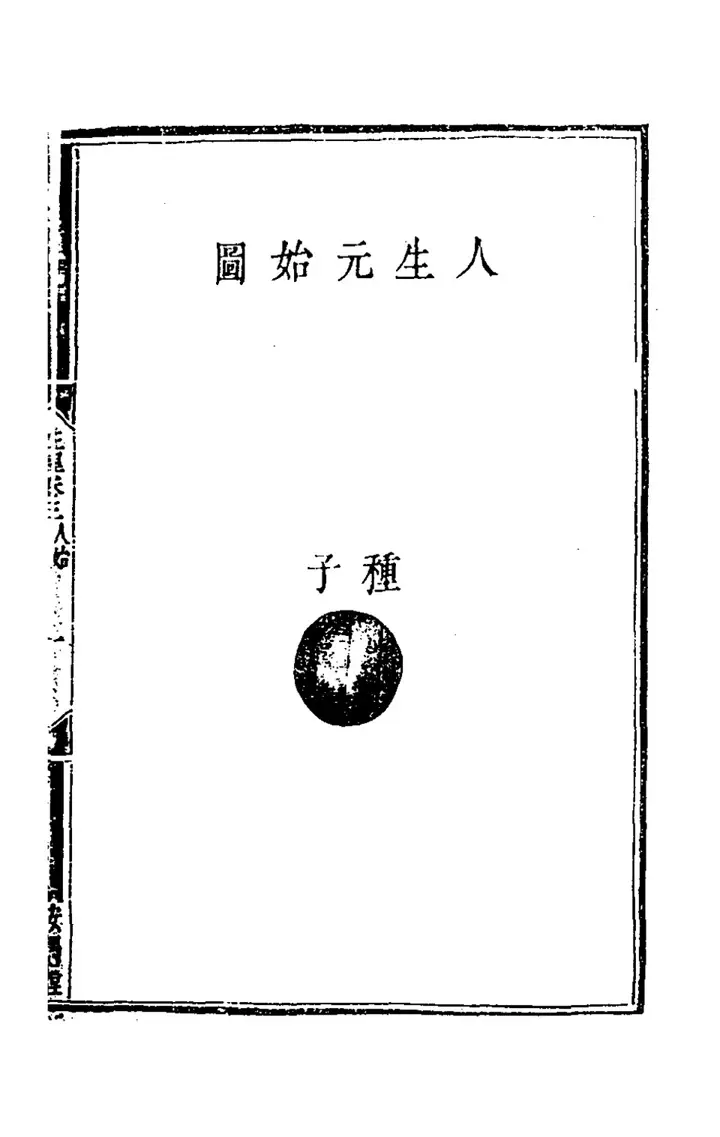
Heaven and earth are the great world; the human body is the small world. Before the great world existed, there were first six grades of formless principle, and afterwards six grades of formed images. When the small world comes to be, there are first six grades of formed images, and afterwards six grades of formless principle. The great world is first formless and then formed: this is proceeding from principle to reach vital energy (qi). The small world is first formed and then formless: this is returning from vital energy to principle. Its formed part arises from a single point, which is what was left over from the natures and principles of the Former Heaven and became its sediment; it is the root-seed of human life for all generations under heaven. When Adam (Adan) was formed into a body by gathering the refined essence of the four elements, this point was lodged in his body; and when Adam begot sons and his line spread to grandsons, this point flowed out into countless millions of bodies. Now countless millions of bodies must have countless millions of points; yet these countless millions of points did not come forth by the transformation and multiplication of Adam's one point. The reason is that in the world of nature and principle of the Former Heaven, every nature was endowed with such a point; only, once Adam's body was formed, all these countless points entered Adam's body and were stored there. As a thing it is too subtle to be glimpsed, beyond colour, image, sound and smell. While it was stored in Adam's body, merged as one root, though it held the bodies of ten thousand generations it did not seem many; when it flowed out to his descendants and each became a root of its own, it did not seem few. Is it not the most wondrous of things, continuing the Former Heaven? That a person has a heart and a body; that the body has outer and inner parts, members and apertures; perception and awareness, nature and feelings; movement and action; success and failure, long life and early death: all of these are held within it and made wondrous by it. When it flows forth and becomes manifest, it too divides into six grades: first, the grade of origin, which is this seed; second, the grade of generation, when the embryo first forms; third, the grade of transformation, when the four roots come to be; fourth, the grade of taking form, when outer and inner divide; fifth, the grade of settled substance, when members and apertures are complete; sixth, the grade of disclosure, when the living spirit appears. The six formed grades of the small world are in no way fewer than the six formed grades of the great world. Note (Hei of Qingyuan): The seed is the Real Existent. The seed of the small world is the primal qi of the great world. In the Former Heaven each principle embraces a qi, just as in the Latter Heaven each qi embraces a principle. What is called 'returning from qi to principle' means causing that principle to be brought fully to light; this is what makes a human being human. 'Take from things afar, take from the body near at hand': what is it one takes? Those who contemplate principle should pay close attention to this chapter.
天地,大世界也;人身,小世界也。大世界未有之先,先有六品無形之理,後有六品有形之象;小世界之有也,先有六品有形之象,後有六品無形之理。大世界先無形而後有形者,由理而達於氣也;小世界先有形而後無形者,由氣而還於理也。其有形者起於一點,乃先天性理所餘,而成其為溟渣者也,天下萬世人生之根種也。自阿丹秉四行之精萃結聚成身,而此一點即寓之於其身;及阿丹生子蔭孫,而此一點流泒於千萬無算之身。夫千萬無算之身,必有千萬無算之一點;而此千萬無算之一點,又非自阿丹之一點變化繁衍以出者也。緣夫先天性理之世,凡有一性,即稟有此一點,但自阿丹之身成,而此千萬無算之一點莫不隨入於阿丹之身而藏寓之。其為物也,妙無可窺,超於色象聲臭之表。當其寄藏於阿丹之身而渾為一本也,雖包藏萬世之身而不覺其多;及其流泒子孫而各為一本也,而亦不覺其少。其殆繼先天而為至妙之物者乎!人之有心也,身也;身之有表裏、體竅也;知覺、性情也;動作、云為也;窮通、壽夭也;皆莫不裕乎其中而妙之也。及其流行昭著,亦分為六品:一、元始品,即此種子也;二、孳生品,始結胎也;三、變化品,四本成也;四、成形品,表裏分也;五、定質品,體竅全也;六、呈露品,靈活現也。小世界有形之六品,葢不減於大世界有形之六品也。
Note by a later commentator: 清源黑氏 (Hei of Qingyuan)
清源黑氏曰:「種子即實有也。小世界之種子,即大世界之元氣。先天之理各抱一氣,即猶後天之氣各抱一理。所謂由氣而還於理者,俾其理發明無不盡透也,此人所以為人也。遠取諸物,近取諸身,所取伊何?觀理者當於此卷留意焉。」
AIScan vol. 4, p. 4–8Transcribed from the scan by AI (Claude), checked as described on the About page.
4 uncertain readings in this passage
- 泒此一點流泒於千萬or 派· variant · C prints 泒 for 派 (also in 流泒子孫); 1923 has 派 (p. 5)
- 蔭生子蔭孫· variant · 蔭 with grass radical as printed; W 荫 (p. 5)
- 稟即稟有此一點or 禀· variant · printed 稟 (p. 6)
- 葢葢不減於大世界or 蓋· variant · 葢 as printed throughout this range (p. 8)
AIBook 3 · 3 · The embryo's first transformation
胚胎初化圖說 孳生品:清濁初分
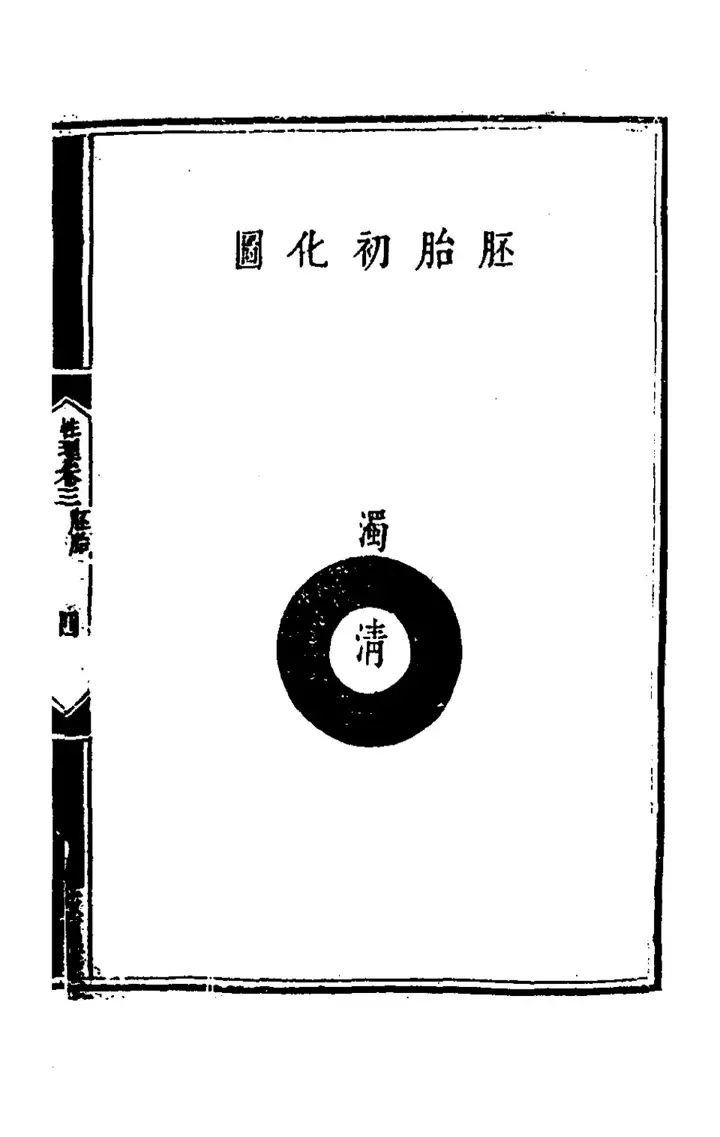
This is the image of the single point entering the mother's womb and first transforming; it is the grade of generation. Before it enters the mother's womb it is kept in the father's spine, pure, subtle and imageless; once it leaves its original place and enters the womb, the imageless has an image. The image is formed from the qi of the mutual stirring of father and mother: the father's yang moves and produces water, and the water, carrying yang qi, conveys it to the mother; the mother's yin moves and produces fire, and the fire, carrying yin qi, receives this point into the womb. Yin and yang meet and water and fire gather; therefore the one then transforms into two: the clear is stored within, the turbid guards without. The clear belongs to yang: it is the father's yang, wrapped by the mother's yin and so transformed. The turbid belongs to yin: it is the father's water, blazed upon by the mother's fire and so transformed. Someone asks: 'Since the clear belongs to yang, it ought to issue outward, yet here it is gathered inward; since the turbid belongs to yin, it ought to be gathered inward, yet here it issues outward. Why?' The answer: 'The generation of the small world and that of the great world neither add nor lack a single grade, but their division of form into inner and outer is truly reversed. In the great world's division of form, what issues outward is the greater and the higher; hence its yang issues outward, and when yang issues outward its yin gathers inward of itself. In the small world's division of form, what is stored within is the greater and the higher; hence its clear is stored within, and when the clear is stored within its turbid surrounds it outside of itself. The reason form is divided in reverse fully shows the wonder of creation, and that the small world, as a thing, is finer and subtler than the great world. For the great world transforms from formlessness to form, and its course runs wholly from inside to outside; running from inside to outside, its meaning is exhausted in the outside. The small world transforms from form to formlessness, and its course runs wholly from outside to inside; running from outside to inside, what is joined within it is subtle indeed. Take the human body: the heart lies innermost, and what the body cannot reach, the heart can reach. The heart reaches the station of the formless, just as the Throne (al-ʿArsh) reaches the station of the world of principle. Therefore the small world takes what is stored within as the greater and the higher.' And again: 'The human heart is like heaven, the human body like earth. What is like heaven is above, what is like earth below. Going from the body to the heart is ascent; going from the heart to the body is descent. This wonder of reversed division of form suffices to show the marvel of creation; and at the meeting of heaven and humanity, the giving and receiving is subtle indeed.' Note (Hei of Qingyuan): By one movement of a human thought there is a small world, just as by one movement of the thought of the True Governor there is the great world. But the True Governor's movement is a movement within the all-knowing; a human's movement is a movement within what one does not perceive. What one does not perceive is still the True Governor moving of Himself: without the True Governor there would be no human being. The principle of reversed division of form is most wondrous.
此即一點入於母腹而初化之象也,是為孳生品。當其未入母腹之先,存於父脊,清妙無象;迨既離本位而入於子宮,無象者有象矣。象葢得乎父母交感之氣而成:父之陽動而生水,水挾陽氣而授之於母;母之陰動而生火,火挾陰氣而納此一點於子宮。陰陽交而水火聚,故一也而遂化為兩:清內藏,濁外護。清者屬陽,即本父之陽為母之陰裹而化者也;濁者屬陰,即本父之水為母之火熾而化者也。說者曰:「清既屬陽,理當外發,而茲乃內斂;濁既屬陰,理當內斂,而茲乃外發,何也?」曰:「小世界之化生,與大世界之化生,品數無增無減,但其內外分形實相反也。大世界之分形,以發越於外者為大、為上,故其陽者發於外;陽發於外,其陰自斂於內矣。小世界之分形,以藏寓於內者為大、為上,故其清者藏於內;清藏於內,其濁自圍於外矣。其所以分形相反之故,正足以見造化之奇,而小世界之為物,較大世界為愈精愈微也。葢大世界自無形而化至有形,其勢皆自內至外者也;自內至外,則其義盡於其外矣。小世界自有形而化至無形,其勢皆自外至內者也;自外至內,則其內之所關合者微矣。如人之一身,心居至內,身之所不能通者,心能通之;心通無形之位,即猶阿而實通理世之位也。故小世界以藏寓於內者為大、為上也。」又曰:「人心如天,人身如地。如天者上,如地者下。由身而至於心為升,由心而至於身為降。此分形相反之妙,足以見造化之奇,而天人之際,其授受也微矣。」
Note by a later commentator: 清源黑氏 (Hei of Qingyuan)
清源黑氏曰:「人一念之動而有小世界,即猶真宰一念之動而有大世界也。然真宰之動,動於無所不知;人之動,動於所不及覺。不及覺者,仍真宰之自為動也,非真宰無以為人也。分形相反之理,甚妙。」
AIScan vol. 4, p. 9–13Transcribed from the scan by AI (Claude), checked as described on the About page.
4 uncertain readings in this passage
- 孳是為孳生品or 孶/孽· variant · printed 孳 (孶-like cut); W 孽 is an error (p. 10)
- 微愈精愈微也or 徵· variant · woodblock form of 微 resembles 徵; context and 1923 微 (p. 11)
- 而即猶阿而實通理世之位or 爾· variant · C and 1923 both print 阿而實 (for 阿爾實 ʿarsh); kept as printed (p. 12)
- 關其內之所關合者微矣· variant · printed 閞-like form of 關 (p. 12)
AIBook 3 · 4 · The four roots become distinct
四本分著圖說 變化品:四色四液
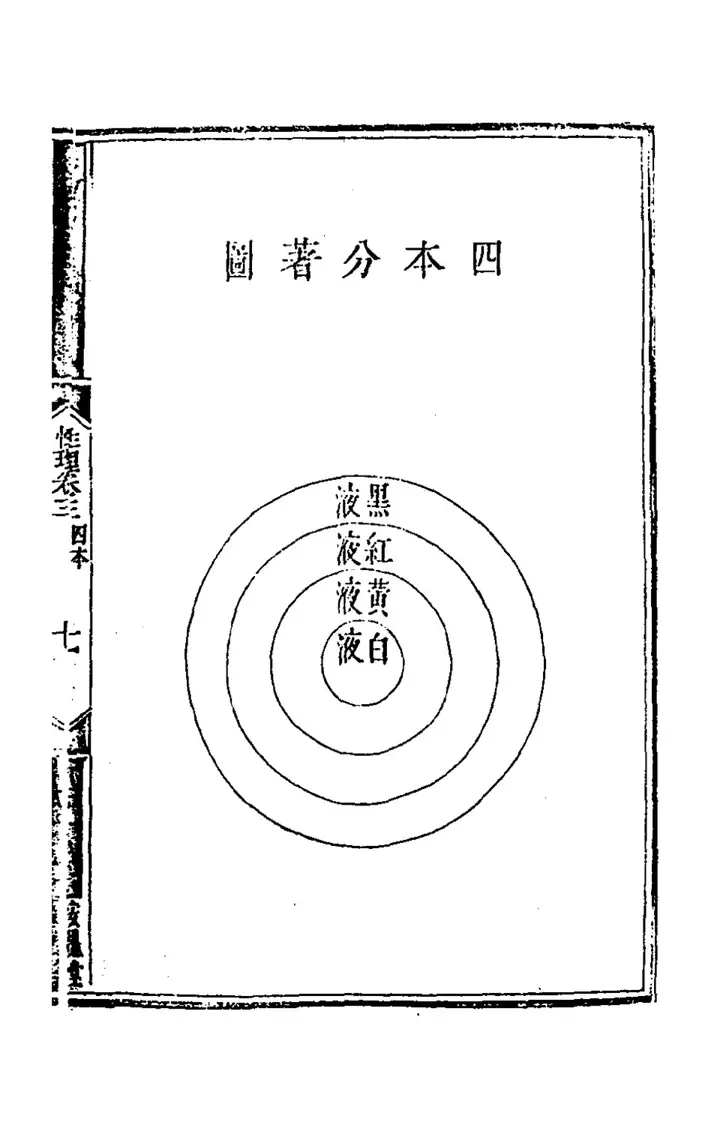
This is the image of the embryo in its first month. That which moved from the father's spine into the womb, the clear and the turbid, receives the warm nourishment of the womb, and the two halves divide into four layers; this is the grade of transformation. That the one point divides into clear and turbid is like the primal qi splitting into the two modes (yin and yang); that the clear and turbid transform into four layers is like the two modes dividing into the four images. The outermost layer is black in colour and belongs to earth; the one next to the black is red and belongs to wind; the one next to the red is yellow and belongs to fire; the one in the very centre is white and belongs to water. White is the extreme of clarity; yellow is the slightly turbid within the clear. Black is the extreme of turbidity; red is the slightly clear within the turbid. These four are the roots of the blood, flesh, essence and qi of the human body. The four roots do not go beyond the two, clear and turbid; what divides them is their colour. The colours divide into four because of the blazing of the yin fire of the womb: the layer lying outside and nearest the fire is therefore black; the second layer, somewhat kept apart from the fire, is therefore red; the one lying somewhat inward and receiving only the fire's qi is therefore yellow; the one lying in the very centre and far from the fire is therefore white. When the four colours are distinct, the four elements wind, fire, water and earth each attach according to the colour formed. Another account: the colour of the clear is originally white, the colour of the turbid originally red; for the clear is transformed from yang water, and yang water is white, while the turbid is transformed from yin fire, and yin fire is red. Once red and white are distinct, they are again warmed and nourished by the yin fire of the womb, so that the outside of the red changes into black and the outside of the white changes into yellow. This is a further account of how the four roots divide into four colours. Note (Hei of Qingyuan): I have read Western books, which also speak of four humours, but I have not seen them explain the principle. Here the source of the four humours is traced and why they are so is fully clarified, which shows that the learning of Arabia (Tianfang) excels through principle.
此胚胎一月之象也。其自父脊而移入於子宮者,清與濁,得子宮之溫養,而兩半者分為四層,是為變化品。夫自一點而分清濁,葢亦猶元氣之判而為兩儀也;本清濁而化為四層,亦猶兩儀之分而為四象也。最外一層者色黑,屬土;其近於黑者色紅,屬風;近於紅者色黃,屬火;其居於最中者色白,屬水。白者,清之至也;黃則其清中之稍濁者也。黑者,濁之至也;紅則其濁中之稍清者也。四者為人身血肉精氣之本。四本不外清濁二者,而其所以分者,分之以其色也。色之所以分而為四者,分於子宮陰火之所熾也:其居外而最與火近者,故其色黑;其二層稍與火相格,故其色紅;其稍近於內而僅得火之氣者,故其色黃;其居於最中而與火相遠者,故其色白。四色分,而風火水土四行,因其色之所成而各有屬焉。一曰:清者之為色本白,濁者之為色本紅。葢清本陽水之所化,陽水色白;濁本陰火之所化,陰火色紅。紅白既判,復為子宮陰火所溫養,則紅之外變而為黑,白之外變而為黃。此又四本分而為四色之說也。
Note by a later commentator: 清源黑氏 (Hei of Qingyuan)
清源黑氏曰:「予閱西洋書,亦有四液之說,但未見其言理。茲溯四液之所本,而備晣其所以然,足見天方之學以理勝也。」
AIScan vol. 4, p. 14–17Transcribed from the scan by AI (Claude), checked as described on the About page.
2 uncertain readings in this passage
- 晣而備晣其所以然or 晰· variant · C cuts 日 on the left (晣); 1923 晰 (p. 17)
- 層其二層稍與火相格· variant · 層 cut in abbreviated 㬝-like form (p. 16)
AIBook 3 · 5 · Inner and outer take separate form
表裏分形圖說 成形品:心天身地
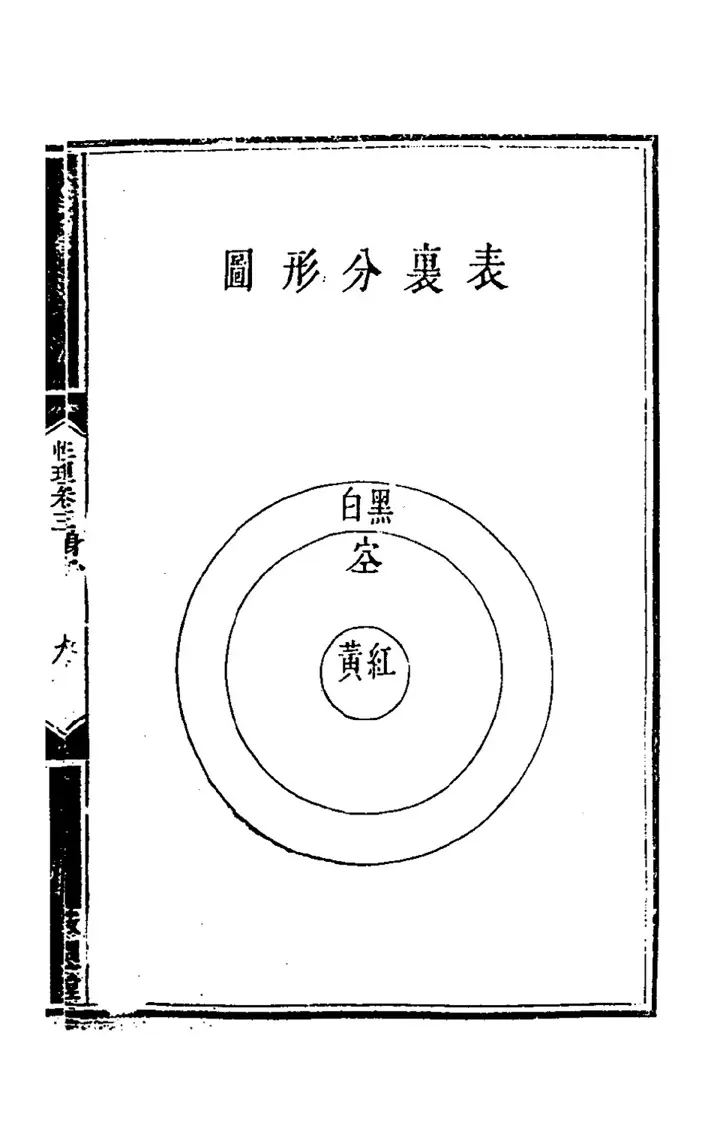
This is the image of the embryo in its second month. At this time the four, white, yellow, red and black, have received the warm nourishing qi of the womb longer than before; and after this length of time the original natures of the four elements, wind, fire, water and earth, rise and stir, leave the layers in which the four colours first formed, and each returns to the proper place of its element. Wind returns to wind's place, and so rises to reach the innermost. The small world takes the inner as the higher, so its innermost is its highest; wind rising and returning to the innermost is returning to the highest. Fire returns to fire's place, rising to next after wind; its place too is inner. With wind and fire inside, water cannot remain inside; its tendency must be to descend and go down, attaching itself to earth. Going down means going to the outside. Wind and fire rise inward, and their form is the heart; water and earth descend outward, and their form is the body. The heart is heaven; the body is earth. When outer and inner are divided in form, the heaven and earth of the small world are fixed in their places. Fire and wind combine to become the heart, water and earth attach to become the body, and between them there is emptiness, just as heaven stands above and earth below with emptiness in the middle. This is the grade of taking form. Note (Hei of Qingyuan): Air and fire rise and become the heart; water and earth descend and become the body. Once outer and inner are divided, an empty space is left in the middle, the four elements interact, and generation and growth begin to flourish. So heart as heaven and body as earth is clear in principle and consistent in fact. Why should anyone make a fine saying of 'head as heaven, feet as earth'?
此胚胎二月之象也。當此之際,其白、黃、紅、黑四者,得子宮溫養之氣,較前為久;久則風火水土四行之本性飛揚發動,離四色初成之層次,而各歸於四行之本位。風歸風位,則升而至於其裏。小世界以內為上,故其至內者為至上;風升而歸於其最內者,乃歸於其最上也。火歸火位,則升而至於風之次,其位亦內也。風火居內,則水不能內存,其勢不得不降而就下,以與土相附矣。就下者,就於其表也。風火內升,其形為心;水土外降,其形為身。心者,天也;身者,地也。表裏形分,則小世界之天地定位矣。火與風相合而為心,水與土相附而為身,其中空焉,亦猶天位於上、地位於下而中空之義也。是為成形品。
Note by a later commentator: 清源黑氏 (Hei of Qingyuan)
清源黑氏曰:「氣火升而為心,水土降而為身,表裡既判,中留空際,四元交互,化育始蕃。是心天身地,理明事順,何人以首天足地為美談也。」
AIScan vol. 4, p. 18–20Transcribed from the scan by AI (Claude), checked as described on the About page.
1 uncertain reading in this passage
- 裡表裡既判or 裏· variant · Hei's note prints 裡 (衣 radical at left); main text uses 裏; 1923 裏 (p. 20)
AIBook 3 · 6 · Inner and outer bodily apertures
內外體竅圖說 定質品:藏府與腦
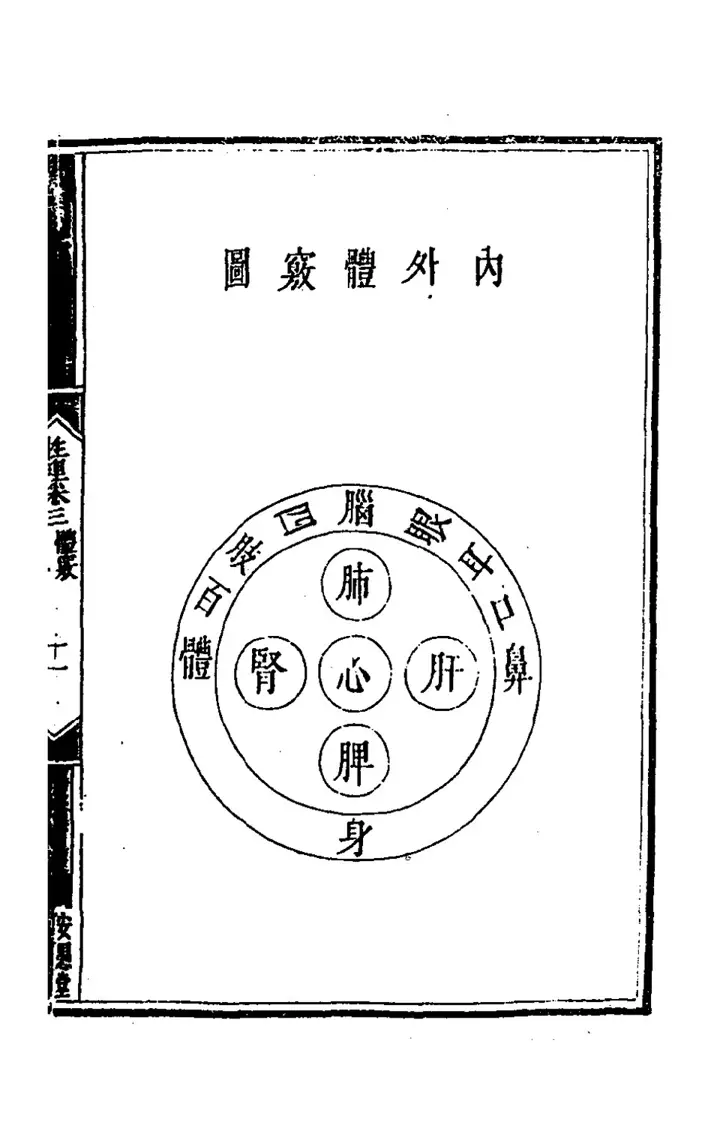
This is the image of the embryo in its third month. In the second month the outer and inner first divided in form; now outer and inner each undergo transformation. In the outer part, what belongs to earth becomes the flesh of the whole body, and what belongs to water flows to become the pathways of the vessels and channels. In the inner part, what belongs to air becomes the substance of the heart, and what belongs to fire issues as the apertures of numinous clarity, facing each other on the left and right of the heart. Once heart and body are formed, the four viscera gather between heart and body as the dwelling places proper to the four elements. Once the four viscera are formed, the six bowels are provided in turn, and ears, eyes, mouth, nose, the four limbs and all the members become distinct. This is the grade of settled substance. All the members and apertures of the body are joined to the viscera and bowels, but what is most joined to the members and apertures of the whole body is the brain alone. For the viscera and bowels each have only their own charge among the things joined to them, while the brain has overall charge of everything joined to it. The brain is formed from the numinous qi of the heart and the essential qi of the body knotted together. In its function it takes the formed into the formless and conveys the formless into the formed; it is the general source of all the vessels, and the perception and movement of all the members depend on it. What is meant by taking the formed into the formless? Whatever the eye has seen, the ear heard, the heart known, the brain gathers and stores within itself; this is what it can take in. What is meant by conveying the formless into the formed? Within the brain dwells the power of general awareness. Its sinews run from the brain to the eyes, and the eyes, receiving the force of general awareness, can see; they run to the ears, and the ears can hear; they run to the mouth and nose, and the mouth knows taste and the nose smell. Thus the liver opens into the eyes, but that the eyes can see is the brain's force; the kidneys open into the ears, but that the ears can hear is the brain's force; the spleen opens into the mouth and the lungs into the nose, but that the mouth knows taste and the nose smell is the brain's force. Its sinews run from the brain to the whole body, and the whole body receives the force of general awareness: the hands can grasp, the feet walk, and all the members feel pain and itch. Even the heart, the seat of numinous clarity, cannot but rely on the brain: when the brain is nourished, the heart's clarity is doubled; when the brain loses its nourishment, the heart's will and qi grow dim. This is what is meant by conveying the formless into the formed. Again: the heart is the chamber and the brain the hall; nothing planned in the chamber fails to appear in the hall. The brain receives what the heart bestows and bestows it on all the apertures. When the members and apertures are complete, the human form is complete. From then on, nourishment has two roots: the outer root is the navel, the inner root the gall bladder. The navel draws the mother's qi and blood into the stomach to take nourishment from them; the gall bladder, from the qi and blood drawn in, distinguishes good from bad, using only the good and gathering up the poisonous. These two roots are how the inner and outer members and apertures obtain their nourishment. Note (Hei of Qingyuan): The outer and inner parts, members and apertures are already present in the seed; here they merely appear in their season. Since everything outer and inner in the body depends on the brain, one who treats people should first know how to treat the brain. Hence Arabian medicine has a branch for the brain, of which the other schools know nothing.
此胚胎三月之象也。二月之胎,先是表裏分形,至此則表裏各有變化矣。其表之屬土者,化為周身之肉;屬水者,流為脈絡之路。其裏之屬氣者,化為心之質;屬火者,發為靈明之孔,而對峙於心之左右。心身既成,而即於心身之間結聚四藏,以為四行專住之位。四藏既成,而六府亦次第皆具,耳、目、口、鼻、四肢、百體悉皆分著,是為定質品也。夫一身之體竅,皆藏府之所關合,而其最有關合於周身之體竅者,惟腦。葢藏府之所關合者,不過各有所司,而腦則總司其所關合者也。腦者,心之靈氣與身之精氣相為締結而化焉者也。其為用也,納有形於無形,通無形於有形,是為百脈之總原,而百體之知覺運動皆賴焉。何謂納有形於無形?凡目之所曾視、耳之所曾聽、心之所曾知,腦皆收納之而含藏於其內,是其所為能納也。何謂通無形於有形?葢腦之中寓有總覺之德也。其筋絡自腦而通至於目,則目得其總覺之力而能視;其筋絡通至於耳,則耳得其總覺之力而能聽;其筋絡通至於口鼻,則口鼻得其總覺之力,而口知味,鼻知臭。故肝開竅於目,而其目之所以能視者,腦之力也;腎開竅於耳,而其耳之所以能聽者,腦之力也;脾開竅於口,肺開竅於鼻,而其口之所以知味、鼻之所以知臭者,腦之力也。其筋絡自腦而通至於周身,則通身得其總覺之力,而手能持,足能行,百體皆知痛癢。即心為靈明之府,而亦不能不有資於腦:腦得其養,而心之靈明加倍;腦失其養,而心之志氣亦昏。是之謂通無形於有形也。又曰:心為室,腦為堂,凡室之所籌畫者,未有不於其堂而顯露者也;腦葢承心之所施,而施之於百竅也。體竅全而人之形成矣。自此以後,其為滋養者有二根焉:外根曰臍,內根曰膽。臍能引母之氣血入胃,以取其滋養;膽能於氣血之所引入者分別美惡,而但用其美者,收其毒者。此二根者,又內外體竅之所由以得其滋養者也。
Note by a later commentator: 清源黑氏 (Hei of Qingyuan)
清源黑氏曰:「表裡體竅,早已具於種子,此特以時發現也。通身表裡皆關係乎腦,則治人者當先知治腦。故天方醫有腦科,諸家不知也。」
AIScan vol. 4, p. 21–26Transcribed from the scan by AI (Claude), checked as described on the About page.
5 uncertain readings in this passage
- 脈是為百脈之總原or 脉· variant · 脈 cut in a 𣲖/脉-like form; also 脈絡 (p. 23)
- 臍外根曰臍· variant · 臍 cut in a contracted form (齊 abbreviated); 1923 臍 (p. 25)
- 昏心之志氣亦昏or 昬· variant · printed form close to 昬 (p. 25)
- 腦皆關係乎腦or 脑· variant · here (Hei's note) the print cuts 腦 as 月+囟 without 巛, a 脑-like popular form; elsewhere full 腦; normalised (p. 26)
- 藏皆藏府之所關合or 臟· variant · C and 1923 print 藏府/四藏/六府 in this passage (W modernises 臟腑); contrast 臟腑 in tf6-7 (p. 22)
AIBook 3 · 7 · The living spirit becomes manifest
靈活顯用圖說 呈露品:性之六品
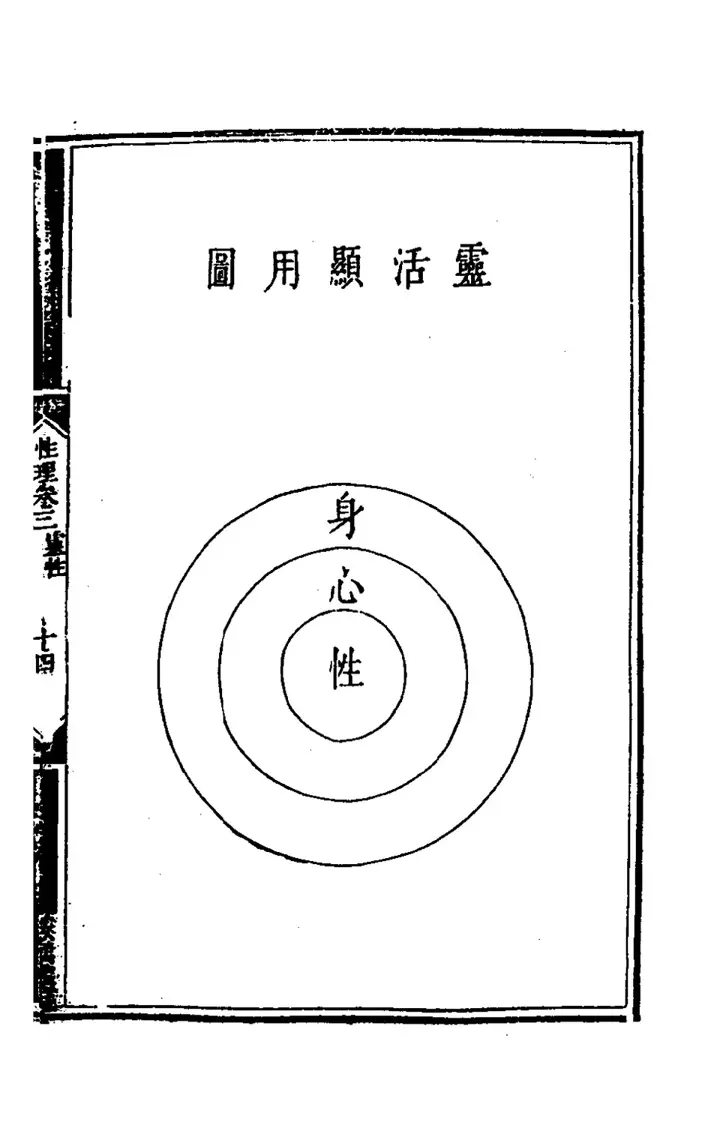
This is the image after the members and apertures are complete. When they are complete, the living spirit arises. The living spirit is the nature by which a human being is human. That nature is one root but contains six grades: first, the continuing nature; second, the human nature; third, the qi nature; fourth, the living nature; fifth, the growing nature; sixth, firmness. Firmness is not called a nature, because it is the same as the nature of metal and stone and has no growth. The continuing nature is what exists by continuing the Original Suchness of the True Governor. The nature of the True Governor has nothing that precedes it, only what continues after it; this nature takes the True Governor's Original Suchness as its own suchness, and so is called 'continuing'. It is the first manifestation of the True Governor, and the root-source of all natures. The human nature is the nature each person received as their allotted share in the Former Heaven. It is not far from the continuing nature, but because of the allotment in the Former Heaven its name and meaning come to differ slightly without one noticing; it is called the original nature. The qi nature is the nature of bodily endowment received in the Latter Heaven; it is called the nature of liking and disliking. The living nature attaches to the body and serves for perception and movement; it is called the nature of food and sex. The growing nature is what makes the body grow from small to large; it is called the nature of development. Firmness is what keeps the body firm and whole and prevents it from falling apart; though not called a nature, it is a nature too. One root containing six grades: truly, divide it and it cannot be divided, unite it and it truly has this natural, wondrous difference; this is why it is the living spirit. The human body divides in form from a single point and gradually reaches the manifest functioning of the living spirit: this is the small world transforming from form to formlessness. The living spirit is the formed within the formless and the formless within the formed; it is the one great mechanism by which heaven comes to humanity and humanity is united with heaven. When the formless attaches, what makes the person human is complete; when the formless returns, what unites the person with heaven is perfected. This is the grade of disclosure. Note (Hei of Qingyuan): From formless to formed, the formed moves and the formless is still; from formed to formless, the formed is still and the formless moves. It is not that the living spirit begins here; rather the living spirit becomes manifest here. The living spirit is the movement of a single thought.
此體竅既全以後之象也。體竅既全,靈活生焉。靈活者,人之所以為人之性也。其性一本而該含六品:一、繼性;二、人性;三、氣性;四、活性;五、長性;六、堅定。堅定不名為性,以其同於金石之性,無生發故也。繼性者,繼真宰之本然而有者也。真宰之性,無有開其先者,但有繼其後者,此性則因真宰之本然以為本然,故曰繼也。此性即真宰之首顯,而以為萬性之本元者也。人性者,人於先天而各得其所分與之性也。此性不遠於繼性,而但因其先天之有分,則其名與義,遂不覺其微有所別矣,是謂本性。氣性者,人所稟於後天氣質之性也,是謂愛惡性。活性者,附於軀體而以為知覺運動者也,是謂食色性。長性者,即所以生長軀體自小而大者也,是謂發育性。堅定者,即所以堅整軀體而不使其解散者也,雖不名性,亦性也。一本而該含六品,是誠分之無可得而分,合之而又確有此自然不同之妙義也,此其所以為靈活也。人之身自一點分形,而漸至於靈活顯用,是為小世界自有形而化至無形也。靈活者,無形中之有形,有形中之無形,是自天之人、由人合天之一大機局也。無形者附,而其人之所以為人者全矣;無形者復,而其人之所以合天者至矣。是為呈露品也。
Note by a later commentator: 清源黑氏 (Hei of Qingyuan)
清源黑氏曰:「無形至有形,有形動而無形靜;有形至無形,有形靜而無形動。非至此始靈活,乃靈活至此顯也。靈活即一念之動也。」
AIScan vol. 4, p. 27–30Transcribed from the scan by AI (Claude), checked as described on the About page.
Book 3 · 8 · Firmness becomes manifest
堅定顯著圖說 堅定先顯
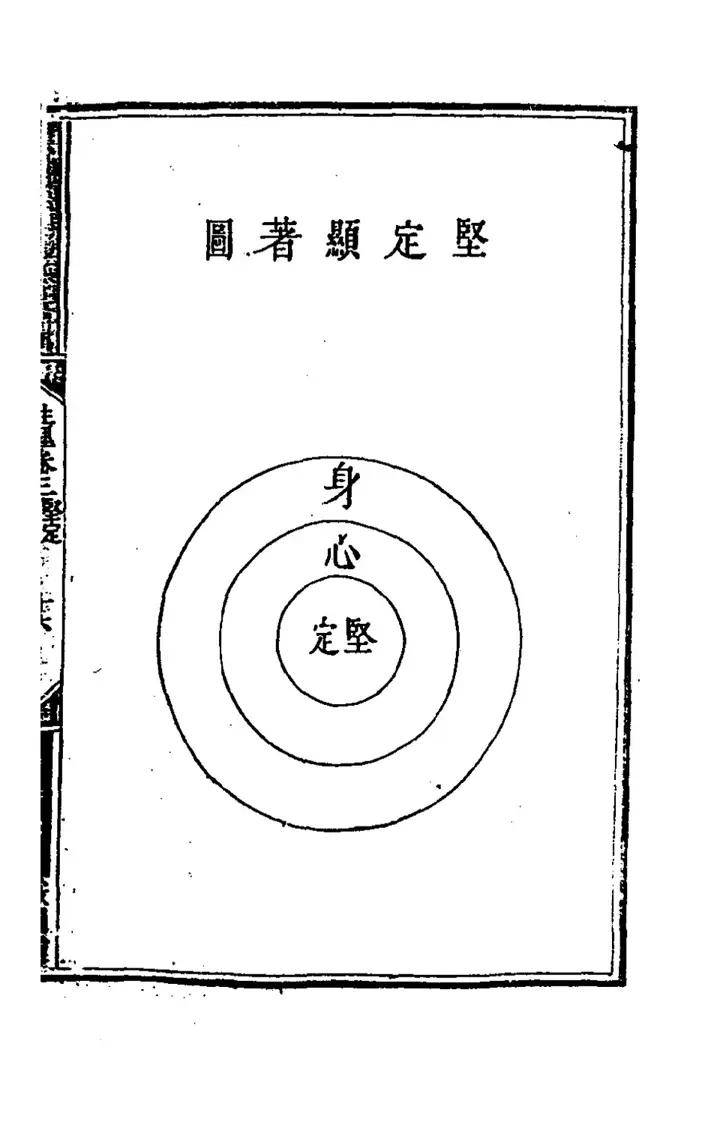
This is the first grade of the manifest functioning of the living spirit. The living spirit as a thing is one root containing six grades. Going from the continuing nature and the human nature to the qi nature, the living nature, the growing nature and firmness is going from the fine to the coarse. In manifestation, firmness appears first, then the growing nature, the living nature and the qi nature, then the human nature and the continuing nature: this is going from the coarse to the fine. Going from the coarse to the fine is again the meaning of transforming from form to formlessness; the small world becomes a small world in this order. That is why what appears first is firmness. Firmness is the nature of metal and stone: growth is not its office, but firmness can truly remain without the slightest change. When firmness appears, the suspension of the viscera and bowels [the text breaks off here at the end of p32] [...] the suspensions [of the viscera] each settle in their proper places and do not come to be shaken; the circulation of qi and blood each returns to its channels and vessels and does not come to overrun them; the bones, great and small, each rest within their measure and do not come to spill sideways; the whole body is firm, ordered and bound together so that it cannot come apart: all of this is the work of the power of firmness. The small world derives strength from the nature of firmness just as the great world derives strength from the nature of firmness. Because the great world obtains this power of firmness, the nine heavens and seven earths never change their positions from the beginning of time, and the sun, stars, rivers and mountains never alter their constancy from the beginning of time. That by which the Maker holds heaven and earth together is precisely this. Because the small world obtains this power of firmness, its whole body is secure and ordered and does not change its position, just as the great world never alters its constancy. The nature of firmness is, further, the very means by which the Maker holds the small world together. The Maker's entire capacity has been wholly entrusted to the human body, and this is the first of its manifest functions to appear. Note (Hei of Qingyuan): "In the fifth month of the embryo the sinews and bones become strong and hard, like metal and stone enclosed within their ore; therefore it is said that the metallic nature has become manifest. The transformation of the formless into form stops at metal and stone; the transformation of form into the formless begins with metal and stone. Its firmness is not only the firmness of the hard: the soft is firm as well. Its fixity is not only the fixity of stillness: movement is fixed as well."
此靈活顯用之初品也。靈活之為物也,一本而該含六品,自繼性、人性而及於氣性、活性、長性、堅定者,由精而及於其粗也;其顯也,堅定先顯,而次及於長性、活性、氣性,又次及於人性、繼性者,由粗而及於其精也。由粗而及於其精者,仍然從有形而化至無形之義也,小世界之所以成其為小世界者,次第然也。夫是以先顯其所為堅定也。堅定者,金石之性也,生發非其所職,而堅定則確能絲毫不易。堅定顯,則臟腑之懸繫各就本位,而不至於搖動;氣血之流通,各歸經絡,而不至於隕越;百骨之巨細,各安分寸,而不至於旁溢;通體堅整連束而不得解散者,皆此堅定之力為之也。小世界得力於堅定之性,亦猶大世界得力於堅定之性也。大世界得此堅定之力,則九天七地,終古不易其位;日星河嶽,終古不改其常。造物之所以綱維天地者,綱維之以此也。小世界得此堅定之力,則其通體安整而不易其位,亦猶大世界終古不改其常。堅定之性,又即造物綱維小世界之本領也。造物之全能,盡付與人身,而此則其顯用之先見者也。
Note by a later commentator: 清源黑氏 (Hei of Qingyuan)
清源黑氏曰:「胚胎五月,筋骨強硬,若金石之韞鑛內,故曰金性顯也。無形化有形,止於金石;有形化無形,始於金石。其堅也,不惟剛堅,而柔亦堅;其定也,不惟靜定,而動亦定。」
AIScan vol. 4, p. 31–34Transcribed from the scan by AI (Claude), checked as described on the About page.
3 uncertain readings in this passage
- 臟則臟腑之懸· variant · here the print has 臟腑 with flesh radical, unlike 藏府 in tf6-5; 1923 same (p. 32)
- 絲確能絲毫不易· variant · 絲 cut in a variant form (p. 32)
- 鑛若金石之韞鑛內or 礦· variant · C prints 鑛 (also 鑛底/鑛面 in tf7-3); kept (p. 34)
AIBook 3 · 9 · The manifestation of growth
發育顯著圖說 長性顯著
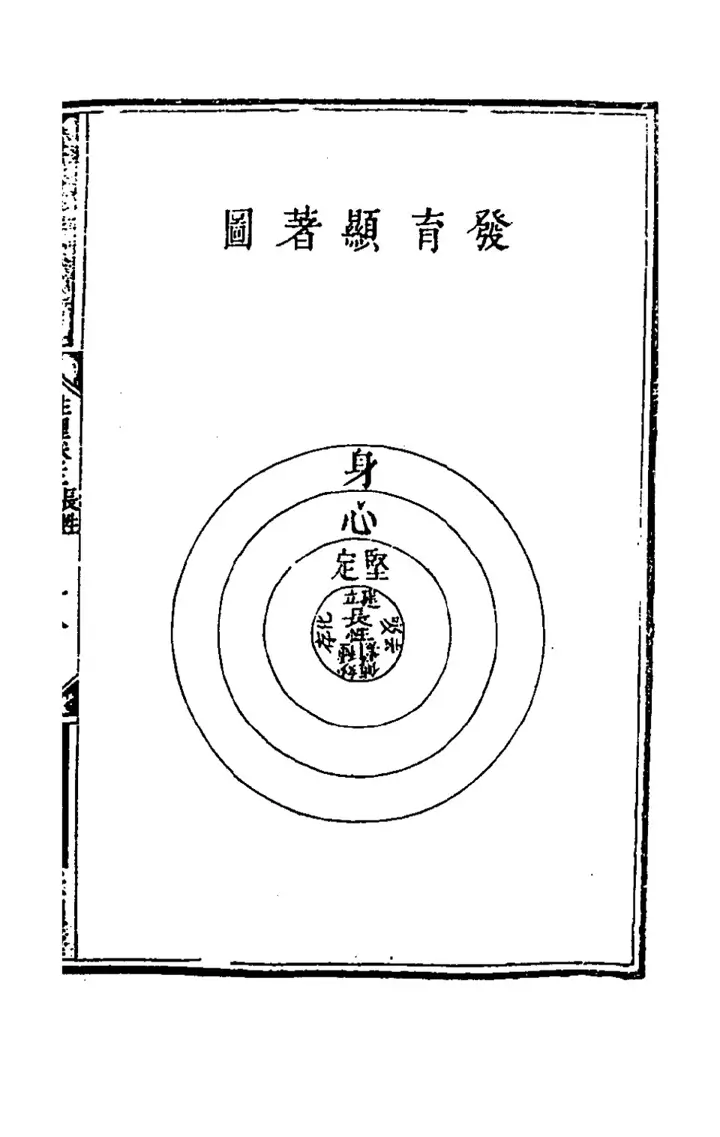
After firmness has become manifest, the nature of growth and nurture becomes manifest. Growth and nurture is the growing nature, the nature of plants and trees. The nature of plants and trees also contains everything, but growing is its special office. Before the growing nature is manifest, the embryo's drawing-in is not yet free: in receiving nourishment from its mother it merely depends on how far the mother's vital strength reaches, and so obtains its nourishment. Once it has become manifest, its vital force is strong and its drawing-in can act freely: in taking its resources from the mother, whether the mother's strength suffices or not, without knowing how it comes to be so, it knows how to seize the mother's vital strength to nourish itself. Having obtained nourishment, it grows. The growing nature, as a thing, has a power of attraction, a power of transformation, a power of retention and a power of expulsion. Because it can attract, it takes things in as the cause of nourishment and growth; because it can transform, what it has drawn in ripens and change comes out of it; because it can retain, it gathers up all the fine essence it has transformed and distributes it among the viscera and limbs; because it can expel, it removes whatever is left over from that fine essence and keeps nothing of it. These four powers are the wondrous root contained in the growing nature. When growth has reached adulthood, from within the fused four powers there further appear two powers that it has always possessed: the power of the wondrous seed and the power of transmitting the image. These appear in due time at the season of procreation. The wondrous seed: before food and drink have been transformed into qi and blood, this power picks out their finest portion and nourishes the primal vessel, and so works wonders in forming the seed. Transmitting the image: when the seed is about to be sown as an embryo, this power impresses into it the form, shape, nature and disposition that its own substance possesses, and so serves to transmit the kind. The seat of the growing nature is the liver: since this nature is able to grow and put forth, and moreover borrows the fire of the liver to assist its strength, its growth and putting forth are twice as easy. What the great world forms as images by the power of this growing nature does not decline in its images; what it forms as shapes flourishes daily in its shapes. The growing nature of the small world is almost the very growing nature of the great world. Note (Hei of Qingyuan): "In the sixth month of the embryo the hair grows and the limbs stretch out freely, like plants and trees sprouting, soaked in dew and facing the sun, growing and transforming of themselves. But since it is called growth and nurture, why do some afterwards die young or suffer, unequally? I reply: the qi one receives may be thick or thin, so the form produced may be long or short; this half comes from the Former Heaven. Outwardly one is affected by the four airs and inwardly one is harmed by ten thousand desires; this half comes from the Latter Heaven. If one traces it back to the root-suchness of the nature, no seed fails to sprout."
堅定既顯之後,則發育之性顯焉。發育者,長性也,草木之性也。草木之性,亦無所不包,而生長則其所專職也。長性未顯之時,胎之吸引不得自由,其受養於母也,不過聽其母之精力之所及者,而因之以得其養。至此既顯之時,則氣力強勝,吸引可以自由,其取資於母也,無論母之精力及與不及,而於不知其然而然,知奪其母之精力以自養矣。得其養則長矣。長性之為物,有吸力,有化力,有存力,有去力。能吸,則有所取以為養育之因;能化,則其所吸者熟而變化出焉;能存,則於其所化之精微者,悉收之以散布於臟腑肢體之間;能去,則於其精微之所遺剩者,悉皆除去之而不留也。此四力者,長性所含之妙本也。迨夫發育成人之後,又於四力渾聚之中,顯露其本有之二力焉:一妙種力,一傳像力。蓋於孳生之時,而乃及時顯露者也。妙種者,飲食未化為氣血之先,此力即掇其最精之分,培養元脉,而妙乎其所以為種也。傳像者,種子將欲稼胎之時,此力即以其本體具有之形狀性情,悉印授於其中,而以為傳類之用也。長性之位在肝,蓋其性既能長發,而又借肝臟之火以助其力,則長發又倍覺其易也。大世界得此長性之力而成象者,其象不衰;成形者,其形日盛。小世界生長之性,殆即大世界生長之性也。
Note by a later commentator: 清源黑氏 (Hei of Qingyuan)
清源黑氏曰:「胚胎六月而毛髮生,肢體條暢,若草木萌蘖,浥露迎陽,自由生化矣。然既曰發育,何後此又有夭札之不齊?曰:所稟之氣有厚薄,故所生之形有修短,此半由先天也;外感四氣,內戕萬欲,此半由後天也。若推其本然之性,則種無有不芽者矣。」
AIScan vol. 4, p. 35–39Transcribed from the scan by AI (Claude), checked as described on the About page.
3 uncertain readings in this passage
- 脉培養元脉,而妙乎or 脈· variant · C and 1923 both print 脉; kept (p. 37)
- 孳蓋於孳生之時or 孽· unclear · small woodblock form; 1923 reads 孳; W has 孽 (p. 37)
- 浥若草木萌蘖,浥露迎陽or 邑· unclear · left radical faint in C; 1923 浥 (p. 38)
AIBook 3 · 10 · The manifestation of perception (1)
知覺顯著圖說 活性顯著 (一)
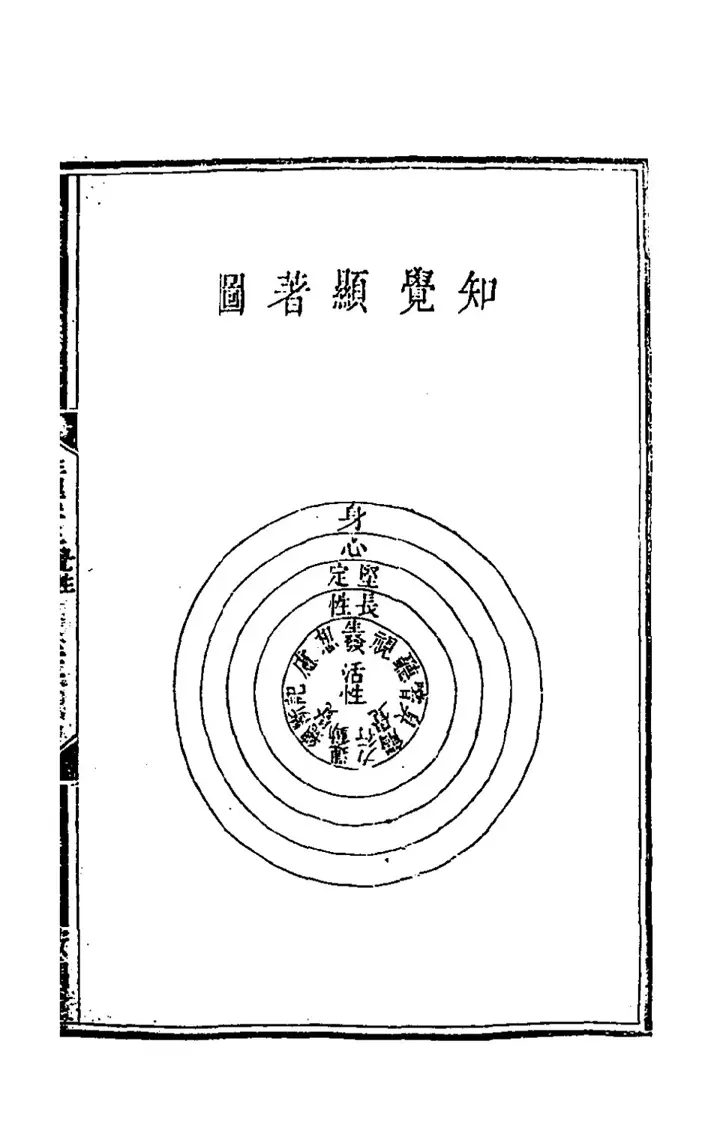
Once the growing nature is manifest, the living nature appears. Before this there was no perception, but now there is perception; before this there was no movement, but now there is movement. Perception and movement arise at this juncture, and this nature becomes the root of food and sex for the whole of life. Perception, as a thing, has ten functions: five lodged outside and five lodged inside. Those lodged outside are sight, hearing, taste, smell and touch, housed in the ears, eyes, mouth, nose and limbs. Those lodged inside are called common sense (總覺), imagination (想), deliberation (慮), judgement (斷) and memory (記); their seats never depart from the brain. Common sense gathers and governs all perceptions, inner and outer, and all the members rely on it in order to perceive; its seat is lodged in the front of the brain. Imagination recalls what has already been obtained and so responds to the use of common sense; its seat comes next, behind common sense. Deliberation takes what has been imagined and weighs whether it is right or wrong, possible or not; its seat is lodged in the middle of the brain. Judgement, spiritually clear and decisive, directly decides what in the deliberation is fitting; its seat comes next, behind deliberation. Memory holds in store, without losing it, everything inner and outer that has been seen, heard, known and perceived; its seat is lodged in the back of the brain.
長性既顯,活性著焉。前此無知覺,而此際則有知覺矣;前此無運動,而此際則有運動矣。知覺運動起於此際,而其性即以為終身食色之根。知覺之為物也,其用十:五寓於外,五寓於內。寓於外者,視、聽、嘗、臭、觸也,寄之於耳、目、口、鼻、肢體。寓於內者,曰總覺,曰想,曰慮,曰斷,曰記,其位總不離於腦。總覺者,總統內外一切知覺,而百體皆資之以覺者也,其位寓於腦前。想者,於其已得之故,而追想之,以應總覺之用也,其位次於總覺之後。慮者,即其所想而審度其是非可否也,其位寓於腦中。斷者,靈明果決,而直斷其所慮之宜然者也,其位次於慮後。記者,於凡內外之一切所見、所聞、所知、所覺者,而含藏之不失也,其位寓於腦後。
AIScan vol. 4, p. 40–42Transcribed from the scan by AI (Claude), checked as described on the About page.
1 uncertain reading in this passage
- 已想者,於其已得之故or 巳· variant · C cuts 巳 for 已; normalised as in tf1 (p. 41)
AIBook 3 · 11 · The manifestation of perception (2)
知覺顯著圖說 活性顯著 (二)
Movement, according to where perception reaches, moves in response to it. Movement within the viscera is the work of qi; motion in the four limbs and hundred bones is the work of qi and blood acting together. There is a power of command and a power of service. Command is lodged in the heart and is that which initiates movement; service is lodged in the body and is that which answers the command and accomplishes the movement. All things possess the living nature, yet some have perception and some lack it, some move and some do not move; it is not that their nature is in some cases whole and in others not. Seen from the outside, some seem to lack perception and some seem not to move, but in reality they never lack perception and movement; it is only that their perceiving is perceiving where people cannot see it, and their moving is moving where people cannot glimpse it. Take metal and stone as things: people think they have no perception or movement, yet melt them and they transform, strike them and they ring: is this not their perceiving? They are born in mountains and flow into waters, are produced at the bottom of the ore-bed and appear on its surface: is this not their moving? If even metal and stone are so, how much more what is more spiritual than metal and stone! Note (Hei of Qingyuan): "In the seventh month the embryo acquires complete perception; once movement appears, one sees it leaping as if eager to be born. Yet why is it born only after waiting one or two more months? I put the question to Yizhai, who said: 'In the mother's womb a person receives the illumination and nourishment of the Seven Governors: in the first month Saturn shines on it, in the second month Jupiter, in the third month Mars, in the fourth month the Sun, in the fifth month Venus, in the sixth month Mercury, in the seventh month the Moon. When the Seven Governors have shone on it in full, the embryo is ripe and is born. If it waits a further one or two months, it must be that during those seven months one or two of the Governors were weak in strength, so that the illumination and nourishment were not ripe, and an intercalary illumination must be added. One with an intercalary Saturn does not survive; one with an intercalary Jupiter lives; one with an intercalary Mars succeeds; one with an intercalary Sun becomes noble and eminent. Venus, together with Mercury and the Moon, are the three yin and receive no intercalation; therefore those who pass ten months are few.'"
運動者,因其知覺之所至,而運動以應之。運之於臟腑之間者,氣之事也;動之於四肢百骸者,氣與血兼行之事也。有督力焉,有役力焉。督寓於心,所以起運動者也;役寓於身,所以應督而成其運動者也。活性萬物皆具,然有有知覺者,有無知覺者,有運動者,有不運動者,非其性之或全或不全也。自其外而觀之,若似無知覺者,若似不運動者,而其實未嘗無知覺運動也。但其為知覺也,知覺於人所不及見;其為運動也,運動於人所不及窺焉耳。如金石之為物也,人以為無知覺運動,然鎔之則化,叩之則鳴,此非其所為知覺乎?生於山,流於水,生於鑛底,見於鑛面,此非其所為運動乎?金石且然,而况靈於金石者乎?
Note by a later commentator: 清源黑氏 (Hei of Qingyuan)
清源黑氏曰:「胚胎七月而生全知覺,一顯運動,即見躍躍欲產矣,然更俟一二月而產者,何也?余質之一齋,曰:『人在母腹中,得七政照養:初月土星照,二月木星照,三月火星照,四月太陽,五月金星,六月水星,七月太陰。七政照遍,胎熟而產焉。其更俟一二月者,必其七月中有一二政氣力衰弱,照養未熟,須再加閏照耳。閏土者不育,閏木者生,閏火者達,閏太陽者貴顯。金與水、月為三陰,不閏,故越十月者鮮。』」
AIScan vol. 4, p. 42–45Transcribed from the scan by AI (Claude), checked as described on the About page.
1 uncertain reading in this passage
- 况而况靈於金石者乎or 況· variant · C prints 况 (also 何况, 景况, 况已); kept (p. 43)
AIBook 3 · 12 · The manifestation of the temperamental nature (1)
氣性顯著圖說 愛惡性顯著 (一)
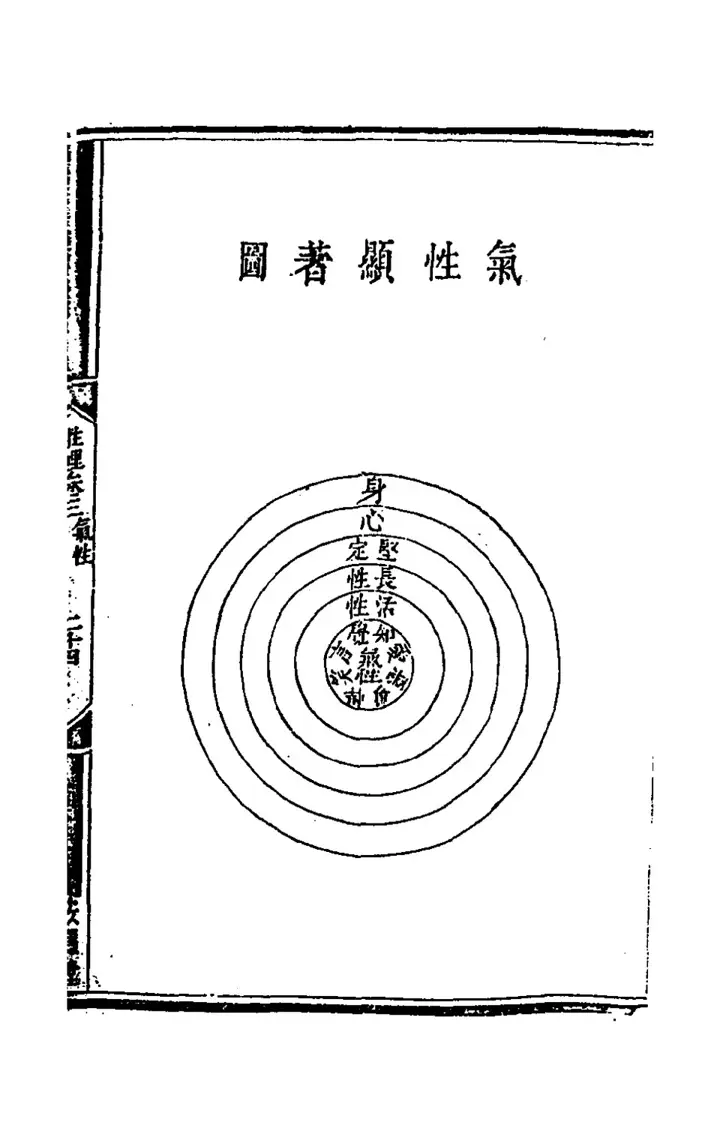
The three ranks of firmness, growth and life become manifest before leaving the mother's womb. Forty days after leaving the womb, the temperamental nature (qi-nature) becomes manifest. When the temperamental nature is manifest, one knows love and aversion. Love and aversion, viewed superficially, are no more than the general name for the seven emotions and six desires; expanded, they are in truth the capacity for leaving the ordinary and becoming a sage. At the first moment of leaving the womb, loving and averting are not yet clearly distinguished, and their first rough signs are seen in natural crying and laughing. Thus natural crying and laughing are where love and aversion first show themselves, and what the temperamental nature first manifests. The human being is the most spiritual of the ten thousand things and possesses this mechanism of being able to love and able to avert. When later it is expanded and filled out, one uses what one loves to strive to do what ought to be loved, and uses what one averts to strive to remove what ought to be averted; all this is done by this qi and this power, and it is thereby that such a person daily advances toward sagehood and worthiness. Although the temperamental nature belongs to the Latter Heaven, its bearing on human beings is like this. The former worthy Ye Zide said: "The temperamental nature is what obediently receives the function of the original nature and makes it its own function." What the temperamental nature can do is all that the original nature wishes to do; the knowing and capacity possessed by the original nature are wholly handed over to the temperamental nature to be manifested.
堅定、長、活三品,顯於未離母腹之時。迨出母腹四十日,氣性顯焉。氣性顯,則知愛惡。愛惡二者,淺觀之,不過七情六欲之總稱;擴充之,實為出凡作聖之本領。當此出離母腹之初,其為愛為惡,未甚分明,而約畧見端者,見之於天然啼笑之中,故天然之啼笑,愛惡之所見端,氣性之所先顯者也。人為萬物之靈,具此能愛能惡之機,迨其後擴而充之,因所愛以力行其所當愛之事,因所惡以力去其所當惡之事,皆此氣此力為之,而以故其人日進於聖賢也。氣性雖屬後天,而其所關於人者如此。先賢葉子德曰:「氣性者,順承本性之用而以為用者也。」氣性之所能為者,皆本性之所欲為者也;本性所有之知能,盡付之於氣性而發現之也。
AIScan vol. 4, p. 46–48Transcribed from the scan by AI (Claude), checked as described on the About page.
1 uncertain reading in this passage
- 畧而約畧見端者or 略· variant · C 畧; 1923 略 (p. 47)
AIBook 3 · 13 · The manifestation of the temperamental nature (2)
氣性顯著圖說 愛惡性顯著 (二)
The temperamental nature is rooted in the bodily constitution (qi-substance), and the constitution in turn is formed from the four elements wind, fire, water and earth. When what a person receives from the four elements is balanced, the temperamental nature is harmonious and even, and the original nature can by it be fully manifested; when what is received from the four elements is unbalanced, the temperamental nature cannot be harmonious and even, and the manifestation of the original nature is likewise incomplete. It is also said that the temperamental nature has four names, assigned to the four elements: the first is the settled nature, belonging to wind; the second the ever-wakeful nature, belonging to water; the third the repentant nature, belonging to fire; the fourth the self-willed nature, belonging to earth. Those who use all four natures are middling people; those who use only the wind and water natures are above the middling; those who use fire and earth are below the middling. Someone asks: "Wind is what is unsettled; why does the settled nature belong to wind?" I reply: "Wind as a thing fills the space above, below and in the four directions, never swelling and never lacking; it seems unsettled yet is truly settled, seems unfixed yet is truly fixed. Therefore the settled nature belongs to wind." Those who use only the settled nature act in the same way as the original nature; they are of the order of the sages. Next, those who use the ever-wakeful nature act in close likeness to the original nature; they are of the order of the worthy and wise. Next, those who use the repentant nature still do not lose the original nature in their acting. Below these, those who use the self-willed nature are wholly perverse and unlike the original nature. This is how the temperamental nature is divided, and those who use the temperamental nature should value knowing how to discern and place themselves. Note (Hei of Qingyuan): "When the preceding three ranks become manifest, humans and animals share them; when the following three ranks become manifest, humans and animals are separated. Humans and animals both have the temperamental nature, but in their endowment each receives a particular disposition, and they are utterly unequal. Humans, birds and beasts all belong to the living kind, yet birds fly with two wings, beasts run on four feet, and humans walk and hurry on two feet. Crows cry caw-caw, ravens croak, oxen bellow and horses neigh, but humans can speak and laugh; and in eating and drinking, dwelling, warmth and clothing they are utterly different; all this is because the temperamental nature distinguishes them. At birth a human being is no more than a living thing: its voice is like those caws and croaks, its suckling like that of lambs and calves; like an insect just hibernating, it knows nothing at all. Once the temperamental nature appears, love and aversion, speech and laughter separate it from the animals. Animals do not speak or laugh, and do not love and avert as humans do."
氣性本於氣質,氣質又本風、火、水、土四行而成。人之所得於四行者均,則氣性和平,而其本性亦得借以全顯矣;所得於四行者不均,則氣性不能和平,而其本性之顯也,亦不全矣。又曰:氣性之名有四,而分屬於四行:一曰安定性,屬風;二曰常惺性,屬水;三曰悔悟性,屬火;四曰自任性,屬土。四性通用者,中人也;專以風、水性用者,中人以上者也;用火、土,則中人以下者也。或曰:「風,不定者也,安定性何以屬風?」曰:「風之為物也,充滿於上下四方之間,無盈無絀,似不安而實安,似不定而實定,故安定性屬風。」專以安定性用者,同於本性以為用者也,聖人之流亞也;其次以常惺性用者,倣彿本性以為用者也,賢哲之流亞也;其次以悔悟性用者,猶不失乎本性以為用者也;下此以自任性用,則純乎悖逆,而不同於本性者也。此氣性之所以分,而用氣性者,貴知所審處也。
Note by a later commentator: 清源黑氏 (Hei of Qingyuan)
清源黑氏曰:「前此三品顯,人與物共;後此三品顯,則人與物分。氣性人物皆具,而於稟賦中各得一情形,彼此絕不相等。如人與鳥獸同屬活類,而鳥則兩翼而飛,獸則四足而走,人則二足而步趨。烏聲嗚嗚,鴉聲啞啞,牛吼馬嘶,而人則能言能笑,以至飲食居處,寒煖被服,絕不相同,皆由於氣性別之也。人之初生,不過一活物耳,音聲同其嗚啞,乳哺類乎羔犢,若虫初蟄,茫無所知;迨至氣性一顯,則愛惡言笑,與物分焉。物無言笑也,不同愛惡也。」
AIScan vol. 4, p. 48–51Transcribed from the scan by AI (Claude), checked as described on the About page.
4 uncertain readings in this passage
- 烏烏聲嗚嗚,鴉聲啞啞or 鳥· unclear · C shows 烏 (no inner stroke); 1923 appears to read 鳥; W 鸟. 烏 'crow' pairs with 鴉 'raven' and is kept as printed (p. 50)
- 煖寒煖被服or 媛· damaged · C's left component looks like 女 (媛), an evident cutting error; 1923 煖 adopted (p. 50)
- 虫若虫初蟄or 蟲· variant · C prints 虫; 1923 蟲; kept as printed (p. 51)
- 倣倣彿本性以為用or 做· variant · C cuts 倣彿 like 做佛 at small size; read 倣彿 (p. 49)
AIBook 3 · 14 · The manifestation of the original nature
本性顯著圖說 本性顯著
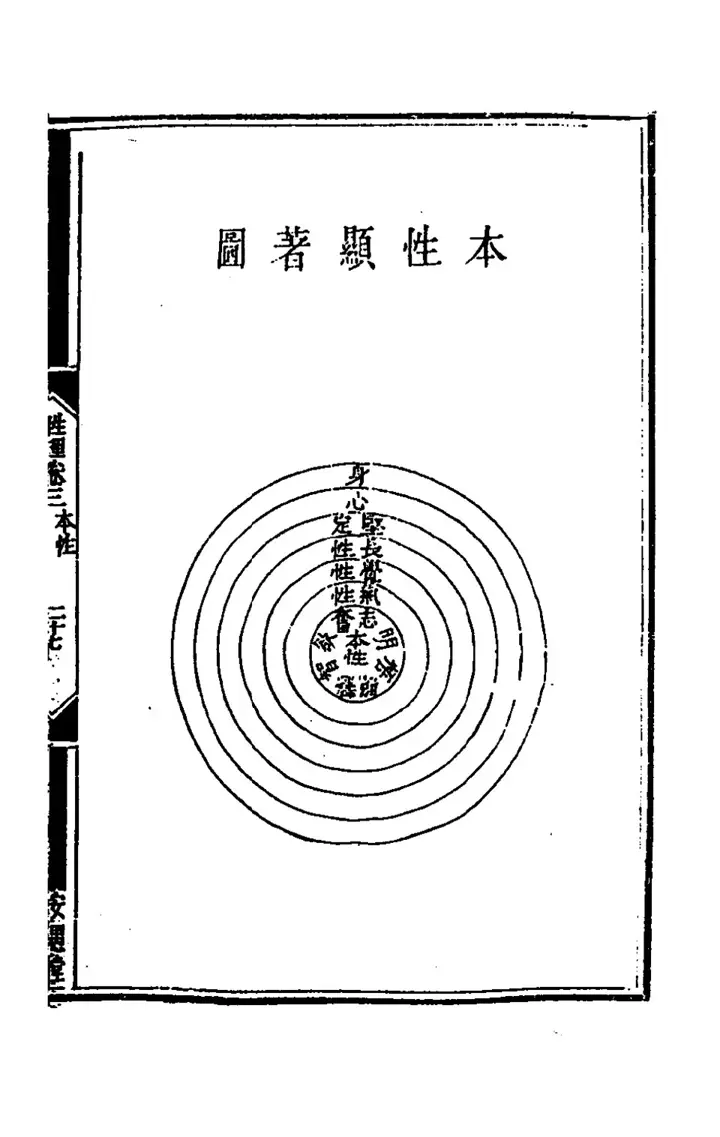
The original nature is what is allotted from the Former Heaven and lacks no excellence. This nature is fused as one with the Latter Heaven's temperamental nature, living nature, growing nature and nature of firmness, but in its manifestation there is a distinction of earlier and later: the four Latter-Heaven ranks become manifest first in order, and this rank becomes manifest last of all. The original nature, the successor nature and the root-suchness of the Real Ruler have an order of sequence but no this-and-that. From the root-suchness of the Real Ruler comes the successor nature; from the allotment of the successor nature comes the original nature: this is their sequence. Yet in reality the knowing and capacity of the original nature are no different from the knowing and capacity of the successor nature, and no different from the knowing and capacity of the root-suchness of the Real Ruler: this is what is meant by having sequence but no this-and-that. Within the original nature all principles are complete, no affair is left out, and all things are provided: so vast is its capacity. Its light penetrates everything it reaches; and within this all-penetration it contains a kind of pure and subtle wisdom that governs all the perceptions of the living nature, and a kind of pure and subtle desire that governs all the loves and aversions of the temperamental nature: these are called the two powers. The two powers display their capacity specifically in the outward world of the Latter Heaven. Further, within this all-penetration there appears a kind of natural turning-back of illumination, which cuts off attachment to the Latter Heaven and directly sees the place from which the original nature came forth; and there appears a kind of natural inclination, which, made bright by that illumination, heads directly for the reality of the Real Ruler's root-suchness: these are called the two virtues. The two virtues display their capacity specifically at the original beginning of the Former Heaven. The two virtues become manifest only after the person's cultivation and illumination of them has reached its limit. Every person possesses this nature, and so every person possesses these virtues, these powers and this all-penetrating light; it is only that their manifestation is complete or incomplete. Master Chami said: "The human nature knows everything and can do everything. Where its use is not fully exercised, it is people who do not exercise it fully, not that its knowing and capacity are complete or incomplete." Chami's saying shows deep insight into this: that the original nature of a human being is the successor nature first manifested by the Real Ruler, and is also the Real Ruler's root-suchness itself! Note (Hei of Qingyuan): "The temperamental nature distinguishes dispositions; the original nature distinguishes meaning and principle. The distinction of meaning and principle is why human beings are more noble and more spiritual than the ten thousand things. The four preceding ranks become manifest according to timing; the manifestation of this rank depends only on whether the endowed qi is clear or turbid, balanced or partial, which shows it early or late, deficient or complete. Without the manifestation of the temperamental nature one has no claim to the name of human; without the manifestation of the original nature one has no reality as a human. Cutting off attachment to the Latter Heaven and heading directly for the Former Heaven: this is the proper work of the original nature."
本性者,本乎先天之所分與,而無美不備者也。其性與後天氣性、活性、長性、堅定之性相渾為一,但其顯也,有先後之分:後天四品以次而先顯,此一品顯於其最後。本性與繼性,與真宰之本然,有次第而無彼此。由真宰之本然而有繼性,由繼性之分與而有本性,是其所為次第也;而其實本性之知能,不異於繼性之知能,不異於真宰本然之知能,所謂有次第而無彼此也。本性之內,萬理具足,萬事不遺,萬物皆備,其體量如此其廣大也。其光之所通,無不貫徹,而於無不貫徹之中,含有一種清妙之智,統攝活性所有一切之知覺;含有一種清妙之欲,統攝氣性所有一切之愛惡,是謂二力。二力者,專於後天表世發現其本領。又於無不貫徹之中,顯有一種天然返照,絕意後天而直見夫本性從出之所;顯有一種天然趨向,因明於照而直趨夫真宰本然之真,是謂二德。二德者,專於先天本始發現其本領。二德必待其人修明之既至而後顯也。人人具有此性,即人人具有此德,具有此力,具有此無不貫徹之光,但其顯有全與不全耳。查密氏曰:「人性無所不知,無所不能,其有所不盡其用者,人之不盡其用耳,非其知能有全與不全也。」查密之說,蓋深有見於人之本性,即真宰首顯之繼性,而亦即真宰之本然也夫!
Note by a later commentator: 清源黑氏 (Hei of Qingyuan)
清源黑氏曰:「氣性以別情形,本性以別義理。義理之別,人之所以貴乎萬物、靈於萬物者也。前此四品顯以時際,此品之顯,惟視氣稟清濁均偏,以見遲早虧全耳。氣性不顯,無以為人名;本性不顯,無以為人實。絕意後天,直趨先天,此本性之能事也。」
AIScan vol. 4, p. 52–56Transcribed from the scan by AI (Claude), checked as described on the About page.
Book 3 · 15 · The manifestation of the successor nature (1)
繼性顯著圖說 繼性顯著 (一)
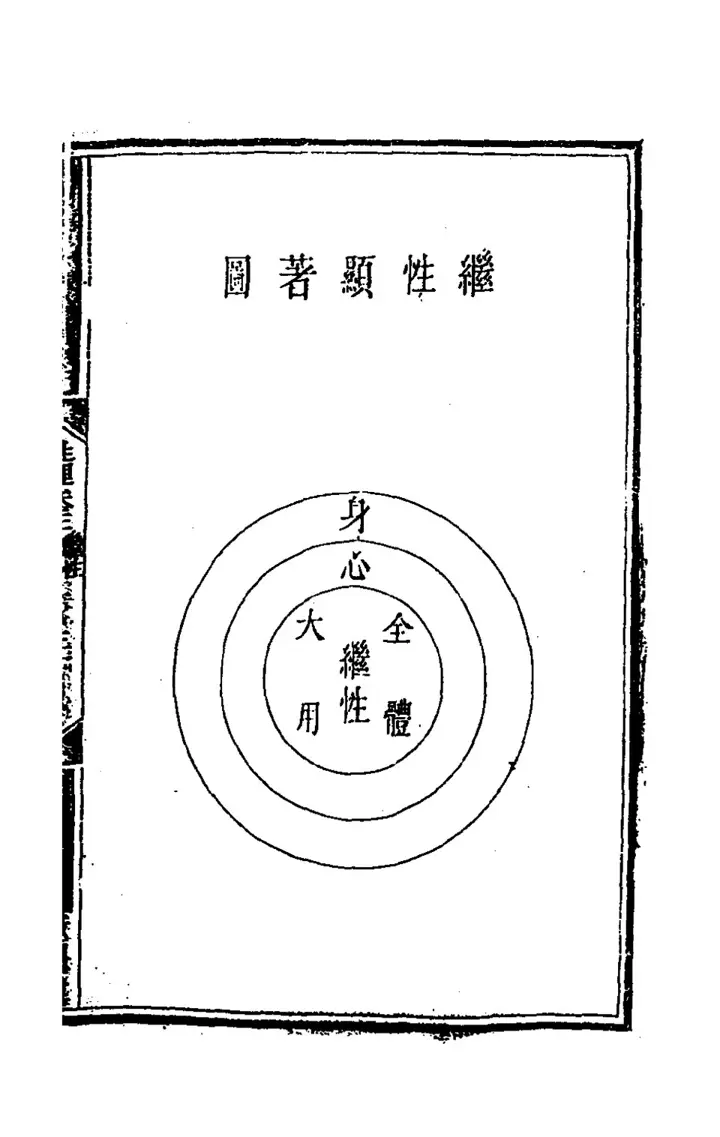
The successor nature is the primal nature first manifested by the Real Ruler. The natures and mandates of all people and things, ancient and present, are all imprinted and divided off from it; it is what is called the one comprehensive mandate of the myriad mandates of all ages. When the Real Ruler begins transformation, it begins from this realm; when the myriad transformations return to the Real, they return by this realm. This one nature is the great metropolis where beginning and final return meet. As a nature it pervades the whole world, neither going nor coming, and is held in common by heaven, earth, humans and things. The original nature is the nature each person possesses individually. When what each possesses becomes manifest, what is held in common also becomes manifest. The original nature and the successor nature were never two. Before the original nature was divided off there was only this successor nature and no original nature; after the successor nature was allotted, it is called the original nature and no longer called the successor nature. Before the original nature is manifest, does the common successor nature not manifest itself daily between heaven and earth? It does, but its manifestation has nothing to do with me. When the original nature has become manifest, manifestation joins manifestation, and the two manifestations become one manifestation: as light joining light, where one cannot divide this light from that light; as water joining water, where one cannot divide this water from that water. Two lights become one light, two waters become one water: this is the meaning of two manifestations becoming one. When the individual manifestation returns into the common manifestation, the common manifestation seems to be manifest in me alone, and the successor nature becomes my successor nature: this is how the successor nature becomes manifest. Once it is manifest, the substance of the successor nature is my substance; how much more so its knowing and capacity, how much more so its operation! Once it is manifest, my substance forgets that it is the substance of the successor nature; why then should it trouble itself about knowing and capacity, about operation? Then my mandate is the one comprehensive mandate of the myriad mandates of all ages, and my condition is the great metropolis where beginning and return meet; and do not the Real Ruler and I then become different names for one reality?
繼性者,真宰首顯之元性也。古今人物之性命,莫不從此而印析之,所謂千古群命之一總命也。真宰之起化也,從此境起;萬化之歸真也,從此境歸。此一性者,起始歸宿之一大都會也。其為性也,周徧普世,無去無來,天地人物所公共者也。本性者,人所各具之性也。各具者顯,則公共者亦顯。本性與繼性原非二也。本性未分之先,祇此繼性而無本性;繼性分與之後,名為本性而不名繼性。本性未顯之時,公共之繼性,何嘗不日顯於天地之間?而但其顯也,無與於我。本性既顯之時,則顯與顯合,而兩顯成為一顯矣。猶光與光合,而無可分其為此之光、彼之光也;猶水與水合,而無可分其為此之水、彼之水也。兩光成為一光,兩水成為一水,是則兩顯成為一顯之義也。各具之顯,歸入於公共之顯,則公共之顯,遂若獨顯於我,而繼性遂得為我之繼性矣,此繼性之所以顯著也。顯則繼性之本體即我之本體,而何况於知能,何况於作用?顯則我之本體忘其為繼性之本體,而又何屑屑於知能,何屑屑於作用?則我之命,即千古群命之一總命也;我之景况,即起始歸宿之一大都會也,而真宰與我,豈不成其為異名同實者哉?
AIScan vol. 4, p. 57–60Transcribed from the scan by AI (Claude), checked as described on the About page.
3 uncertain readings in this passage
- 析莫不從此而印析之or 拆· unclear · C form ambiguous between 析 and 拆; 1923 析; W 析 (p. 58)
- 祇祇此繼性而無本性or 只· variant · C 祇; W 只 (p. 58)
- 群千古群命之一總命or 羣· variant · C 群; 1923 羣 (p. 58)
AIBook 3 · 16 · The manifestation of the successor nature (2)
繼性顯著圖說 繼性顯著 (二)
The human body is a small world. What becomes manifest in it last of all is what is first in the arising of transformation. The great world, manifesting from the formless to form, puts first what is first and last what is last; the Real Ruler presides over it throughout, and heaven, earth and the ten thousand things cannot act of themselves. The small world, manifesting from form to the formless, puts first what is last and last what is first; the Real Ruler presides over it throughout, and human beings too cannot act of themselves. But when it puts last what is first, and further manifests up to that before which there is nothing prior, the Real Ruler does not preside over it. What is not presided over is what is free (self-determining). Being free is not possible for any but the Real Ruler. Note (Hei of Qingyuan): "The Real Principle is like a seal; the successor nature is like its impression; the impression comes after the seal, hence it is called 'successor'. People possess the knowing and capacity of the original nature as the upright-and-good, the worthy-and-wise, the reverent sage, the ranked sage and the great sage, each according to the knowing and capacity endowed in them, and they are manifestly distinct. If the successor nature becomes manifest, then one traces back to the beginning and returns to the end, the whole substance is transformed and fused, and this is called the Human Ultimate. Other schools speak of 'exhausting the nature'; the Heavenly Direction (Islam) speaks of 'manifesting the nature': it is one meaning. Manifesting it thoroughly is exhausting it perfectly, but rarely does one see anyone able to exhaust it."
夫人身,一小世界也。其最後之所顯者,乃起化之最先者也。大世界由無形而顯至有形者,先其所先而後其所後也,真宰為之主持於其間也,天地萬物不得而自由也;小世界由有形而顯至無形者,先其所後而後其所先也,真宰為之主持於其間也,人亦不得而自由也。後其所先,而又且顯至於先之無可先者,真宰不得主持於其間也。不得主持於其間者,自由者也。自由,非真宰不能也。
Note by a later commentator: 清源黑氏 (Hei of Qingyuan)
清源黑氏曰:「真理如印,繼性如跡,跡後於印,故謂之繼。人具本性之知能,廉善、賢知、欽聖、列聖、大聖,各因其所賦之知能,而顯然皆有區別。若繼性顯著,則原始返終,全體渾化,斯稱人極也。諸家言盡性,天方言顯性,一義耳。顯之透,即盡之精,但鮮見其能盡耳。」
AIScan vol. 4, p. 60–62Transcribed from the scan by AI (Claude), checked as described on the About page.
Key terms in this text
Each term's Arabic or Persian counterpart carries its grounding: the text itself, a published scholar, or AI. Tap one to find it in the text.
Chinese: transcribed by AI (Claude) from the CADAL scans on Wikimedia Commons (public domain), checked against the zh.wikisource text (CC BY-SA); Books 1–5 also collated with the 1923 photoreprint (CADAL, Commons), and the Root Classic with the Chinese printed in Murata, Chittick and Tu (2009); punctuation is editorial. Books 1–5 keep the notes of Hei of Qingyuan (清源黑氏, Hei Mingfeng), a later commentator, apart from Liu Zhi's text. Arabic: Nūr al-Ḥaqq (Ma Lianyuan), al-Laṭāʾif, as printed in Murata, Chittick and Tu, The Sage Learning of Liu Zhi (2009), pp. 103–153 (public domain text; taken from the book's text layer and checked against the page images by AI, page by page; not yet proofread by a person). Characters: Unihan (Unicode licence), cjk-decomp (Apache-2.0), the Kangxi Dictionary (public domain) via Wikisource (CC BY-SA). The English and the term mappings marked AI were written by AI (Claude). Murata's translations are in copyright and are cited, never reproduced. How this text was established.